
You are using an out of date browser. It may not display this or other websites correctly.
You should upgrade or use an alternative browser.
You should upgrade or use an alternative browser.
Tonewood and Magnetism - Missing the Point
- Thread starter smitty_p
- Start date


DonP
Guest
So when Jimi strung the righty Strats lefty it created a whole different tone i would guess by this.
Yeah, I was thinking about that. His tone wasn't what you normally expected from Strat players.

syscokid
Ambassador of War & Peace

Jake E Lee (Bark At The Moon) Charvel Signature Model. Talks about the Jimi thing at 1:20:So when Jimi strung the righty Strats lefty it created a whole different tone i would guess by this.
... Jake E Lee Signature Model | Artist Series | Charvel® Guitars

RobV
Ambassador of Bedroom Wankery
I'm with Robert on the scale length thing.
Of course scale length will effect tone.
Longer scale length + same diameter string
= more tension on the string to achieve a given pitch.
More tension on the string = a more strident high end.
It's not just the scale length either.
The amount of string from bridge to tailpiece and
nut to tuning machine has to be figured in as well.
The longer the total length of the string is, the tighter
it has to be wound to achieve a certain pitch.
Play a Stratocaster.
Play a Stratocaster with a reversed headstock.
The one with the reversed headstock will have tighter lows
and less strident highs. This is because its low strings have
more tension and its high strings have less tension than
the one with the normal headstock.
Added icing on the cake benefit:
Bending the high E, B and G strings will also be easier due to the
lower tension on those strings with the reverse headstock.
Gibson got it right with the Firebirds.
Neck through construction.
Reverse headstock.
Good design.
I am in this camp. I also think the type of bridge or lack there of (string thru) also has something to do with it. More or less connection to the body for vibrations/sustain?

I reckon they did it deliberately. They may not have analysed the harmonics, but they knew that the sound got brighter closer to the bridge. Angling it the way they did gave them bright highs plus a bit of extra depth to the lows. Smart of them.
I thought it was just for string spacing?
Jake used mahogany with ebony board....wow...I used the same combination on my 24.75" Strat....
I am in this camp. I also think the type of bridge or lack there of (string thru) also has something to do with it. More or less connection to the body for vibrations/sustain?
Good point...what puzzles me though is I have played Floyd Rose equipped guitars that had more sustain and unplugged volume than my hardtail Schecter.
Every time I think I have it figured out, along comes a new twist!

chilipeppermaniac
Ambassador of Decibels
Good point...what puzzles me though is I have played Floyd Rose equipped guitars that had more sustain and unplugged volume than my hardtail Schecter.
Every time I think I have it figured out, along comes a new twist!
From my own UNscientific experience on hearing/feeling/timing the ringing,vibrating sustain of all the guitars I have ever owned.
I must say when strumming my PRS Santana 2 unplugged, that thing rang and rang and rang forever. I have never run across another guitar from Gibson, Fender, PRS, Epiphone, that even came close. I still remember putting my ear to the back of the neck to see just how long it could detect the ringing of the strings even to the last perceivable sound. The decay seemed like an eternity.
Too bad that guitar cost $4000 and I had to sell it to pay bills. Sadly the fella who bought it and loved it, later passed away as I was informed by his brother.
RobV
Ambassador of Bedroom Wankery
From my own UNscientific experience on hearing/feeling/timing the ringing,vibrating sustain of all the guitars I have ever owned.
I must say when strumming my PRS Santana 2 unplugged, that thing rang and rang and rang forever. I have never run across another guitar from Gibson, Fender, PRS, Epiphone, that even came close. I still remember putting my ear to the back of the neck to see just how long it could detect the ringing of the strings even to the last perceivable sound. The decay seemed like an eternity.
Too bad that guitar cost $4000 and I had to sell it to pay bills. Sadly the fella who bought it and loved it, later passed away as I was informed by his brother.
That was how I felt about my 1st SG Std. and I haven't found something as good yet. It was used with a clean headstock break & repair, wrapped bridge and BB pro's. Plugged into the DSL50 green channel I had at the time was amazing. That is where I am heading with my current SG. DSL or JTM type amp also.

Could it be that the position of the pups in the guitar i.e. distance from bridge might be a contributing factor in the difference of tonal qualities? Add in the string height from the pups and these two factors may change the tone? Then there is the variance in actual value of the capacitors. So many variables to consider in addition to the type of wood and shape of guitar.I am a "tonewood" agnostic. But, I know my Les Paul and SG sound different despite having the same pickups. I know that if I put those same pickups in my Legacy, ASAT, or even Firebird they are all going to sound different. I know this from playing many guitars over the course of too many years. I really don't actually care about the argument one way or another because when it comes to what I hear coming out of my amp the reason why they sound different doesn't really matter...but I do know that whatever it is that makes them different is good, because it gives us may different sounds and many different ways to express ourselves. That, in the end, is all that matters.
chilipeppermaniac
Ambassador of Decibels
Could it be that the position of the pups in the guitar i.e. distance from bridge might be a contributing factor in the difference of tonal qualities? Add in the string height from the pups and these two factors may change the tone? Then there is the variance in actual value of the capacitors. So many variables to consider in addition to the type of wood and shape of guitar.
Wav, that is basically what I was getting at in a previous post as well.
"
I agree with Robert and Tony here. Scale length, geometry of bridge to pup and pup to neck locations etc all have effect on how a guitar sounds and/or feels to play.
Also, I can't help but believe mass of bridges, hard tail or Trem style, Semi Hollow vs Full Hollow, Plywood body, Solid mahog, Ash, Basswood, Pine etc, or Maple Cap vs Full Solid body, Set vs Bolt on neck, weight relief vs boat anchor guitar all have effects on the vibes of all the components and how this transmits thru the pups to the pots and signal chain to come out thru the amp and speakers.
I can't dispute how they sound is a factor of all these things. Even at least one player has suggested a Single pickup guitar like a JR or Esquire Tele will sound different if the bridge pups are isolated for comparison due to no rout up by neck vs a rout and pup in there.
Like Tony said, his 2 ES335's are all the same and yet they sound different."
Then we also have the person playing to add to the equation. So many variables, so many options... Maple vs mahogany vs alder vs plywood. This is why I own more than one guitar. I'm hoping that someday I'll find the right combination of wood, pickups, strings, caps, pots, straps or what ever to make my playing sound good. So far I'm still in pursuit of this elusive tone that will magically make my playing something that someone other than myself will enjoy. 


eSGEe
Ferengi Ambassador of Trade
Ancient Japanaese SECRET OF TONE........AKA--crazy American buys ANYTHING!
YOu see before you the humbucker from an old 70's era Japanese el cheapo guitar
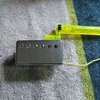
OR SO YOU THINK CRAZY MAN!!!
take off the cover and HERE is some REAL TONE WOOD
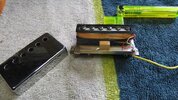
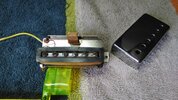
\
So tonewoodian scholars....how does this calculate into the tonewood/magnetism conundrum????
YOu see before you the humbucker from an old 70's era Japanese el cheapo guitar
OR SO YOU THINK CRAZY MAN!!!
take off the cover and HERE is some REAL TONE WOOD
\
So tonewoodian scholars....how does this calculate into the tonewood/magnetism conundrum????
chilipeppermaniac
Ambassador of Decibels
How did you ever find that? Adrian
With his super powerful Ferengi finding powersHow did you ever find that? Adrian
OP

Ancient Japanaese SECRET OF TONE........AKA--crazy American buys ANYTHING!
YOu see before you the humbucker from an old 70's era Japanese el cheapo guitar
View attachment 7119
OR SO YOU THINK CRAZY MAN!!!
take off the cover and HERE is some REAL TONE WOOD
View attachment 7120
View attachment 7121
\
So tonewoodian scholars....how does this calculate into the tonewood/magnetism conundrum????
How does this calculate into the tonewood/magnetism conundrum? It doesn't!
Was this pickup marketed as a humbucker or a single coil?
Last edited:
OP
Actually, there is a simple test you can do. Plug your guitar into your amplifier. Strike a tuning fork and touch it to any part of the guitar, far away from the strings or pickups. You'll hear sound through the amplifier. The fork is setting the body into vibration and the strings begin to vibrate sympathetically to the body. It will be most effective if you use a tuning fork that is the same frequency as one of the strings.
Granted, that is extreme and well beyond the strength of the vibrations the strings would impart to the body and receive back again, but it does demonstrate that the strings can vibrate sympathetically to the body.
I tried this tuning fork trick again, as I haven't done it in a few years.
The results are even more interesting than I remembered. I used an A-440 tuning fork on a couple of my guitars - my Les Paul and one of my SGs. Not only do you get sound out of the amplifier, but once you pull the tuning fork away, the guitar continues to produce sound, audible through the amplifier. You have to dampen the strings with your hand to stop the sound, demonstrating that the strings, themselves, are vibrating. It doesn't matter where on the guitar you touch the tuning fork, the results are the same. I even touched it to the end of the headstock.
Last edited: