Tonewood and Magnetism - Missing the Point

It's not just the scale length either.
The amount of string from bridge to tailpiece and
nut to tuning machine has to be figured in as well.
The longer the total length of the string is, the tighter
it has to be wound to achieve a certain pitch.

No, this isn't right. The string tension depends on the string diameter, the note pitch and the scale length, nothing else. The overall length could be a mile and the tension is still the same.

Overall length does make a difference in bending. It changes how far you have to bend the string to achieve a given pitch change. The longer overall length string needs to be pushed further.
 
Oh, that looks really interesting!

I'll check them out.

Bea, do you know of any English translations of "Physik der Elektrogitarre"?
No. Its in the works, but they seem to seek for translators. I guess it might be faster to learn German...

Meanwhile the preprints of all chapters have been taken from the page. I have downloaded them all before i bought the book.
 
Last edited:
No. Its in the works, but they seem to seek for translators. I guess it might be faster to learn German...

I've considered learning German before...maybe this is good incentive to get started!

Or...maybe you could offer your skills to them as a translator!
 
That's to one part a matter of (my) time, to the other part they are seeking for native English speakers.

BTW: here a paper in English: https://www.hs-regensburg.de/fileadmin/media/fakultaeten/ei/pdf/TMT-2010-Zollner.pdf

Oh, man, that looks awesome...just my kind of stuff!

I did find an interesting summary statements in that excerpt:

"...but the corpus wood is largely insignificant – unless it were made of insulating material (...which it never is). As long as an E-guitar is crafted according to the rules, the most sound affecting parts are the pickups."
 
Oh, man, that looks awesome...just my kind of stuff!

I did find an interesting summary statements in that excerpt:

"...but the corpus wood is largely insignificant – unless it were made of insulating material (...which it never is). As long as an E-guitar is crafted according to the rules, the most sound affecting parts are the pickups."

I am no scholar...but I think this statement is based on theory....after changing close to 10 sets of pickups in my 1987 Squirecaster, which I later put into some other guitars, they all sounded different than they did in the Squire...even with the same pot and cap values....so what changed???
 
No, this isn't right. The string tension depends on the string diameter, the note pitch and the scale length, nothing else. The overall length could be a mile and the tension is still the same.

Overall length does make a difference in bending. It changes how far you have to bend the string to achieve a given pitch change. The longer overall length string needs to be pushed further.

I did some research and it is possible that I posted incorrect information.
I have found no documentation to support my overall length post.
D'Aaddario seems to agree with Don though.
Apologies to all.

So why do the reverse headstock Stratocasters sound different?

string_tension_header_35963.jpg

String Tension 101

+ DOWNLOAD THE FULL STRING TENSION PDF

Modern music has become so sub-divided and fragmented that there is no longer one turn-key string solution for every playing style or desired sound. At one point in time, there were no standardized string gauges, but John D’Addario Sr. changed all that in 1939 with the introduction of light, medium and heavy gauges for acoustic instruments. Throughout most of the 20th century, standardized electric and acoustic guitar gauges were sufficient for needs. Occasionally, new gauges (often hybrids of existing sets), were created for specific purposes and string offerings from manufacturers became immense. However, today there are so many popular styles and trends that it is often necessary for players to go outside of standard gauge sets to get the effect they desire. Whether it’s open tunings, drop tunings, baritone guitars, 5-string guitars, 7-string guitars or a variety of other reasons, many players are opting to go their own way and customize their string selection and sound.

Why Do You Need To Know About String Tension?
D’Addario receives hundreds of inquiries each year from players who have questions or problems to solve related to string gauges or tensions. To assist players in determining the appropriate string for their needs, we created the Online String Tension Guide, a complete book of charts for determining the appropriate string to be used in just about any situation. The guide includes formulas for determining string tension for any string on any instrument type or scale length using three basic measurements: the Unit Weight, the Scale Length of the instrument, and the Frequency of the string. If scientific formulas aren’t your strong point, we have pitch/tension charts for just about every string we make, including electric guitar, acoustic guitar, classical guitar, and bass guitar.

T (Tension) = (UW x (2 x L x F)2) / 386.4

String Tension Facts and Figures
Before we dig in to examples of how to determine various string tensions, here is a brief summary of what string tension is and what effect it has on your instrument and your playing.


Guitar Fingerboard Layout
(Standard Tuning)

Guitar-Fingerboard-Layout_13812.jpg

String tension is determined by vibrating length, mass, and pitch. The string diameter alone does not determine a string’s tension. By using different raw materials (nickelplated steel or phosphor bronze, etc.) or by varying the ratio between the core and the wrap wire, two strings with the same diameter, tuned to the same pitch, could have two different tensions.

There are many factors other than string gauge that determine the actual and perceived string tension on your instrument:

• Scale length, or the distance between the nut and the saddle. The longer the scale, the higher the tension is for the same string tuned to the same pitch – for example, a standard Fender™ guitar at 25½” scale has more string tension and will feel stiffer than a standard Gibson™ 24¾” scale guitar, even if both are tuned to the same standard pitch.Some players adjust for this by using slightly heavier gauges on shorter scale guitar than on longer scale guitars.

Acoustic/Electric/Classical Guitar = 25 1/2”
Electric Bass Guitar (Superlong Scale) = 36”
Electric Bass Guitar (Long Scale) = 34”
Electric Bass Guitar (Medium Scale) = 32”
Electric Bass Guitar (Short Scale) = 30”
Mandolin = 13 7/8”
Mandola = 15 7/8”
Mandocello = 25”
Mandobass = 42”
Banjo = 26 1/4” (19 5/8” for 5th string)

• The flexibility of the instrument top and neck.

• The string break-angle at the nut and saddle/bridge.

• String height or “action” as adjusted at the saddle.

• Truss rod adjustment (neck relief).

Note: Before deciding on a string gauge, be sure your instrument is properly “set up.” Unusually high action can change the way the string tension feels and can also result in poor intonation.

How to Measure String Tension
String tension is measured in pounds of pull per string. When all of the tensions of each string are added up, you get the “set tension” for that set. If, for example, you want to change the tuning of one string, you should try to select a string gauge that will offer a similar tension to the string you are replacing, but can be tuned to the desired pitch.

ex_tensionguide_13813.jpg
 
I'm with Robert on the scale length thing.

Of course scale length will effect tone.
Longer scale length + same diameter string
= more tension on the string to achieve a given pitch.
More tension on the string = a more strident high end.

It's not just the scale length either.
The amount of string from bridge to tailpiece and
nut to tuning machine has to be figured in as well.
The longer the total length of the string is, the tighter
it has to be wound to achieve a certain pitch.

Play a Stratocaster.
Play a Stratocaster with a reversed headstock.
The one with the reversed headstock will have tighter lows
and less strident highs. This is because its low strings have
more tension and its high strings have less tension than
the one with the normal headstock.

Added icing on the cake benefit:
Bending the high E, B and G strings will also be easier due to the
lower tension on those strings with the reverse headstock.

Gibson got it right with the Firebirds.
Neck through construction.
Reverse headstock.
Good design.

Tell you something....the shorter scale really imparts something into my playing. It's more fluid for some reason...and a Strat with a 24.75" scale takes on an entirely different character...and the tone is much more articulate....I think this is the best way I can explain it.

A 25.5" scale guitar, to my ear, sounds like six voices singing in unison.

A 24.75" scale guitar, to my ear, sounds like six voices singing in harmony
 
Last edited:
I am no scholar...but I think this statement is based on theory....after changing close to 10 sets of pickups in my 1987 Squirecaster, which I later put into some other guitars, they all sounded different than they did in the Squire...even with the same pot and cap values....so what changed???
Perhaps pickup placement in relation to the bridge(distance from), and placement of pickup poles to nearest fundamental harmonic.
These factors would influence the sound from the same pickup in different guitars.

My two P90 loaded SGs sound very different from each other.
The biggest difference between them is pickup placement.
The one with the small pick guard has the pickups spread further apart. The bridge pickup is closer to the bridge, and the neck pickup is closer to the neck, than the one with the large pick guard.
I would wager that if I traded pickups between the two that the difference would remain.
 
Perhaps pickup placement in relation to the bridge(distance from), and placement of pickup poles to nearest fundamental harmonic.
These factors would influence the sound from the same pickup in different guitars.

My two P90 loaded SGs sound very different from each other.
The biggest difference between them is pickup placement.
The one with the small pick guard has the pickups spread further apart. The bridge pickup is closer to the bridge, and the neck pickup is closer to the neck, than the one with the large pick guard.
I would wager that if I traded pickups between the two that the difference would remain.

Hmmm...could be. I had not considered that, but I am aware the SG/LP pickup placement is different and that, to some degree, is said to have a tonal influence, although I never experimented with it...Good point.
 
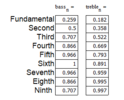
The Strat bridge pickup is very particular. The treble end is 1.4 inches from the bridge, while the bass end is 2 inches. This means that the balance of harmonics across the strings is very different, and must be responsible for a lot of the Strat sound. Using these distances, I've calculated the relative strength of harmonics at the treble and bass strings

upload_2017-7-27_17-0-14.png

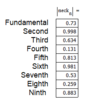
The neck pickup is 6.25 inches from the bridge and has this balance

upload_2017-7-27_17-3-51.png


Interestingly, the bridge pickup grabs a lot of seventh harmonic, which is strongly discordant - it isn't a part of the chord sequence. This could also be a big part of the characteristic Strat tone ( a bit of the quack maybe). I'm going to keep looking to see what else is interesting.

We may call it music, but it is all science in the end
 
the bridge pickup grabs a lot of seventh harmonic, which is strongly discordant - it isn't a part of the chord sequence. This could also be a big part of the characteristic Strat tone ( a bit of the quack maybe).
I think so.
 
I know, I was thinking of the standard Strat pickup. With a humbucker there is a problem - it's really hard to say exactly where it is. It is sort of distributed along more than an inch of string.
 
I'm with Robert on the scale length thing.

Of course scale length will effect tone.
Longer scale length + same diameter string
= more tension on the string to achieve a given pitch.
More tension on the string = a more strident high end.

It's not just the scale length either.
The amount of string from bridge to tailpiece and
nut to tuning machine has to be figured in as well.
The longer the total length of the string is, the tighter
it has to be wound to achieve a certain pitch.

Play a Stratocaster.
Play a Stratocaster with a reversed headstock.
The one with the reversed headstock will have tighter lows
and less strident highs. This is because its low strings have
more tension and its high strings have less tension than
the one with the normal headstock.

Added icing on the cake benefit:
Bending the high E, B and G strings will also be easier due to the
lower tension on those strings with the reverse headstock.

Gibson got it right with the Firebirds.
Neck through construction.
Reverse headstock.
Good design.

I agree with Robert and Tony here. Scale length, geometry of bridge to pup and pup to neck locations etc all have effect on how a guitar sounds and/or feels to play.

Also, I can't help but believe mass of bridges, hard tail or Trem style, Semi Hollow vs Full Hollow, Plywood body, Solid mahog, Ash, Basswood, Pine etc, or Maple Cap vs Full Solid body, Set vs Bolt on neck, weight relief vs boat anchor guitar all have effects on the vibes of all the components and how this transmits thru the pups to the pots and signal chain to come out thru the amp and speakers.

I can't dispute how they sound is a factor of all these things. Even at least one player has suggested a Single pickup guitar like a JR or Esquire Tele will sound different if the bridge pups are isolated for comparison due to no rout up by neck vs a rout and pup in there.

Like Tony said, his 2 ES335's are all the same and yet they sound different.
 
Last edited:
The Strat bridge pickup is very particular. The treble end is 1.4 inches from the bridge, while the bass end is 2 inches. This means that the balance of harmonics across the strings is very different, and must be responsible for a lot of the Strat sound. Using these distances, I've calculated the relative strength of harmonics at the treble and bass strings

View attachment 7116

The neck pickup is 6.25 inches from the bridge and has this balance

View attachment 7118


Interestingly, the bridge pickup grabs a lot of seventh harmonic, which is strongly discordant - it isn't a part of the chord sequence. This could also be a big part of the characteristic Strat tone ( a bit of the quack maybe). I'm going to keep looking to see what else is interesting.

We may call it music, but it is all science in the end


Don, Does a Tele Bridge pup act similarly since it is angled as well?
 
Back
Top