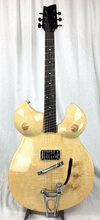
First and foremost, I want to thank and honor
@Don O for his kindness and generosity in allowing me to perform a long term road-test of the Mesa Fillmore 50 Combo.
The quality of the build, and attention to detail, really is unparalleled...as one would expect in a $1,800.00 amplifier.
Takeaways:
The cleans are simply fabulous and the reverb is very rich and broad. It rivals any Blackface or Princeton in this regard.
The gain channels 'Drive' and 'High' both produce adequate gain structure for most players.
'Drive' has a slight volume drop when switching from the 'Hi' setting. You can hear that this is classic Jose Zener Diode Clipping at work.
At relatively high gain, you can get a good 'classic rock' tone for most song covers. Flat out, the best you can get in terms of gain structure is an AC/DC type of attack. Beyond this, you'll need a boost like the TS-9...but even when being hammered with a TS-9, your best gain texture will be Ala Leslie West on Mississippi Queen.
This is not a negative quality in the least, but it just doesn't afford the harder, edgier and tight speaker-thumping low end, coupled with a searing midrange overtone that a Marshall can seemingly deliver without maxxing-out the controls. Quite honestly, I do not think it (the Mesa Fillmore) was designed to do that.
The amp's tone controls are very unusual.
First, you must understand that as you increase the gain, the amp's circuitry rolls off bass, so the louder you push the amp, the thinner your tone becomes and above about 12 Noon, the bass knob really seems to be completely out of play.
Mids too are another strange thing in terms of function.
So, while playing recently, I noticed I was a little low in the mix, so my instinct is not to increase volume, but bump the mids.
If you dial up more mids, nothing happens, even with the mid control dimed-out.
Instead, you need to roll off the bass and the high EQ controls to begin to hear the mids start emerging.
If you need more treble, increasing the treble EQ doesn't produce a sonically pleasing tone. It gets thin and bright fast and it's very prone to squeal at high treble levels (the manual warns of this) because increasing treble also increases gain and simultaneously reduces mids and bass frequencies.
Mesa manual says to use presence instead of treble to deliver a higher top-end edge without increasing gain. The manual also says that great tones can be had with the treble EQ all the way to zero, because they designed the amp to be biased towards the upper end of the tonal spectrum.
They aren't kidding. With treble at zero, the amp still had plenty of top end.
This was confusing to me and took extra time to adjust to this learning curve in a live band setting. No doubt this could eventually become engrained with practice.
The Fillmore is plenty loud, but I could not dial in a percussive thump no matter what settings I dialed in.
Now, with respect to the controls and how they influence your tone. Huge dial position changes by themselves produce very little change sonically. Each tone control seems to influence the others to some degree. So, for example, to get more bass, you turn down treble and gain. For more high end, you turn down bass and mids, then increase presence.
In comparison to tonal changes vs. dial range of motion, the Mesa will give you a teacup full of gain at '10' and my Ivanberg Modded ORI50 or a JCM800 2204 will give you a two litre soda bottle full. The same is true for the reactivity of the tone EQ's. The Mesa Fillmore's controls are very, very subtle in their influence on your tone.
So, where does the Mesa Fillmore shine???
It's light. At only 44 pounds, it fits easy into my trunk. Ding! Ding! Ding!
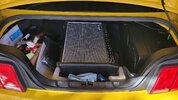
For a guy playing a wide range of covers, the heaviest of which is likely Ram Jam's Ol' Black Betty, the Fillmore would be stellar. The Fillmore can nail Bill Bartlett's tone on that song perfectly, buut that's about ALL you will get from the amp alone.
A country picker would also love the Fillmore, as would a jazz player. It would be a great session amplifier too, but considering that most pro sessions are using amp simulations, like Blue Cat Destructor and Avid Eleven Mk II, I'm not sure it offers you more than the simulation can.
For the tone that I hear in my head???
Only ONE amp has ever truly delivered it WITHOUT pedals...@Don O's 1997 Marshall 8280 2x12 Bi-Chorus Combo or the 8200 Bi-Chorus Stereo Head. I found the tone from the 8280/8200 even better than from the Engl Fireball and Engl Marty Friendmann Inferno WITHOUT a clean boost.
I've gotten "honorable mention tone" from a JCM800 2204 with an extra gain stage and my full pedalboard and also from my pair of ECC823 equipped DSL40C's with an Electro-Harmonix 12VR75 speaker, but in both cases, it was little better than an acceptable compromise. It never, ever was a tone that I loved. But, I could get by with it.
Now, fast forward to last Saturday night's performance. Pressed for time and space in my wife's car with our daughter riding shotgun, I minimized and took my 1999 Marshall MG50 Solid State 1x12" Reverb Combo, a footswitch and my Les Paul 50's Standard Gold Top. No FX at all and my amp was mic'd for the performance.
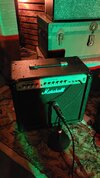
I felt like I totally smoked our performance in terms of playing and tone. Everyone had very positive things about our energy. I also fielded a lot of post-performance questions about my setup.
I also played half of our set dead-clean on the "Green Channel."
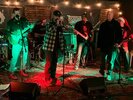
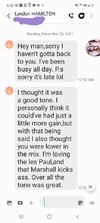
A very good musical friend (and Grammy nominated L.A. producer) was in attendance. Without telling him I was running a Solid State amp, I texted him and asked him his perceptions of my tone, based on the performance he attended.
Here's the message I received:
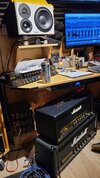
I can play through tube amps anytime I want, and sometimes I do, both live and in the studio. Here's a recent pic from a private "locked out" session at rat's Nest Studios:
So, you cannot, in all honesty, say that my preference for SS tone is because I've never played through a "good" tube amp. I could start naming McIntosh, Hellwin, Butcher, Dumble ODS and all the other, Holy Grail amps that I've played through to quantify my experience,
but let's agree to set those ideologies, prejudices, brand loyalty and biases aside.
For me, to get a tight focused low end with a searing midrange and pronounced, yet controlled high end frequency, I have to hit a tube amp with a TS-9, full gain, exploitation of ALL tone controls, including (2) GE-7's, the tone knobs on my CS-3 Compressor and TS-9 Tube Screamer, and the (2) Hi/Lo Pass tone controls on my CE-5 Chorus.
In summary, I've pretty much created a solid state, square-wave signal, which a good SS amp can deliver with fewer pedals.
I'm familiar with Marshall style tone controls, so I'm likely gonna stick with Marshall from here on out.
Ultimately, I want a Marshall 8200 Bi-Chorus Stereo Head or a 8280 2x12 Bi-Chorus Stereo Combo, but rather than buy some of the "junkers" I've found recently, that need to be recovered and may need internal repairs, I'm going to run with a forum member's, two-year old, owned since new MG100HFX.
This amp will allow me to replace/eliminate my Blackstar ID-Core 100watt as my primary DAW interface. It will reduce my "pedal dependency" from 12 FX to only 7 (Wah, Tuner, Comp, FX Loop Volume Pedal, (1) solo boost EQ delay and noise gate, and shrink my pedalboard from 34" to only 24" in overall length.
I'm still keeping an eye out for a nice 8200 Bi-Chorus Stereo Head, but it may take quite some time to find one that hasn't been beat up.
Notwithstanding, I pretty pleased with the direction things are going!!!
Merry Christmas!!!!