

Looks like it to me..It would bug me beyond description, but you are probably right...now, is this a proper fix???
LOL
Bad can happen at any time,, luckily it is you to piece it back to normal…
Cheers

Looks like it to me..It would bug me beyond description, but you are probably right...now, is this a proper fix???
LOL

THIS^^^^^^^Mahogany is a very delicate wood.
I glued a headstock back on an Epiphone DOT which is a 3x3 and 14 degree angle vs a Strat style. Stuck with 10's on it and my friend has not had any breakage issues in 10+ years.So did you get the new strings on it? Will you go with a lighter gauge now?


I glued a headstock back on an Epiphone DOT which is a 3x3 and 14 degree angle vs a Strat style. Stuck with 10's on it and my friend has not had any breakage issues in 10+ years.


IME, headstock repairs have made for better unplugged sustain but also a slightly stiffer and less lively feel.The rumor is, that a properly repaired headstock/neck break results in a better sustaining and resonant guitar.

Was it a gift or he was buying it off you, Robert?

Ya switched to aluminum shielding on #12, FWIW. :dood:The first 12 guitars featured copper shielding. Around serial #13, I switched to aluminum to save $$$$.
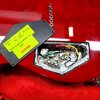
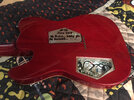
I added my "INSP #20" and cell # to the inside of the cover a few days ago, replacing the original Post-It Note, which had lost its stickiness.
View attachment 82534
I've also shielded the cover plates on some models and then skipped shielding the cover on others. It didn't seem to make much difference as long as the cavity was shielded.
This guitar features 0.01uf tone capacitor which makes the tone knob useable across 360° of rotation.
The bridge humbucker in this guitar is a hand wound Artec Classic Standard from their Giovanni line, with a flipped Alnico 4 magnet, wood spacers and around 8.4k ohms.
The neck pickup in this guitar is also a Artec Giovanni '59 Model' at around 7.2k ohms.
There is a coil split microswitch for the bridge pickup and the guitar is out of phase when the three way switch is in the middle position.
In over 20 years of repairs I had never heard that before.IME, headstock repairs have made for better unplugged sustain but also a slightly stiffer and less lively feel.
So the necks come alive less easily at volume.
It generally has made the guitars noticeably brighter sounding too, perhaps with slightly faster attack.
I think that's one reason metal players often seem to like the change, while blues players sometimes don't.
Of course my sample size is not large, and was limited to three mahogany Gibson necks.
But the results were pretty similar in each case.
I still have one of them.
In over 20 years of repairs I had never heard that before.
I guess I learned something new.
Gold Star day!
