I Dropped A Guitar Today:

Well, that sucks. You took the right steps to fix it. It will never break there again.

If you have the means, a little bondo and refinishing the area would render it invisible. I know, that means new logos and more time. What you have done looks structurally sound to me.

Some people like to route out a couple of small channels and fill them with new wood of the same type, but I don't think that is needed with this break - it's more for when the break makes your neck look like a Steinberger.

You used the right type of glue too. I've seen people try to epoxy their necks back together - spoiler alert, it's a bad idea. Too brittle and just creates a bigger headache to repair it right.

Good job fixing your klutzy moment. Nice save!
 
Last edited:
I glued a headstock back on an Epiphone DOT which is a 3x3 and 14 degree angle vs a Strat style. Stuck with 10's on it and my friend has not had any breakage issues in 10+ years.

I was just trying to be silly with Robert. Not serious though.

@Robert Herndon: Not connecting the name together I searched that guitar because I was interested in that very nice looking.. sort of "barcode'y", headstock. You really did a nice and original looking design with that. It's very attractive. (y)(y)

Hell if the original builder cracked that, you should get a few bucks back on it I think. I think you're being shortchanged.

:)
 
The rumor is, that a properly repaired headstock/neck break results in a better sustaining and resonant guitar.
IME, headstock repairs have made for better unplugged sustain but also a slightly stiffer and less lively feel.
So the necks come alive less easily at volume.

It generally has made the guitars noticeably brighter sounding too, perhaps with slightly faster attack.
I think that's one reason metal players often seem to like the change, while blues players sometimes don't.

Of course my sample size is not large, and was limited to three mahogany Gibson necks.
But the results were pretty similar in each case.
I still have one of them.
 
Well,

Its been clamped for about 12 hours now and I won't be subjecting it to any stress whatsoever until 24 hours have passed, that's the recommendation on the Titebond label.

Going back a little to the construction of these guitars...

There was a guitar builder in Whittier, California known as B.Hefner and Company. They were essentially a Warmoth in terms of what you could buy from them.

Once i had the designs laid out, I drove down there and picked out all the wood. They cut and shaped everything for me.

The concept was to build a Telecaster like a Les Paul with maple/mahogany/maple sandwich body and one piece mahogany necks with a unique 'tounge-and-groove' neck joint with a vent hole for glue release.

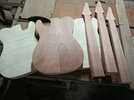
Von Herndon Stagecrafter First Cuts.jpg

(The saw in this image is non-functional. This is a glamor shot)

Because my original plan was to build and sell these guitars, I needed my own, unique headstock design. I tried to come up with something 'interesting' but not too far-out.

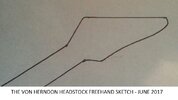
It started out as a sketch on a Five Guys napkin.

Von Herndon Headstock Freehand Sketch.jpg

That shape would have to be adjusted so the strings would get a straight pull through the nut.

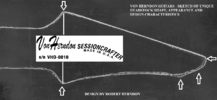
It eventually became this...

VON HERNDON GUITAR HEADSTOCK DESIGN SKETCH.png

The shape of the headstock, the name 'Von Herndon,' and the trade names 'StageCrafter,' 'SessionCrafter' and 'StudioCaster' are registered trademarks.

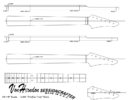
The neck would be a 1958 Les Paul profile mixed with a Fender 'U' profile, but with a Mustang's 24.0" scale length.

Von Herndon Neck Plans - 2.png

A luthier friend in Pomona helped me with the binding and setting the fretboards in place. He also helped me set the necks in his hydraulic press.

The first 4 guitars were stained and poly'd by B.Hefner.

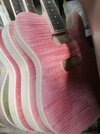
Von Herndon StageCrafter Bodies.jpg

From serial number VHO-0005 onwards, I stained and applied the U-Pol myself in the garage. The unusual red color is the result of mixing red and orange RIT dye in varying shades.

Each batch of guitars look slightly different in color, because the individual batches of dye are mixed by eye.

The first guitars used a water slide decal under the poly. After that, I started experimenting with lazer-cut stencils. Somewhere around serial number 15 or 16, I started spraying the serials on with flat white, Testor's brand model paint.

This was cheaper than the water slide decals and I stayed with this method until the very last guitar.
 
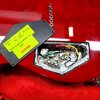
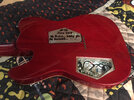
The first 12 guitars featured copper shielding. Around serial #13, I switched to aluminum to save $$$$.

I added my "INSP #20" and cell # to the inside of the cover a few days ago, replacing the original Post-It Note, which had lost its stickiness.

20220404_111025.jpg

I've also shielded the cover plates on some models and then skipped shielding the cover on others. It didn't seem to make much difference as long as the cavity was shielded.

This guitar features 0.01uf tone capacitor which makes the tone knob useable across 360° of rotation.

The bridge humbucker in this guitar is a hand wound Artec Classic Standard from their Giovanni line, with a flipped Alnico 4 magnet, wood spacers and around 8.4k ohms.

The neck pickup in this guitar is also a Artec Giovanni '59 Model' at around 7.2k ohms.

There is a coil split microswitch for the bridge pickup and the guitar is out of phase when the three way switch is in the middle position.
 
Last edited:
Ok,

So this guitar was on its way to Nashville Session Ace David Langely when the accident occurred.

David, a former member of the Tommy Overstreet Band, was chosen by my Mom as the recipient of this guitar. We have known David 40 years.

David felt like the blending of the two guitars would allow him to shoulder a Telecaster-style shape, while delivering a more Les Paul tone.

Here's a clip of David playing...

 
Despite feeling like I built a decent guitar, they seemed to be disliked by Fender and Gibson purists, who felt the design was polluted with elements from the other guitar construction methodology.

All total, 27 StageCrafters were produced and most reside with session players.

The 28th and final guitar I produced was the Von Herndon DoubleNeck...
 
The first 12 guitars featured copper shielding. Around serial #13, I switched to aluminum to save $$$$.

I added my "INSP #20" and cell # to the inside of the cover a few days ago, replacing the original Post-It Note, which had lost its stickiness.

View attachment 82534

I've also shielded the cover plates on some models and then skipped shielding the cover on others. It didn't seem to make much difference as long as the cavity was shielded.

This guitar features 0.01uf tone capacitor which makes the tone knob useable across 360° of rotation.

The bridge humbucker in this guitar is a hand wound Artec Classic Standard from their Giovanni line, with a flipped Alnico 4 magnet, wood spacers and around 8.4k ohms.

The neck pickup in this guitar is also a Artec Giovanni '59 Model' at around 7.2k ohms.

There is a coil split microswitch for the bridge pickup and the guitar is out of phase when the three way switch is in the middle position.
Ya switched to aluminum shielding on #12, FWIW. :dood:

30CC11D8-59DB-4D4A-823A-A8933BD1B21A.jpeg
 
IME, headstock repairs have made for better unplugged sustain but also a slightly stiffer and less lively feel.
So the necks come alive less easily at volume.

It generally has made the guitars noticeably brighter sounding too, perhaps with slightly faster attack.
I think that's one reason metal players often seem to like the change, while blues players sometimes don't.

Of course my sample size is not large, and was limited to three mahogany Gibson necks.
But the results were pretty similar in each case.
I still have one of them.
In over 20 years of repairs I had never heard that before.

I guess I learned something new.

Gold Star day!
 
Back
Top