High Voltages After Headfirst Origin 50 Mod

The doc asked if I wanted to see the video after one of mine. I politely said, no thanks.
They don't even knock me out anymore. I can see the monitor too. As the scope travels through, it reminds me of a creepy roller coaster ride. Of course I just have to yell out: "Wheeeeeee!" while I try to hold my arms up!!
 
I still haven't been able to force myself to do that.

It's not the scope. It's intentionally forcing yourself to have debilitating diarrhea that I can't get past.
For me it’s not the diarrhea, it’s the taste of the salt water crap you have to drink a gallon of in about 30 minutes. My first one, 20 years ago they gave me a small, maybe 10 oz bottle of Fleet something. I thought how is this little amount of stuff gonna work. Went down easy and whew, cleaned me about in about 4 hours. Probably lost a few pounds too. But since then it’s been that gallon jug a salt water tasting crap. I chase it down with white wine :dood:
 
@old rocker - Question...does your transformer hum continue with amp switched on??? A very low frequency hum...
A little low level 50 or 60 cycle hum from the PT is no problem. Excessive hum or buzzing is indicative of a problem though.
The PT & OT of an amplifier will usually have the laminate cores oriented on different planes, be seperated as much as possible etc, in an effort to lessen PT hum being picked up by the OT. In tube audio amps we often see the transformers shielded, like this16352775024035599038992865249209.jpg

Interestingly, if an amp is hooked to a dummy load, the amp can be driven hard with a function/signal generator, causing the OT to "ring" at the same frequency as that that the amp is being driven with, exhibiting the same phenomenon as a PT humming at the 50 or 60 cycles of the mains power being applied to it. Cheers
 
Wasn't Angus renowned for biasing at about 80 to 85 % and blowing tubes in every show?
Good tone yes, clean hmmm, and not what I'd consider a good role model for biasing...
That's why I laugh everytime someone says "Angus played clean just loud". Well you don't need much gain on the pot when your starting right up there do you?
Well it definitely sounds much better when the tubes are very slightly red. (not too much)
It wildly increases the sensitivity and sustain.
But you wind up with a set of tubes that will go about 40 hours....
It's understandable why you would do this to record a song, album, to get the most killer sound possible.
But it's not practical for everyday use.

I know people who do this on purpose just to get that sound.
And they spend quite a lot replacing the tubes. They might spend $400 on a set of tubes, just to torture the tubes.
Because it sounds killer.

But in the real world, we tend to limit the bias to 70% or less. (for class AB amplifiers)
That's the advantage to using a scope - finding the ideal bias point, but saving the heat.
The bias meter does not tell you where this point is, but the scope will.
So I can get the cleanest headroom, prolong the life of the tubes, less heat, all at the same time.
 
Last edited:
@Amp Mad Scientist - I am still curious as to why you are permitting your dinosaur avatar to use such a blatantly incorrect method to toast his pop tarts. Holding it by one end and passing it though the toaster's heat signature will not a well prepared pop tart make. I would suggest at least slowing down his movement to allow more heat infusion into the pastry. I have been making pop tarts for many, many years and I would consider myself one of the foremost knowledgeable and skilled Pop Tartist's in this forum. I have also prepared countless Toaster Strudels and I am also well versed in the preparation and consumption of the knock-off brands as well.

Pop Tarts.jpg

While camping, I use a coat hanger and bend it to form a cradle, so that I can toast pop tarts in an open flame and get a nice, even, golden brown texture. Even then, you cannot wildly, albeit mindlessly, pass the pastry through the flame in such fashion as your dinosaur does. The trajectory and timing through the flames must be taken into consideration, as does wind speed and direction. A simple miscalculation will result in a tart that tastes like smoke, or charcoal.

What about an avatar that has the pastries popping out of the toaster into the dinosaur's claws, whereas he then waves them wildly because the bitches are quite hot and he is attempting to shed heat via convection. Keep in mind that one should be careful not to violate Newton's Law of Cooling in as much that the rate of heat loss of a body is proportional to the difference in temperatures between the body and its surroundings while under the effects of a breeze, so it would take some time for the cooling process to take effect, especially of toasting has been taking place around 450–500 degrees Fahrenheit.

1635426918421.png

So, should you, and most wisely so, modify your avatar to depict the correct methodology of toasting these tasty treats, I will be forever grateful...
 
@Amp Mad Scientist - I am still curious as to why you are permitting your dinosaur avatar to use such a blatantly incorrect method to toast his pop tarts. Holding it by one end and passing it though the toaster's heat signature will not a well prepared pop tart make. I would suggest at least slowing down his movement to allow more heat infusion into the pastry. I have been making pop tarts for many, many years and I would consider myself one of the foremost knowledgeable and skilled Pop Tartist's in this forum. I have also prepared countless Toaster Strudels and I am also well versed in the preparation and consumption of the knock-off brands as well.

View attachment 74844

While camping, I use a coat hanger and bend it to form a cradle, so that I can toast pop tarts in an open flame and get a nice, even, golden brown texture. Even then, you cannot wildly, albeit mindlessly, pass the pastry through the flame in such fashion as your dinosaur does. The trajectory and timing through the flames must be taken into consideration, as does wind speed and direction. A simple miscalculation will result in a tart that tastes like smoke, or charcoal.

What about an avatar that has the pastries popping out of the toaster into the dinosaur's claws, whereas he then waves them wildly because the bitches are quite hot and he is attempting to shed heat via convection. Keep in mind that one should be careful not to violate Newton's Law of Cooling in as much that the rate of heat loss of a body is proportional to the difference in temperatures between the body and its surroundings while under the effects of a breeze, so it would take some time for the cooling process to take effect, especially of toasting has been taking place around 450–500 degrees Fahrenheit.

View attachment 74845

So, should you, and most wisely so, modify your avatar to depict the correct methodology of toasting these tasty treats, I will be forever grateful...
He could be just trying to keep them warm while trying to figure out how to get his Lil arms to reach his mouth....
 
STOCK ORIGIN 50 VOLTAGE READINGS:

Courtesy of Timo V at the Marshall Forum:

Power setting_____Low______Mid______High____
-----------------------------------------------------------------
Power tube plates____436____420______441___Volts

Power tube screens___61___165___436______Volts

Idle current_____77______120_____66____mA

Bias___0______-7.9_____-37.7______Volts

PI anodes___46___106__268__Volts

Power output*___1.8/3__5.5/8.5__42/58_Wrms

*Max P-out non-clipped/clipped.
----------------------------------------------------------------------------------------------
(NOTES)

A supply node for V1 and V2 is 260 Volts, and power setting does have very minor effect on it.

One more bit of information. I have seen claims that ORI50 has stiff power supply, this is wrong. B+ sags from 440 Volts at idle to 360 Volts at full output. Because the bias from the factory was set on cool side, i have since biased my Origin to 80 mA. This added nice fullness and grit to amps tone.
The amp was measured with 8 ohm load and 1 kHz test signal to FX loops return.
 
@Amp Mad Scientist - I am still curious as to why you are permitting your dinosaur avatar to use such a blatantly incorrect method to toast his pop tarts. Holding it by one end and passing it though the toaster's heat signature will not a well prepared pop tart make. I would suggest at least slowing down his movement to allow more heat infusion into the pastry. I have been making pop tarts for many, many years and I would consider myself one of the foremost knowledgeable and skilled Pop Tartist's in this forum. I have also prepared countless Toaster Strudels and I am also well versed in the preparation and consumption of the knock-off brands as well.

View attachment 74844

While camping, I use a coat hanger and bend it to form a cradle, so that I can toast pop tarts in an open flame and get a nice, even, golden brown texture. Even then, you cannot wildly, albeit mindlessly, pass the pastry through the flame in such fashion as your dinosaur does. The trajectory and timing through the flames must be taken into consideration, as does wind speed and direction. A simple miscalculation will result in a tart that tastes like smoke, or charcoal.

What about an avatar that has the pastries popping out of the toaster into the dinosaur's claws, whereas he then waves them wildly because the bitches are quite hot and he is attempting to shed heat via convection. Keep in mind that one should be careful not to violate Newton's Law of Cooling in as much that the rate of heat loss of a body is proportional to the difference in temperatures between the body and its surroundings while under the effects of a breeze, so it would take some time for the cooling process to take effect, especially of toasting has been taking place around 450–500 degrees Fahrenheit.

View attachment 74845

So, should you, and most wisely so, modify your avatar to depict the correct methodology of toasting these tasty treats, I will be forever grateful...
Well, it took 550 posts, but you just hijacked your own thread... :alien:
 
STOCK ORIGIN 50 VOLTAGE READINGS:

Courtesy of Timo V at the Marshall Forum:

Power setting_____Low______Mid______High____
-----------------------------------------------------------------
Power tube plates____436____420______441___Volts

Power tube screens___61___165___436______Volts

Idle current_____77______120_____66____mA

Bias___0______-7.9_____-37.7______Volts

PI anodes___46___106__268__Volts

Power output*___1.8/3__5.5/8.5__42/58_Wrms

*Max P-out non-clipped/clipped.
----------------------------------------------------------------------------------------------
(NOTES)

A supply node for V1 and V2 is 260 Volts, and power setting does have very minor effect on it.

One more bit of information. I have seen claims that ORI50 has stiff power supply, this is wrong. B+ sags from 440 Volts at idle to 360 Volts at full output. Because the bias from the factory was set on cool side, i have since biased my Origin to 80 mA. This added nice fullness and grit to amps tone.
The amp was measured with 8 ohm load and 1 kHz test signal to FX loops return.

440 volts at idle 360 volts at full output does not indicate sag.
It indicates that the voltage drops when the load increases (ohms law).
This is normal for any guitar amp, despite if the power supply is stiff or not.

When they say "stiff,"
they are taking about 50uF filter caps VS 20 uF filter caps, etc...
The 20uF would have more sag, the 50uF would have less.
The 50uF stores more energy for a longer period of time. Therefore is more stiff than 20uF.

If you are going to measure stiff VS sag...
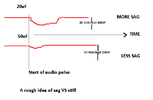
you need to look at the spontaneous voltage drop on a given fast pulse of audio.
(probably using a time base storage scope...) you would see the voltage sink, then rise up[ again upon a given fast pulse of audio.
And this would be stored as a horizontal / vertical graphic recording, VS time.
Not idle VS full power.

Generally, bigger filter caps are used to reduce the amount of hum from the power supply.
20uF will have a lot more hum than 50uF.
100uF would have less hum than 50uF...
and as the filter caps increase the power supply becomes more stiff. (sinks less fast on a given pulse of audio) but still sinks.

So, what filter cap configuration does the amp use?
We don't know, no schematics. (unless your gonna draw one)

So look at voltage drop VS time on a pulse input, if you want to see stiff VS sag.
(since you have no time reference on a pulse, you can't see stiff VS sag)

sag VS stiff.png

A Hi Fi amp would have big capacitors...because they try to stop the sag a much as possible.
They want the voltage to stay constant, upon a pulse of audio.

But the smaller the capacitor, the more hum in the audio...so more sag usually means more hum too.

It's going to be a compromise, between hum which is not desirable...and sag which is desirable in a guitar amp.

Without sag in a guitar amp, the sound is sterile and bland.
Human ears: like the sag.
 
Last edited:
440 volts at idle 360 volts at full output does not indicate sag.
It indicates that the voltage drops when the load increases (ohms law).
This is normal for any guitar amp, despite if the power supply is stiff or not.

When they say "stiff,"
they are taking about 50uF filter caps VS 20 uF filter caps, etc...
The 20uF would have more sag, the 50uF would have less.
The 50uF stores more energy for a longer period of time. Therefore is more stiff than 20uF.

If you are going to measure stiff VS sag...
you need to look at the spontaneous voltage drop on a given fast pulse of audio.
(probably using a time base storage scope...) you would see the voltage sink, then rise up[ again upon a given fast pulse of audio.
And this would be stored as a horizontal / vertical graphic recording, VS time.
Not idle VS full power.

Generally, bigger filter caps are used to reduce the amount of hum from the power supply.
20uF will have a lot more hum than 50uF.
100uF would have less hum than 50uF...
and as the filter caps increase the power supply becomes more stiff. (sinks less fast on a given pulse of audio) but still sinks.

So, what filter cap configuration does the amp use?
We don't know, no schematics. (unless your gonna draw one)

So look at voltage drop VS time on a pulse input, if you want to see stiff VS sag.
(since you have no time reference on a pulse, you can't see stiff VS sag)

View attachment 74868

A Hi Fi amp would have big capacitors...because they try to stop the sag a much as possible.
They want the voltage to stay constant, upon a pulse of audio.

But the smaller the capacitor, the more hum in the audio...so more sag usually means more hum too.

It's going to be a compromise, between hum which is not desirable...and sag which is desirable in a guitar amp.

Without sag in a guitar amp, the sound is sterile and bland.
Human ears: like the sag.

Thank you for the detailed information!!!!
 
I got halfway thru this post when I realized it's not another pop tart equation. :io:
Well this is what's happening when you play a note:
first the voltage takes a dive on the attack, then as the note decays the voltage recovers and climbs back up.
This creates an envelope effect that is distinct in tube guitar amps. Attack Decay Sustain Release

It shapes the loudness and it shapes the compression. This is why tube amps sound alive, instead of bland.
If you take the sag out, the amp sounds awfully boring..

Every time you play a note, there is a dance of moving voltages all throughout the amp. It's a ballet of constantly moving constantly changing characteristics.
Nothing in the amp is really steady when you play...it moves all the time.

What is particularly interesting is what happens when a note sustains. It is very different than what most people would imagine or predict.
It's like a whole separate science.
 
Well this is what's happening when you play a note:
first the voltage takes a dive on the attack, then as the note decays the voltage recovers and climbs back up.
This creates an envelope effect that is distinct in tube guitar amps. Attack Decay Sustain Release

It shapes the loudness and it shapes the compression. This is why tube amps sound alive, instead of bland.
If you take the sag out, the amp sounds awfully boring..

Every time you play a note, there is a dance of moving voltages all throughout the amp. It's a ballet of constantly moving constantly changing characteristics.
Nothing in the amp is really steady when you play...it moves all the time.

What is particularly interesting is what happens when a note sustains. It is very different than what most people would imagine or predict.
It's like a whole separate science.

Everything you say here in this post makes sense.

I'll tell you what...

The Ivanberg Modded ORI50 is the best amplifier experience I've ever had...period.

Whatever magic fruit @syscokid and @ivan H squeezed to make this happen, it's just absolutely glorious
 
Back
Top