I have never tried it, so I really can’t answer.I you turn the gain to zero, does some audio still bleed through?
Does the sound actually go to zero or is there still a little bit of volume?

I have never tried it, so I really can’t answer.I you turn the gain to zero, does some audio still bleed through?
Does the sound actually go to zero or is there still a little bit of volume?
There's still some signal bleed in my amp but the problem only occurs when the master is set high/on "10".I you turn the gain to zero, does some audio still bleed through?
Does the sound actually go to zero or is there still a little bit of volume?


Thought I'd share my mod of the Origin 50 H.
In the future I'll probably convert it into a 3 gain stage circuit by using V2 for the 3 stage/cathode follower, but meanwhile I've played around with turning the amps basic architecture into "a more classic sounding Marhall circuit" than what the original amp was.
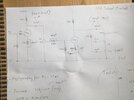
Still tweaking (aren't we all ;-) ) but below is the schematic of the preamp as of today (tomorrow might be a different thing ;-) ).
I hope that it's readable.
The circuit has most of the classic Marshall values, and where they differ it's mostly me trying to compensate for the plate driven tonestack as well as for the lack of a cathode follower.
Eventhough the sound/feel of an overdriven cathode follower can't be replaced I've tried the following.
- V1a plate resistor=220k which results in "more gain"
- V1b cathode resistor= Tried 620 ohm - 680 ohm, and even though it did produce more crunch and compression it also added a bit of mush. Settled for the classic 820 ohm
- Regarding the tonestack I've changed the caps in order to create more of the traditional Marshall tonestack sound, despite the fact that this tonestack is plate driven. Will probably swap the mid pot for a 50k one.
What isn't shown in the schematic is my resonance control (1M/4.7nF) instead of the tilt control.
The presence control now has a 0.68uF cap for added grit.
The amp doesn't have that much gain but it sounds a million times better than the stock Origin which is a super weird circuit indeed.
Still Tweaking
Haven’t got the slightest clue about how V2 is set up as I haven’t touched it.I realize that there's no reason to add more gain or gain stages....
It's all in the input sensitivity, and really has nothing to do with gain.
After the first 2 stages (V1a V1b) there "is" no more gain, because you have run out of power supply voltage.
V2a increases the overall sensitivity, but does not add any gain.
V2a saturates grid of V2b.
V2b is a cathode follower which only subtracts gain.
In other words,
the output of V2 is always less gain than the input of V2.
V2 is a compression stage not a gain stage.
Higher sensitivity yes, but lower gain output. V2 cannot add gain because there is no more voltage in the power supply to increase the gain.
Think of it this way:
Imagine a rack mount compressor limiter.
Turn the input of the compressor all the way up...this increases the input sensitivity to max.
Now turn the output level of the compressor down, so that the output is less than the original input.
You have created high sensitivity, low gain.
And that is exactly what V2 does.
It increases the sensitivity...
but subtracts gain.

Haven’t got the slightest clue about how V2 is set up as I haven’t touched it.
It’s in use for the loop, and I don’t trust that hand written schematic of the 20w version a bit as it’s turned out to be wrong in so many ways.
Do you by "V2" mean the phase inverter? (The signal flow is: V1a - V1b - Tonestack - loop (if engaged) - Phase Inverter etc)
I think what I'm saying is adding more and more gain stages isn't providing the result that you would hope for.Haven’t got the slightest clue about how V2 is set up as I haven’t touched it.
It’s in use for the loop, and I don’t trust that hand written schematic of the 20w version a bit as it’s turned out to be wrong in so many ways.
Do you by "V2" (in this amp) mean the phase inverter? There is no cathode follower in this circuit.
The signal flow is: V1a - V1b - Tonestack - loop (if engaged) - Phase Inverter etc
Or maybe you were discussing, in general, what V2 does if set up as a cathode follower?
I really didn't get how it related to my mod of the Origin 50.
Yes I know, that but at this stage I'm not doing this.One of the things the Headfirst Mod does is repurpose V2 from acting as a buffer for the FX Loop and turns it into an extra gain stage
I agree that "more gain" necessarily isn't the best thing.I think what I'm saying is adding more and more gain stages isn't providing the result that you would hope for.
The guitar player wants: more sensitivity.
But it's not actually anything to do with adding more gain.
Sensitivity and gain are 2 different things. They are not the same thing.
And until we seperate sensitivity and gain....thinking of them as 2 separate functions; we will not make much progress.

Not that I know if anyone is interested, but today I had the opportunity to play my amp really loud and by doing that I could decide the final tweaks.
(There are some question marks in my schematic a few posts up)
- Coupling cap/V1a: Decided to stick with 4.7nF. A nice balance between full and tight
- V1b stays 820r/0.68uF but I’ll switch a Fat Cap in/out with the push/pull gainpot.
- Treble cap/tone stack: Went for 250pF as I didn’t like the added (harsh) high mids produced by larger values.
- Mid pot: Will change the 25k for a 50k.
- Decided to keep the 0.68nF presence cap.
Apart from this the amp is as the schematic above.
Killer some sounding “Old School” amp

:dood::dood::dood::dood::dood:This amp spent three days running while out on loan to local studio. Zero issues....the engineer and producer both told me, "It has more than twice the gain and it is both louder and quieter than our Mike Morin Modded JCM800 2204..."
What I like about his tone in the first 45 seconds of this video is how articulate it sounds, while still providing a very dynamic harmonic.
The Marshall cathode follower circuit increases sensitivity and subtracts gain.I agree that "more gain" necessarily isn't the best thing.
I've always preferred 3 gain stages over 4, and this "2 gain stages mod" that I'm working on right now actually sounds great and is very touch sensitive!
I'll probably end up modding this into a "lower gain 3 gain stages with cathode follower amp" at some point in the future.
Why not something a little bit like a Super Bass
The Marshall cathode follower circuit increases sensitivity and subtracts gain.
Like a compressor (that's really what it is).
The output gain of the Marshall cathode follower circuit is always less than the input. The circuit does not add any gain.
And if you do not believe this, hook up your scope and see for yourself.
The Marshall cathode follower is the perfect example of higher sensitivity, lower gain.
The cathode follower output is always less gain than the input gain.
It is a rather primitive compressor.
But showing once again that gain and sensitivity are 2 different things.