440 volts at idle 360 volts at full output does not indicate sag.
It indicates that the voltage drops when the load increases (ohms law).
This is normal for any guitar amp, despite if the power supply is stiff or not.
When they say "stiff,"
they are taking about 50uF filter caps VS 20 uF filter caps, etc...
The 20uF would have more sag, the 50uF would have less.
The 50uF stores more energy for a longer period of time. Therefore is more stiff than 20uF.
If you are going to measure stiff VS sag...
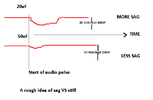
you need to look at the spontaneous voltage drop on a given fast pulse of audio.
(probably using a time base storage scope...) you would see the voltage sink, then rise up[ again upon a given fast pulse of audio.
And this would be stored as a horizontal / vertical graphic recording, VS time.
Not idle VS full power.
Generally, bigger filter caps are used to reduce the amount of hum from the power supply.
20uF will have a lot more hum than 50uF.
100uF would have less hum than 50uF...
and as the filter caps increase the power supply becomes more stiff. (sinks less fast on a given pulse of audio) but still sinks.
So, what filter cap configuration does the amp use?
We don't know, no schematics. (unless your gonna draw one)
So look at voltage drop VS time on a pulse input, if you want to see stiff VS sag.
(since you have no time reference on a pulse, you can't see stiff VS sag)
View attachment 74868
A Hi Fi amp would have big capacitors...because they try to stop the sag a much as possible.
They want the voltage to stay constant, upon a pulse of audio.
But the smaller the capacitor, the more hum in the audio...so more sag usually means more hum too.
It's going to be a compromise, between hum which is not desirable...and sag which is desirable in a guitar amp.
Without sag in a guitar amp, the sound is sterile and bland.
Human ears: like the sag.