Birds Incoming!!

Lots of cool info on using a spray gun. Thanks, shreddy!

What would be the minimum performance standards for an air compressor, if you were to spray a guitar or even some furniture?
The video shreddy poster said at minimum, a sustained 40 psi. Larger tanks are a better in this regard, as you probably know
 
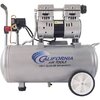
I have a California Air Tools 8010: 8 gallons, 1 HP motor... Do you think it's too small to maintain proper pressure for enough time?

View attachment 21032
I have used this size with success. It just keeps running while you spray.

Your spray gun will have a minimum CFM rating stamped on it (cubic feet per minute). It will also have the maximum air pressure stamped on it.

If the compressor has a high enough CFM rating you will be OK .
 
RVA, I believe that the CFM should drop at a higher pressure. The compressor will have a harder time maintaining the volume of air as it tries to keep the pressure higher.
Of course, this is just me thinking out loud!
 
RVA, I believe that the CFM should drop at a higher pressure. The compressor will have a harder time maintaining the volume of air as it tries to keep the pressure higher.
Of course, this is just me thinking out loud!
I would think we are supposing a situation where the compressor could maintain the higher PSI. This would push more air/paint/product. Even the video says higher PSI means more paint/output. The reverse would be counter-intuitive. If it cannot keep up, or has specs like sysco posted, I would presume your tank and/or motor are too small.

I also am just thinking out loud. I shall now go do some real research.
 
The Relationship Between Pressure and Flow in a Compressed Air System | Compressed Air Best Practices

What is the Relationship Between Flow and Pressure?
Another little known fact about compressed air from an end user’s point of view is that discharge pressure has a direct impact on flow. In fact, we know from Boyle’s Law that:

P1 x V1 = P2 x V2

Where P1 is the initial pressure, V1 is the initial volume, P2 is the final pressure, and V2 is the final volume.

Let’s take a look at an example of how to use Boyle’s Law in a real-world scenario:

  • A plant has a 25-hp rotary screw compressor rated at 100 acfm at 100 psig.
  • However, they can only maintain 80 psig in the production area.
  • How much more compressor hp does the plant need to maintain the required 100 psig in the plant header?
Using Boyle’s Law:

100 acfm x 100 psig = (X) acfm x 80 psig

Using a little Algebra:

100 acfm x 100 psig / 80 psig = 125 acfm

125 – 100 = 25 acfm

25/4.5 = 5.5 hp (I assumed 4.5 cfm per 1 hp)

In this simple example, I would recommend adding a 7.5-hp compressor to the system to add volume, which will stabilize the discharge pressure to the desired level.
 
Understanding relationship between air pressure and flow

“Pressure” and “flow” are common terms when discussing air compressors, but the relationship between the two is often misunderstood.

Pressure, typically measured in psi, determines an air compressor’s ability to perform a certain amount of work at any given point in time. Consider an application as simple as sliding a wooden block across a table with compressed air. In this application, 75 psi (5.2 bar) of air might not deliver enough force to move the block, but 100 psi (6.9 bar) would.


At a minimum, the compressor must provide the pressure (force) needed to perform the job. If the minimum pressure required is 100 psi but the compressor can’t provide it, the job won’t get done. However, too much pressure can damage compressed air equipment or cause it to operate erratically. Each pneumatically powered device has a stated pressure range in which it works reliably, and these limits must not be exceeded.

Flow is the ability of an air compressor to continuously perform a task. In the U.S., flow is typically measured in cubic feet per minute (cfm) at a specific pressure. The amount of flow depends on the length of time needed to complete the task.

For example, if you only had to move the previously mentioned block a short distance every hour, a small compressor with a compressed-air storage tank would be suitable. The compressor would refill the tank, storing the air until the next time it was needed to move the block. However, if the process required the block to continuously move during a 24-hour period, a larger compressor with continuous flow would be needed.

Insufficient flow will require breaks to be taken during the process while the compressor builds up pressure in a reserve air tank. Frequent breaks to let pressure build or pressure that builds slowly indicates that air may be leaking from the compressed air system.

Pressure is determined by the job being performed. For instance, spraying paint requires significantly less pressure than bottle blowing. Flow is determined by how many of these jobs must be performed simultaneously or how often they must be performed.

For a given compressor, such as a 50-hp (37.3kW) one, flow will decrease as pressure increases, and vice versa. Therefore, it’s important to purchase a compressor that optimizes flow and pressure.

And keep in mind that every 2 psi (0.14 bar) increase in pressure results in 1 percent more energy needed to maintain the same airflow (cfm).
 
HEy Raybert----you know they sell this stuff right?
paint_template-1


;) smile Ray---- (if I could get you on Candid Camera -- I WOULD!)
 
I have a California Air Tools 8010: 8 gallons, 1 HP motor... Do you think it's too small to maintain proper pressure for enough time?

View attachment 21032

I would also ponder buying a small touch up gun to use your 1 hp compressor. After all, we are talking enough paint/clear to cover a guitar body not a whole car.
Worst is you'd have to refill your cup a few times and let your compressor recharge itself. But I can't see this happening too often in laying down enough to coat your guitar body.
 
I would think we are supposing a situation where the compressor could maintain the higher PSI. This would push more air/paint/product. Even the video says higher PSI means more paint/output. The reverse would be counter-intuitive. If it cannot keep up, or has specs like sysco posted, I would presume your tank and/or motor are too small.

I also am just thinking out loud. I shall now go do some real research.

Also, the more paint more output portion of this statement can also translate to more over spray/more wasted material.
 
Back
Top