Ok, I want to present a few questions and open up a general discussion about this topic. I'm doing some real fine tuning on my Double Neck and I want to be sure I'm not missing anything.
Originally, I was using a standard ABR-1 style bridge. I recently switched to a roller bridge from Philadelphia Luthier Tools, a bridge I have used multiple times on other guitars. It comes pre-adjusted and this will usually get you in the ballpark on most guitars.
Here is the one that I installed on my Mom's Les Paul Custom Replica and it required no adjustment to be properly intonated: (sharp eyes will notice the 'A' sting is not in the roller groove in this photo)
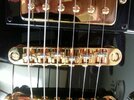
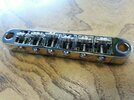
The one I installed on my doubleneck was set in about the same "lightning bolt" arrangement as shown below:
So I have now played through several sets of strings on this guitar. Each time I change strings, I make sure the floor of the nut is square, smooth & clean before restringing. The intonation was really close just by dropping the bridge on and only a minor adjustment was needed.
Recently, I felt like the guitar just wasn't correctly intonated, so I started checking it. I found that I had some slight intonation anomalies where the pitch was a little off at certain positions, even though if anyone else would have strobed the guitar, they would have called it good.
I could hear a pitch difference between the open and fretted notes that even my Korg Pitchblack (on the strobe setting) wasn't picking up.
So, I swapped strings (Sticking with EB .010's) and tuned everything up.
When I intonate, I look for the 12th fret harmonic (naturally) but I then check intonation on that string at 1st, 3rd, 5th, 7th and 9th frets to see where they are at. As one might expect, when the 12th was spot-on, there were some issues with the fretted note on the "lower frets" not being quite right, so I started making some adjustments.
When I was finished, I noticed I had moved the E/A/D saddles quite a bit from where they were originally, which surprised me, because I had been playing and recording with this guitar in that condition.
Here's what the bridge looks like now:
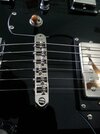
Now, I am not trippin' out on the lateral arrangement of the saddles and neither do I expect every guitar to have identical saddle position, but rather I am trying to sort this out in my head.
Now, the intonation is improved everywhere along the neck. G/b/e are spot-on at every fret checked, even the 12th.
E/A/D are on the money at 1st, 3rd, 5th. 7th & 9th, with a slight variation at the 12th fret.
Barre chords are in tune all the way to the 14th fret. Open chords are in tune at all positions.
Good job, right???
Not exactly...
I keep fighting this "sitar-ish" jangle mostly on my D and G strings. It' seems to go away as the strings age, but it's downright irritating when you put on a new set.
So, I relaxed the strings and examined the nut slots. Everything looked good. No "Pinking" when tuning up or down. I even swiped the floor of each slot with my gauged welding tip cleaners just to be sure the floor was flat. The strings are also marking the nut all the way across the floor and 1st fret clearance is .015" to .020" respectively.
Here's where the questions begin:
This old gentleman Luthier I ran into up at The Ranch this weekend were discussing this, because I been fighting the "jangling" G string for a while on more than one guitar. He suggested this was an intonation anomaly!!!!
So I asked him to explain. He claimed that there are more then one point, in a bridge saddle's travel, where the open pitch 12th fret pitch will be similar, but only one "sweet spot" in the saddle's travel where it is precisely dead-on.
WTF???
So, I wrestled with this in my had most of the drive home last night and I just cannot accept this theory (as of yet) because to my mind, intonation is a product of mathematics and it can only be "correct" in one position in the saddle's range of movement.
So, I wanted to open this up to discussion and ask your opinions on the topic. To make things a little more focused, I would like to ask these questions specifically:
1. Is there more than one place in a bridge saddle's range of motion where intonation can be correct???
2. What is causing this jangling d/G string anomaly that I thought was cured by dressing the floor of the nut slots???
Thanks.....
Originally, I was using a standard ABR-1 style bridge. I recently switched to a roller bridge from Philadelphia Luthier Tools, a bridge I have used multiple times on other guitars. It comes pre-adjusted and this will usually get you in the ballpark on most guitars.
Here is the one that I installed on my Mom's Les Paul Custom Replica and it required no adjustment to be properly intonated: (sharp eyes will notice the 'A' sting is not in the roller groove in this photo)
The one I installed on my doubleneck was set in about the same "lightning bolt" arrangement as shown below:
So I have now played through several sets of strings on this guitar. Each time I change strings, I make sure the floor of the nut is square, smooth & clean before restringing. The intonation was really close just by dropping the bridge on and only a minor adjustment was needed.
Recently, I felt like the guitar just wasn't correctly intonated, so I started checking it. I found that I had some slight intonation anomalies where the pitch was a little off at certain positions, even though if anyone else would have strobed the guitar, they would have called it good.
I could hear a pitch difference between the open and fretted notes that even my Korg Pitchblack (on the strobe setting) wasn't picking up.
So, I swapped strings (Sticking with EB .010's) and tuned everything up.
When I intonate, I look for the 12th fret harmonic (naturally) but I then check intonation on that string at 1st, 3rd, 5th, 7th and 9th frets to see where they are at. As one might expect, when the 12th was spot-on, there were some issues with the fretted note on the "lower frets" not being quite right, so I started making some adjustments.
When I was finished, I noticed I had moved the E/A/D saddles quite a bit from where they were originally, which surprised me, because I had been playing and recording with this guitar in that condition.
Here's what the bridge looks like now:
Now, I am not trippin' out on the lateral arrangement of the saddles and neither do I expect every guitar to have identical saddle position, but rather I am trying to sort this out in my head.
Now, the intonation is improved everywhere along the neck. G/b/e are spot-on at every fret checked, even the 12th.
E/A/D are on the money at 1st, 3rd, 5th. 7th & 9th, with a slight variation at the 12th fret.
Barre chords are in tune all the way to the 14th fret. Open chords are in tune at all positions.
Good job, right???
Not exactly...
I keep fighting this "sitar-ish" jangle mostly on my D and G strings. It' seems to go away as the strings age, but it's downright irritating when you put on a new set.
So, I relaxed the strings and examined the nut slots. Everything looked good. No "Pinking" when tuning up or down. I even swiped the floor of each slot with my gauged welding tip cleaners just to be sure the floor was flat. The strings are also marking the nut all the way across the floor and 1st fret clearance is .015" to .020" respectively.
Here's where the questions begin:
This old gentleman Luthier I ran into up at The Ranch this weekend were discussing this, because I been fighting the "jangling" G string for a while on more than one guitar. He suggested this was an intonation anomaly!!!!
So I asked him to explain. He claimed that there are more then one point, in a bridge saddle's travel, where the open pitch 12th fret pitch will be similar, but only one "sweet spot" in the saddle's travel where it is precisely dead-on.
WTF???
So, I wrestled with this in my had most of the drive home last night and I just cannot accept this theory (as of yet) because to my mind, intonation is a product of mathematics and it can only be "correct" in one position in the saddle's range of movement.
So, I wanted to open this up to discussion and ask your opinions on the topic. To make things a little more focused, I would like to ask these questions specifically:
1. Is there more than one place in a bridge saddle's range of motion where intonation can be correct???
2. What is causing this jangling d/G string anomaly that I thought was cured by dressing the floor of the nut slots???
Thanks.....
Last edited: