OK, let's get back to the idea of 'side chaining'. First off, what does that even mean, and why should we want to do it? Normally, if you put a noise gate in a signal chain, when it opens and closes is dictated by the source. For instance, if we've got an electric guitar with a shed load of ditortion and overdrive, we might use a noise gate at the end of the chain to cut out all the noise in between notes. Of course, we need to be careful with our settings, or we'll get the tail end of notes cutting off suddenly, instead of decaying naturally. But, providing we are careful, it's a perfectly useful way of reducing noise.
When we 'side chain', we use a signal other than the source to trigger the gate.
Let's look at a couple of examples to help us understand why we might want to do that. Radio DJs often rely on something they call 'line ducking'. What they're actually doing is side chaining a gate, but using it to 'duck' – in other words, reduce the level – of the music when the DJ is talking. So the gate in in the signal chain of the music, but it's side-chained to the DJ's mic channel. The Threshold is set so that the gate is triggered when the DJ speaks, and the Reduction is set to just enough for the DJ to be hear clearly over the music.
As another example, imagine some one is playing long, sustained chords on a keyboard over an up-tempo track. The result is probably going to sound a bit dull, but we could create exiting rhythmic patterns by gating the keys and triggering the gate by side chaining it from, say, the hi-hat. You'll find that trick all over dance music, and now you know how it's done, you'll spot it everywhere.
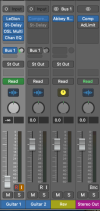
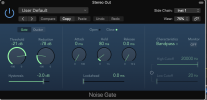
Looking at my screen shot, you'll see my gate is side chained from 'Inst 1'. No prizes for guessing that's my drum track, because that's all there is on my little example recording. So why would I do that, rather than leave the source as the drums through the main signal chain. Well, if you experiment with this, you'll find you can't get tight, aggressive gating if the gate is triggered after reverb and room simulation has been applied. That because the extended reflections of the reverb keep the gate open. But if you use the dry, source drums as the side chain trigger, you can get the gate to slam shut really quickly. Gated reverb on snares was a staple sound of the 1980s, when digital reverb became part of mainstream music production.
This track contains a number of subtle variations on the same idea. In fact, it was hanging around with producer Tony Mansfield and engineer Pete Hammond that helped me to get my production chops together. This track was reorded on analogue, with no MIDI and no console automation: