Would anyone like to know more about…?

simoncroft

Well-Known Member
Country flag
…any particular aspect of recording and mixing? As a retired technology writer who's happy to provide tutorial material as long as it helps others, I'm inviting you to tell me if there are any topics you'd like to know more about. For instance, there's a lot of confusion about how to go about applying EQ to each track in a mix. Or did you wonder how to get a really big vocal sound? Or the gated snare that was so popular in the 1980s?

I first worked in pro audio in 1979, and I got the gig because I already knew a fair bit about PAs and mics. Later on, I got to hang out with, and learn, from some of the best engineers in the business, so there's a lot I'm happy to share. After all, it's how I learned, so it's time to give some back.
 
Yes sir. Lets talk from capture being done. What is the next step in mixing it all?

My captures are pretty level & decent from studio session prep & PA set up & band experience but from here on out is a wild ride for me once the recording is done. Its there, its level but want to try & get the best it can be,
 
OK, great. Let me say this back to you, so I can be sure we're talking about the same thing. You've got all the individual parts recorded for the song, the levels are good and you're happy with the performances. What you want to know is the best way to go about the mix, in terms of process, how you organise the project, the most logical order in which to do things, how to use EQ and pan to get the clearest mix, and what plug-ins are likely to help on what. Is that about it?
 
Two of the engineers I learned most from were Pete Hammond https://www.discogs.com/artist/34067-Pete-Hammond and André Jacquemin André Jacquemin: Monty Python's Maestro on Every Sperm Is Sacred and Brian Song. Something they both instilled in me was: be methodical and consistent in the way you organise you work. This was back in the days of analogue tape and enormous mixing consoles, but a lot of the same things apply.

For instance, it's just as important to give the WAV files that make up your project meaningful names and it was to fill out track-sheets, showing what parts were recorded on the multitrack tape, for each song. Otherwise, if you come back to the project later – or you need to send the files to someone else to be mixed – it will take you a lot longer to work out what-was-what if they have meaningless idents the DAW has generated, rather than 'Kick Drum', 'Snare', or whatever.

Similarly, if you receive someone else's project for mixing, and none of the files are properly identified, it can be a frustrating start!

Here's an extreme example. I used to put together on-line Blues jam, whereby you sent me your solo and I'd include it in the audio compilation, which went with the video. Can you imagine how much harder it is when a few out of 15 guitarists don't floow the instructions and forget to include a count-in, so you have to guess where their notes sit against the backing track? :oops: :oops: :oops:

 
OK, great. Let me say this back to you, so I can be sure we're talking about the same thing. You've got all the individual parts recorded for the song, the levels are good and you're happy with the performances. What you want to know is the best way to go about the mix, in terms of process, how you organise the project, the most logical order in which to do things, how to use EQ and pan to get the clearest mix, and what plug-ins are likely to help on what. Is that about it?
Exactly. Spend a loot of time before i hit record. Getting the tone i want first for the song. usually involves massive a/b guitar/amp./spreaker comparison till i have my mix layer right for the song.

Things go into reaper, roughly around -18 range & pretty well balanced
 
** Gotcha. I'll try to make this more Reaper orientated from here on it. I'd almost finished the post below when your's came in.**

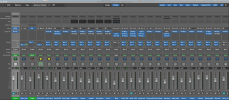
However, the above doesn't in itself solve a couple of related organisational problens: 1) More tracks = more mixer channels, to the point it's starting to look like the never-ending controls from the cockpit in the classic comedy movie Airplane, 2) The drums alone are taking up nine channels, which is a lot of faders to move if you decide the drums need to be louder, for instance.

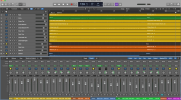
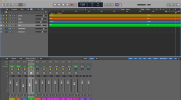
Logic offers a facility called 'Stacks', whereby selected tracks can be grouped together, with the option of a master fader for that Stack (which I always use, because we now have one fader for the drums if we decide they whole kit it too quiet/loud). Not only does this heirarchy make fine-tuning the final mix a lot easier, it drastically reduces the amount of real estate taken up by the mixer when the Stacks are closed.

** There is bound to be a similar feature in Reaper, so I'll look to see what it is.**

SV Stacks.png
 
My Reaper is very well organized & color coded & all basically sitting there . I have Abbey Road suite, Tracks5 & prob a bunch of other stuff like Amplitude. I favor non coloring plugins cause i put the time int the capture so it can be played that way again. I use GAP 73 JoeMeek 6Q pre's

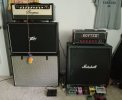
1 watt repr o (2).jpg
 
See ya in a few hours, Reaper set up.. with all this new knowledge & inspiration got to see if i can capture something gooder,,,had killer drum idea & got it translated with EZ2. All my tracks color coded,, its vass time !!!... have no clue for lyrics but will happen prob around 6 pm lol might try plug in mania for a change
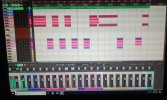
reap 1 (2).jpg
 
…any particular aspect of recording and mixing? As a retired technology writer who's happy to provide tutorial material as long as it helps others, I'm inviting you to tell me if there are any topics you'd like to know more about. For instance, there's a lot of confusion about how to go about applying EQ to each track in a mix. Or did you wonder how to get a really big vocal sound? Or the gated snare that was so popular in the 1980s?

I first worked in pro audio in 1979, and I got the gig because I already knew a fair bit about PAs and mics. Later on, I got to hang out with, and learn, from some of the best engineers in the business, so there's a lot I'm happy to share. After all, it's how I learned, so it's time to give some back.
This is a super nice thing!!!!
As a left handed person, I have difficulty presenting what some would consider detailed instructions. I can do plenty of things, and learn quickly. I am happy to RTFM…some of them are quite entertaining…looking at you Mackie ;) …But telling someone exactly how to do it is apparently quite a chore for me.

That said…Thank you sir! I’m absolutely ecstatic to see this generosity.
:cheers:
 
I can’t wait to get to mixing levels.
Like, what should be louder than what.
I’ve had some good advice from people. I’m sure there is some kind of “this is how it’s done” rule or guideline
 
Back
Top