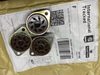
I agree with you regarding the protection diodes. If you look back through threads where I've shown my tube rectified builds, none of them have any protection diodes. I do use old production GZ34's though, I've had a few new production types fail, always at start-up. I think the whole "protection diode" thing grew out of people experiencing new production GZ34 failures. Then one person mounted the protection diodes on the socket, then the rest of the sheep followed. Hell, I've even seen disk caps in parallel with the diodes mounted on the socket, more bad practice.
How does a (new production) GZ34 fail (other new production types don't seem to)??? The GZ34 drops less voltage across it than other rectifier tubes as it has lower internal resistance. The reason for this is that the plates are very closely spaced to the cathodes. In old production types, to prevent cathode overheating (& arc over) due to filter in-rush current demands, the cathode material gets thicker down its length, being thickest at the base where it is tied to the pin. Destructive testing shows that new production types do not replicate this feature, nor is the cathode material as thick as old production types at the base of the cathode.
Considering that a JTM45/JTM50's calculated filter capacitor inrush current is in the order of 40A for a micro-second (calculated for me by Kevin O'Connor), we can see why new production GZ34's sometime arc over (plate/cathode) at power-up.
If we look at some old power supply's using GZ34's (Hammond organs for example) we sometimes see a small value resistance placed between the power transformer high voltage secondary leads & rectifier plate pins, say 47 ohm 5watt, or between pin 8 & the main filter (usually 10 watt). The purpose of these is to limit filter inrush current at power up. Of course, they will increase HT sag under demand a little too.
Sorry for the long rant. Cheers


?