Tube Amp Reliability

Adrian, a buddy who is now passed away used to play a Boogie like you say. I can't remember which model it was, but he basically took the amp part out of his combo and to make his load lighter when gigging, he would carry the speaker in one hand and a head cab he installed the amp part in with the other.

I am thinking his was a Mark 2 or Mark 3 but don't quote me on that, as I only mentioned it once to him before he passed away.
 
The Marshall or the Laney? Robert

No, my Marshall is not screwed up. Since I fixed it last year with great help from DonP, Ivan, Nick at the Marshall forum, 67, Smitty, Relic. But my Laney still needs the mouse damage fixed.

Here is a bad ass Laney Demo for a 100 watt version of my AOR 50 watt type. Great metal type amps in my opinion.

 
Im loving that crap outta the thing ---- Damn Hackmasters ruined me for all other amps-----and saved the interwebs from FLIPPER FODDER!
I bet the used amp market has taken a real hit of late in Central Fl. !!!!
 
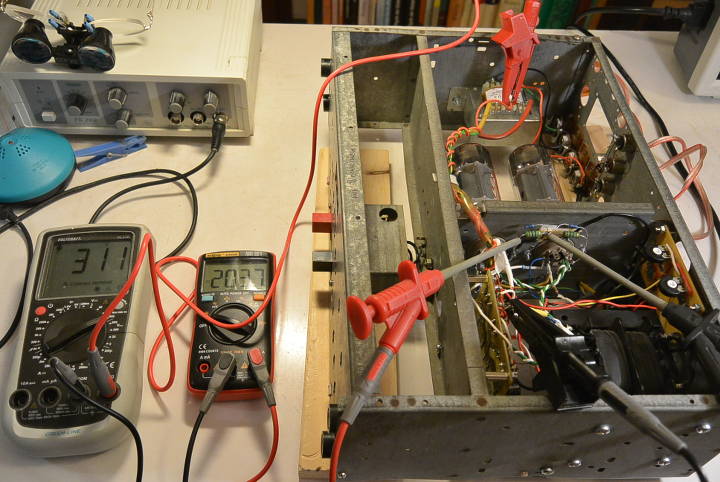
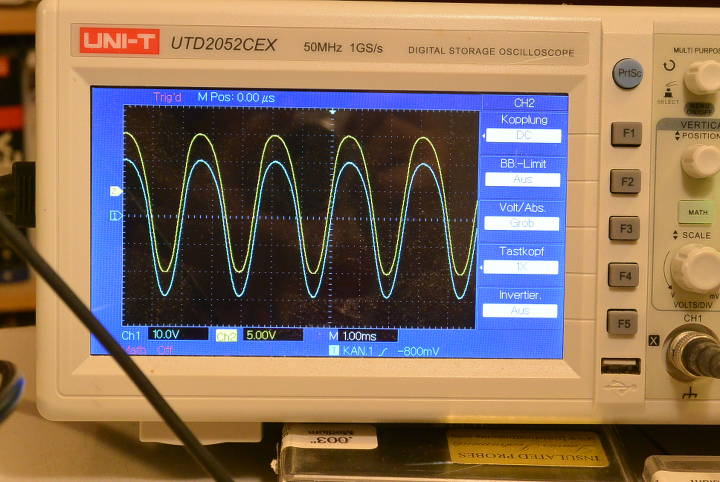
Mhmm, my current project -
--- has a problem with the phase splitter which clips too early.
The power tubes run - here with a fairly small idle current of 20 mA. Thats my first fully self designed and self built amp - up to now i have only modified and repaired/restored tube amps.

DSC_3928.JPG
 
--- has a problem with the phase splitter which clips too early.
The power tubes run - here with a fairly small idle current of 20 mA. Thats my first fully self designed and self built amp - up to now i have only modified and repaired/restored tube amps.

DSC_3928.JPG


Bea, Run this by Ivan and DonP, they are super smart about circuit design and specs that will yield the results you are seeking and or spot the reason or component that is causing your early breakup behaviour.
 
Bea, Run this by Ivan and DonP, they are super smart about circuit design and specs that will yield the results you are seeking and or spot the reason or component that is causing your early breakup behaviour.
Thanks for the compliment Chilli.
The cathodyne type phase inverter has some good points, one being that it is better balanced than a long tail pair, though it has less output. It does NOT like to be overdriven, which causes it to produce some odd artefacts. Try sticking a large value grid stopper resistor at the input of the cathodyne phase inverter (at least 100k. The cathodyne has very low Miller capacitance so you won't roll off highs).
Valve Wizard goes into good detail on designing a cathodyne phase inverter on his sight. Just do a google search for "cathodyne phase inverter valve wizard" & you'll find it. Hope this helps. Cheers
Edit: Though this type phase inverter doesn't like to be overdriven, it can be used to overdrive the power stage. If you want it to do this, stick another gain stage between each half of the cathodyne & it's corresponding power tube. Cheers
 
Last edited:
Valve Wizard goes into good detail
... yes, his books are in my bookshelves, among a few others (Schröder, elektrische Nachrichtentechnik, going even deeper than Blencowe).

But it is too tempting to mostly optimise a circuitry in trial and error once You have LTspice at hand ... but this situation it seems better to go the traditional way to draw the loadlines.

BTW: the problem was also visible in spice, (due to the limitations of the valve models) just at voltages large enough to disappear on the output, especially under NFB.
 
Bea, Is LTSpice a program/diagnostic tool aide? Also forgive me, what does "draw the load lines mean?

As I was learning from our gang, amp and electronics books and computer videos/articles/how to's, I bought some good equipment like my Hakko soldering station, oscilloscope, variac, various multimeters, an ESR tester, power supply and a few other good tools. Plus I have watched countless hours of guys like this fella.


I may have gotten a late start at learning at age 53, but in so doing, I also gained the technological resources afforded to us via the web and the perks of being able to learn from folks like Mr Carlson, you, Iven etc. Very satisfying too.
 
Last edited:
You have al lot more equipment than you need, at least for a start. I am working with two or three multimeters in order to control the voltages (for some of my amps i need a range up to 1000 V) or to measure the resistances (as reading the color codes of modern metal film resistors is a pain in the ass). I have one two channel scope and sometimes wish to have a third channel. And i have one simple tone generator.

LTSpice is a free but powerful circuit simulator. Available for Mac and Windows, the latter runs fine in WINE on every platform supported by that. You need additional model libraries for some parts, especially the tubes, but also a potentiometer.

"draw the load lines" means the old fashioned graphical analysis of (not only) tube circuits using their data sheets.
 
Bea, Thanks. Yes I know about the amount of equipment for what I needed. I certainly didn't acquire it all just to do my initial diagnosis. I mostly got some of it to be able to learn the equipment for future projects and also for other possible related uses like car diagnosing, HVAC repairs, and other electronics needs that may come my way.

For my start, I began with my 2 Identical Multimeters, Chopsticks, a home made discharge tool, a good lighted magnifying visor headset, and a tone generator made from a battery powered Radio Shack Mini Audio Amplifier

02771008_01_b692128a-b018-4ebb-a31f-6dff13efdf37_450x.jpg


Also, since my amplifier was nearing 45 years old at the time, I felt that being able to test leakage of capacitors that weren't already replaced was vital, so I got an ESR tester.

So armed with basically those tools and help from our forum members and my own study, I was able to put the amp in a mostly 100% factory condition. I say mostly because as I later found out, I had things seemingly tip top shape and all seemed a go in making good sound in all 4 inputs of the amp. Then one day, the intermittent loss of signal cropped up again. This was when the simple chopstick did it's job. I tapped everywhere inside the amp and got no sound or changes. Then I proceeded to the back of the amp and was tapping things in the fuse holders, Ohms selector and voltage selector etc. This is when I thankfully discovered how to make the signal resume and cut out in a repeatable occurrence. Turns out the brass female ferrules inside the Ohms selector socket had weakened so the male plug in cap was wiggly and loose. The wiggling made it lose contact or resume contact if set just so. When I saw it lose sound, I deduced this was likely the original source of my whole reason for servicing the amp. To correct this, I disassembled the socket and ever so carefully squeezed the ferrules tight enough to permit a snug fit, then did the same for the voltage socket.

Thanks for also answering about the LTSpice. I will look into that.
 
... yes, his books are in my bookshelves, among a few others (Schröder, elektrische Nachrichtentechnik, going even deeper than Blencowe).
Another very worthwhile publication is The Radiotron Designers Handbook (forth edition) by (Aussie) F Langford Smith. Considered by many to be the tube "Bible". It's out of print though can be downloaded. It is almost 1500 pages though. Fritz Langford Smith did a lot of work in the communications field in Britian & here in Oz. Cheers
 
Back
Top