
You are using an out of date browser. It may not display this or other websites correctly.
You should upgrade or use an alternative browser.
You should upgrade or use an alternative browser.
TTR tube amp gurus: please help!
- Thread starter jtcnj
- Start date


syscokid
Ambassador of War & Peace

jtcnj's amp is running way too hot of power tube dissipation according to his calculations of his cathode biased amp. That definitely needs to be addressed before any further preamp tube tweaking is involved.Wouldn't it be a whole lot easier to put a 5751 in V1?

ivan H
Ambassador of Tubes & Grooves

Sorry I had not seen this thread earlier.
I have a JCM800 micro(ish) amp, but have not experienced this problem.
I haven't yet ready the entire thread, but would like to comment on a couple of things mentioned.
Firstly, the power stage is not operating in class A, it is operating in (a hot biased) class AB1. A cathode biased output stage does not equal class A operation.
The 10k NFB (series) resistor may "seem" to be a low value, however when we consider how just low the output voltage is (roughly 2.8V on the OT's 8 ohm tap at 1W output), it becomes apparent why a low value NFB series resistor is used. Even then, the amp is not taking much feedback, evident by the presence control having little effect. The NFB is "voltage" feedback.
For comparison purposes, an amp driven to 100W output will have about 28.28V on the OT's 8 ohm tap. An amp driven to 50W output will have 20V on the OT's 8 ohm tap. Compared to this amp's 2.8V/8 ohm/1W, that is a huge difference in the NFB's source voltage, hence the low value of the NFB voltage divider's "series" resistor. The NFB voltage divider's "shunt" resistor is the 4k7 (to ground) on the presence control (also part of the PI's "tail" resistor).
Ok, to your problem.
As I said earlier, I have one of these JCM800 micro(ish) amps that doesn't seem to suffer from your problem, but, aside from circuit differences etc between yours & mine, maybe I'm not using it like you do. I usually run mine through a 4x12 loaded with V30's or a 4x12 loaded with Greenbacks.
I'm using a Classictone 40-18085 PT that I had lying around. I don't think my B+ is quite as high as yours & can't remember off the top of my head what value cathode (bias) resistor I've used on the 12AU7.
However it is common for cathode biased tubes operating in class AB to be biased hot (though not as hot as yours is). Up around 90% max dissipation is ok, maybe even more, but I'd be trying to get yours biased cooler, as Sysco has suggested.
I also have both pre & type 3 post master volumes. This allows me to turn the "pre" master up enough to overdrive the PI while setting the "post" master so that I dont blast the crap out of the 12AU7. Maybe try adding a post master.
I've not calculated the time constant/frequency roll off point with 0.022uf output couplers in this circuit, but we don't hear of people experiencing blocking distortion here.
You could try another type output tube. People report better sound (& feel) from the amp when using a 12BH7 output tube. Another choice is an ECC99, though at 5 watts per triode, this will increase output. It will require a different value cathode (bias) resistor too. Cheers
Edit:
One other thing,,, don't expect EL34 pentode type "grind" etc from a twin triode output tube. Cheers
I have a JCM800 micro(ish) amp, but have not experienced this problem.
I haven't yet ready the entire thread, but would like to comment on a couple of things mentioned.
Firstly, the power stage is not operating in class A, it is operating in (a hot biased) class AB1. A cathode biased output stage does not equal class A operation.
The 10k NFB (series) resistor may "seem" to be a low value, however when we consider how just low the output voltage is (roughly 2.8V on the OT's 8 ohm tap at 1W output), it becomes apparent why a low value NFB series resistor is used. Even then, the amp is not taking much feedback, evident by the presence control having little effect. The NFB is "voltage" feedback.
For comparison purposes, an amp driven to 100W output will have about 28.28V on the OT's 8 ohm tap. An amp driven to 50W output will have 20V on the OT's 8 ohm tap. Compared to this amp's 2.8V/8 ohm/1W, that is a huge difference in the NFB's source voltage, hence the low value of the NFB voltage divider's "series" resistor. The NFB voltage divider's "shunt" resistor is the 4k7 (to ground) on the presence control (also part of the PI's "tail" resistor).
Ok, to your problem.
As I said earlier, I have one of these JCM800 micro(ish) amps that doesn't seem to suffer from your problem, but, aside from circuit differences etc between yours & mine, maybe I'm not using it like you do. I usually run mine through a 4x12 loaded with V30's or a 4x12 loaded with Greenbacks.
I'm using a Classictone 40-18085 PT that I had lying around. I don't think my B+ is quite as high as yours & can't remember off the top of my head what value cathode (bias) resistor I've used on the 12AU7.
However it is common for cathode biased tubes operating in class AB to be biased hot (though not as hot as yours is). Up around 90% max dissipation is ok, maybe even more, but I'd be trying to get yours biased cooler, as Sysco has suggested.
I also have both pre & type 3 post master volumes. This allows me to turn the "pre" master up enough to overdrive the PI while setting the "post" master so that I dont blast the crap out of the 12AU7. Maybe try adding a post master.
I've not calculated the time constant/frequency roll off point with 0.022uf output couplers in this circuit, but we don't hear of people experiencing blocking distortion here.
You could try another type output tube. People report better sound (& feel) from the amp when using a 12BH7 output tube. Another choice is an ECC99, though at 5 watts per triode, this will increase output. It will require a different value cathode (bias) resistor too. Cheers
Edit:
One other thing,,, don't expect EL34 pentode type "grind" etc from a twin triode output tube. Cheers
Last edited:

Amp Mad Scientist
Ambassador of Heresy
"...the power stage is not operating in class A ..."Sorry I had not seen this thread earlier.
I have a JCM800 micro(ish) amp, but have not experienced this problem.
I haven't yet ready the entire thread, but would like to comment on a couple of things mentioned.
Firstly, the power stage is not operating in class A, it is operating in (a hot biased) class AB1. A cathode biased output stage does not equal class A operation.
The 10k NFB (series) resistor may "seem" to be a low value, however when we consider how just low the output voltage is (roughly 2.8V on the OT's 8 ohm tap at 1W output), it becomes apparent why a low value NFB series resistor is used. Even then, the amp is not taking much feedback, evident by the presence control having little effect. The NFB is "voltage" feedback.
For comparison purposes, an amp driven to 100W output will have about 28.28V on the OT's 8 ohm tap. An amp driven to 50W output will have 20V on the OT's 8 ohm tap. Compared to this amp's 2.8V/8 ohm/1W, that is a huge difference in the NFB's source voltage, hence the low value of the NFB voltage divider's "series" resistor. The NFB voltage divider's "shunt" resistor is the 4k7 (to ground) on the presence control (also part of the PI's "tail" resistor).
Ok, to your problem.
As I said earlier, I have one of these JCM800 micro(ish) amps that doesn't seem to suffer from your problem, but, aside from circuit differences etc between yours & mine, maybe I'm not using it like you do. I usually run mine through a 4x12 loaded with V30's or a 4x12 loaded with Greenbacks.
I'm using a Classictone 40-18085 PT that I had lying around. I don't think my B+ is quite as high as yours & can't remember off the top of my head what value cathode (bias) resistor I've used on the 12AU7.
However it is common for cathode biased tubes operating in class AB to be biased hot (though not as hot as yours is). Up around 90% max dissipation is ok, maybe even more, but I'd be trying to get yours biased cooler, as Sysco has suggested.
I also have both pre & type 3 post master volumes. This allows me to turn the "pre" master up enough to overdrive the PI while setting the "post" master so that I dont blast the crap out of the 12AU7. Maybe try adding a post master.
I've not calculated the time constant/frequency roll off point with 0.022uf output couplers in this circuit, but we don't hear of people experiencing blocking distortion here.
You could try another type output tube. People report better sound (& feel) from the amp when using a 12BH7 output tube. Another choice is an ECC99, though at 5 watts per triode, this will increase output. It will require a different value cathode (bias) resistor too. Cheers
Edit:
One other thing,,, don't expect EL34 pentode type "grind" etc from a twin triode output tube. Cheers
This is a class A output stage.
When the output operates constantly between 90-100%, it's class A.
That is the dictionary definition of Class A.
True, if the power tube is over 100%, then you do need to fix that...
If you bias a Class A amp colder (less than 90%), you get a lot of cross over distortion.
The colder it is, the more cross over distortion you will hear.
This type of distortion is not desirable. (it's fizz)
So, 90% would be correct, up to 100%.
A post master volume will only make this amp sound even mud-dier.
Try it.
Taking out the master will make it sound better. Try it.
These type of master volume controls only reduce the headroom. There is no master volume which makes an amp sound cleaner.
You "can" use a different output tube...
But it will not increase any wattage.
The power supply has a limit, and a different tube does not change the limit.
The output transformer also has a limit. It is not designed for more wattage.
"Dark and muddy..."
not surprised, look at the design.
Some of it could be re-designed to make it brighter, I can see that much.
Amp Mad Scientist
Ambassador of Heresy
View attachment 72026
My voltages are close to this; my 12au7 plate is around 391 (I dont have my notes here) using a 1k cathode resistor.
The text in the drawing is small, the power node voltages before the plate resistors from left to right are 335v, 335v, 350v, and 360v for the PI.
I will fill out and post a similar voltage form later from home
Are the output tubes red plating?
If the tubes are running so much power they would be red plating right now.
If the tubes were running way beyond 100%, then they would most certainly be red plating.
If the tubes are not red plating, then it is possible that there is a mistake in the power measurement.
How exactly, did you make this power measurement?
2.
The lack of high frequency is probably the 2 grid stopper resistors, 470K.
I think these resistors should have probably been bypassed by a small cap.
3. The schematic already shows a trainwreck PPI master volume...
(the 1MA pot)
But I think I would take that out for starters.
Last edited:
OP

jtcnj
Ambassador of the Crossroad
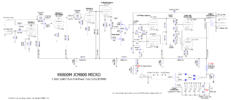
Sorry for the confusion on the schematic. I posted that version because it included voltages.
The later design MV is pre-phase inverter.
The circuit in my build is below, with the following changes.
I omitted the Lo input, splicing what would have been the Lo input tip and switch, cascading v1a and v1b as the Hi input normally would.
I used a single output jack; OT wired for 8Ω into a 25w, 8Ω WGS Green Beret 12" speaker.
Where there are 470pf caps shown I used 500pf (what I had on hand). One of the 500pf was used for the bright cap before v1b. I used one 390pf for the treble peaker before v2a (again what I had on hand).
Allowing for tolerances, I would not expect much difference.
I made up a voltage chart yesterday but failed to take a pic of it; will do later this evening.
The node voltages are around 15-20v higher than in the first schematic posted earlier in the thread.
The dark and muddy tone I describe is most apparent with A or D string root typical rock power chords.
It is a bit brighter if I roll up the guitar tone pot, but much more apparent on the higher strings: adding those treble frequencies just makes the higher strings -say open D chord or that open D position power chord - harsh. I usually end up with typical humbucker guitar 500kΩ tone pots around 2-4 on most guitar / amp match ups. And again, it doesnt solve things on the A and D (or low e).
I have not seen redplating..
To calculate the power tube dissipation I measured the voltage across the shared cathode resistor, divided by the 1kΩ resistor value and multiplied by plate voltage, then divided by 2. I failed to subtract the cathode voltage of around 16v from the plate voltage. I will re-check the cathode resistor actual value; i think it was 989Ω or so.
I will look into bypass caps around the 470kΩ resistors at the power tube grids once I get the voltages and power tube dissipation sorted.
The later design MV is pre-phase inverter.
The circuit in my build is below, with the following changes.
I omitted the Lo input, splicing what would have been the Lo input tip and switch, cascading v1a and v1b as the Hi input normally would.
I used a single output jack; OT wired for 8Ω into a 25w, 8Ω WGS Green Beret 12" speaker.
Where there are 470pf caps shown I used 500pf (what I had on hand). One of the 500pf was used for the bright cap before v1b. I used one 390pf for the treble peaker before v2a (again what I had on hand).
Allowing for tolerances, I would not expect much difference.
I made up a voltage chart yesterday but failed to take a pic of it; will do later this evening.
The node voltages are around 15-20v higher than in the first schematic posted earlier in the thread.
The dark and muddy tone I describe is most apparent with A or D string root typical rock power chords.
It is a bit brighter if I roll up the guitar tone pot, but much more apparent on the higher strings: adding those treble frequencies just makes the higher strings -say open D chord or that open D position power chord - harsh. I usually end up with typical humbucker guitar 500kΩ tone pots around 2-4 on most guitar / amp match ups. And again, it doesnt solve things on the A and D (or low e).
I have not seen redplating..
To calculate the power tube dissipation I measured the voltage across the shared cathode resistor, divided by the 1kΩ resistor value and multiplied by plate voltage, then divided by 2. I failed to subtract the cathode voltage of around 16v from the plate voltage. I will re-check the cathode resistor actual value; i think it was 989Ω or so.
I will look into bypass caps around the 470kΩ resistors at the power tube grids once I get the voltages and power tube dissipation sorted.
ivan H
Ambassador of Tubes & Grooves
Sorry buddy, but you are just sooo freaking far off base with your definition of a class A output. So here it is."...the power stage is not operating in class A ..."
This is a class A output stage.
When the output operates constantly between 90-100%, it's class A.
That is the dictionary definition of Class A.
True, if the power tube is over 100%, then you do need to fix that...
If you bias a Class A amp colder (less than 90%), you get a lot of cross over distortion.
The colder it is, the more cross over distortion you will hear.
The definition of a class A output is that the tubes conducts/plate current flows for the entire 360 degrees of the input signal. THATS IT. The tube never goes into cutoff. Feel free to google the definition of a class A output folks, for those for those who don't have, or have access to valve text books.
To achieve this class A operation, the tube is biased to be operating at the centre of the linear portion of the tubes characteristic curves (or better yet, in guitar amp talk, just slightly above this point, so that when pushed, the tube will clip rather than go into cutoff, WHERE IT WILL NO LONGER BE OPERATING IN CLASS A).
Tubes operating in Class AB very much can be biased at 90%+, so long as they are biased toward the lower portion of the linear section of the characteristic curves (so that they go into cutoff sometime during the negative going half cycles of the input signal).
I have got to get to work, so will take an early smoko & get back to you on the subject of crossover notch distortion.
I would like to say though, buddy, you do have some very good input here on TTR, which is great. We must be aware however, that people are taking in what we post here, therefore it MUST BE FACTUAL. Can't just feed them bullcrap & pass it off as gospel. Cheers
Last edited:
ivan H
Ambassador of Tubes & Grooves
Ok, I'll try to sneak this in while we wait on materials delivery.
Crossover distortion, aka crossover notch distortion occurs in class AB & class B amplifiers.
A class A push pull amplifier does not suffer this crossover notch distortion phenomenon due to the fact that the output tubes are conducting for the whole of the signal. Their outputs are then summed in the output transformer. There is no handing over of duty to the other half of the push pull "team" & therefore no possibility of crossover notch distortion.
That said, the JCM800 micro's output stage CAN suffer crossover distortion due to it being a class AB1 design.
Rather than me take time (that I don't have at the moment) to give a proper explanation of crossover notch distortion, I'll hand you over to Mr Aiken (if I can link the page properly).
Note he states that crossover distortion only occurs in class AB & class B amplifiers. Cheers
Crossover distortion, aka crossover notch distortion occurs in class AB & class B amplifiers.
A class A push pull amplifier does not suffer this crossover notch distortion phenomenon due to the fact that the output tubes are conducting for the whole of the signal. Their outputs are then summed in the output transformer. There is no handing over of duty to the other half of the push pull "team" & therefore no possibility of crossover notch distortion.
That said, the JCM800 micro's output stage CAN suffer crossover distortion due to it being a class AB1 design.
Rather than me take time (that I don't have at the moment) to give a proper explanation of crossover notch distortion, I'll hand you over to Mr Aiken (if I can link the page properly).

67plexi
Ambassador of Amps
I was looking at this
My personal experience was the Clasictone 40-18027 PT was trash went through 3 to get one good one
the first two ran hot then dead gee why did Classictone go out of business ??
My personal experience was the Clasictone 40-18027 PT was trash went through 3 to get one good one
the first two ran hot then dead gee why did Classictone go out of business ??
syscokid
Ambassador of War & Peace
Are you using the ClassicTone 40-18027 in this amp? I'm noticing that it has two different CenterTaps for plate voltages: 550v & 630v. Are you using the 550v CT?Sorry for the confusion on the schematic.
Amp Mad Scientist
Ambassador of Heresy
Note he states that crossover distortion only occurs in class AB & class B amplifiers. Cheers
My Oscilloscope disagrees.
He is not considering crossover distortion which occurs after the amp reaches the point of clipping.
He is talking about non-clipped audio signal.
I am interested in what happens when the amp is pushed to the point of screaming, pleading, and begging for holy mercy, clipped of course.
My Oscilloscope disagrees.
He is not considering crossover distortion which occurs after the amp reaches the point of clipping.
He is talking about non-clipped audio signal.
I am interested in what happens when the amp is pushed to the point of screaming, pleading, and begging for holy mercy, clipped of course.
OP
jtcnj
Ambassador of the Crossroad
I used the Hammond 290CAX, the 275v-275v / 550v secondary tap.Are you using the ClassicTone 40-18027 in this amp? I'm noticing that it has two different CenterTaps for plate voltages: 550v & 630v. Are you using the 550v CT?
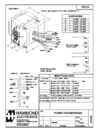
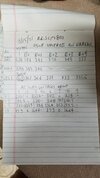
The voltage chart below is with wall voltage, not variac as noted.
I had to squeeze in the grid voltages in some spots.
Note: V2 pin 8 is 200.5v and V3 pin 8 is 39.2v
As was mentioned, I want to get the plate dissipation sorted first. I could add zener diodes to the B+ (dropping all the node voltages), increase the cathode resistor value, or a combination of both, I suppose.
It doesnt sound horrible; maybe it is the tone of the 12au7 triodes vs. big bottles as @ivan H mentioned.
I would consider converting to a pair of EF80.
I will try to post some mic'd cab sound clips, but I am challenged in this task.
syscokid
Ambassador of War & Peace
Ah, ok then. Still wondering why you're getting those high plate voltages...I used the Hammond 290CAX, the 275v-275v / 550v secondary tap.

67plexi
Ambassador of Amps
The Hammond 290CAX is designed for 115 VAC primary voltage
Amp Mad Scientist
Ambassador of Heresy
1. Adding zener diodes is a crappy method of dropping voltages.I used the Hammond 290CAX, the 275v-275v / 550v secondary tap.
View attachment 72190
The voltage chart below is with wall voltage, not variac as noted.
I had to squeeze in the grid voltages in some spots.
Note: V2 pin 8 is 200.5v and V3 pin 8 is 39.2v
As was mentioned, I want to get the plate dissipation sorted first. I could add zener diodes to the B+ (dropping all the node voltages), increase the cathode resistor value, or a combination of both, I suppose.
It doesnt sound horrible; maybe it is the tone of the 12au7 triodes vs. big bottles as @ivan H mentioned.
I would consider converting to a pair of EF80.
I will try to post some mic'd cab sound clips, but I am challenged in this task.
View attachment 72192
Zener diodes drift all over the place based on temperature, and a zener diode is an extremely primitive device.
You will see that several techs have started using zeners as a method to drop voltage...
but it makes the amp sound like poo-poo.
IMHO, zeners used to drop voltage is a very Micky Mouse solution, and does not do anything to improve sound quality.
(I've tried this zener method and it sucks). It sounds like ass.
2. Using a transformer with multiple voltage taps, is a much more stable method. Much better than any zener diode.
Classic tone or Hammond would be a much preferred choice to lower the voltage....waaaaay better idea.
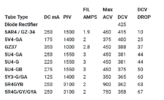
3. Rectifier Tubes:
Using different rectifiers, you can get a variation of as much as 90 volts.
The rectifiers all fit in the same socket.
The rectifiers all have the same pin out...etc...which makes swapping them pretty easy.
So, rectifier swap to adjust voltage is a pretty good method.
Certainly a much better method than a zener diode. Waaay better.
4. But:
there is no reason to lower the voltage...when you could just change the cathode resistor, in a Class A amplifier.
I see a lot of people try to lower the voltage with zener diodes...to compensate for the fact that the cathode resistor is the wrong value.
When in fact, changing the cathode resistor is a much much better idea. And the sound quality will be much better compared to a zener diode etc...
(remember the tube should run at 90-100% of rated plate dissipation, at idle no sound, in a class A amplifier) and so adjust the cathode resistor accordingly.
In the "18 watt" forum:
It has become popular to use zener diodes...to adjust for the fact that the cathode resistor is the wrong value.
But these guys are degrading the sound quality of their amplifiers.
To compensate for too high a voltage:
They could have changed the cathode resistor - to the correct value- and their amps would have sounded a lot better.
Last edited:
syscokid
Ambassador of War & Peace
"115 vac" might be a misprint from Mouser. The Hammond's datasheet describes 120 vac or 240 vac, at jtcnj's post #32.The Hammond 290CAX is designed for 115 VAC primary voltage
The VAC from the PT to the diodes should be measured. It should be 275 vac per lead.
Amp Mad Scientist
Ambassador of Heresy
Ah, ok then. Still wondering why you're getting those high plate voltages...
The schematic shows 370 VDC B+ voltage. The measurement shows 384.
That's not a very big difference in B+ voltages.
I would not be alarmed, so far.
Also if the amp is biased correctly it will drop the B+ voltage or raise the B+ voltage depending on which way the bias adjustment goes.
I'm not sure of the plate current at the output tubes.
That's the question now.
I think an alternative method to measure plate current should be used, to verify that the first measurement was correct.
Amp Mad Scientist
Ambassador of Heresy
To calculate the power tube dissipation I measured the voltage across the shared cathode resistor, divided by the 1kΩ resistor value and multiplied by plate voltage, then divided by 2. I failed to subtract the cathode voltage of around 16v from the plate voltage. I will re-check the cathode resistor actual value; i think it was 989Ω or so.
So, you measured 16VDC across the 989 ohm resistor?
This is with no input, volume set to zero?
correct ohm Speaker was connected when you measured this?
So, you measured 16VDC across the 989 ohm resistor?
This is with no input, volume set to zero?
correct ohm Speaker was connected when you measured this?
OP
jtcnj
Ambassador of the Crossroad
I believe so; I will re-measure this evening.To calculate the power tube dissipation I measured the voltage across the shared cathode resistor, divided by the 1kΩ resistor value and multiplied by plate voltage, then divided by 2. I failed to subtract the cathode voltage of around 16v from the plate voltage. I will re-check the cathode resistor actual value; i think it was 989Ω or so.
So, you measured 16VDC across the 989 ohm resistor?
This is with no input, volume set to zero?
correct ohm Speaker was connected when you measured this?