TTR tube amp gurus: please help!

jtcnj

Ambassador of the Crossroad
Country flag
So, I've been playing the RR JCM800 1w a lot lately, at volume.
It is LOUD, relative to the 1w moniker and pushes a 25w WGS Green Beret 12" well.
Using pedals at times, but really trying to wring out the tones of the amp itself without pedals.

Different guitars, pickups. P90, Tele single coils, PAFs in LP, LP jr Super Distortion bridge.
Twiddled the knobs endlessly; if I play with them anymore I may start to go blind.

I find the cranked up tone dark and muddy: no grind, no sizzle.
Tried various tubes.

The MV is Pre- PI.
The 12au7 triodes in push pull are each at about 3.25w with 391v at the plates.
cathode biased, shared resistor.

The tube is rated 2.75w max. 3.25/2.75 = 118% of max.
I'm not concerned about tube life here, and have not seen redplating.
I know cathode biased push pull are often run at or a little over 100%.

I'm thinkin lowering the dissipation closer to that 2.75w may tighten / brighten things a bit.
I will try raising the cathode resistor some more, but at some point may have to drop the B+ a bit.

Nothing seems out of place through the preamp through the range of the pre-amp volume pot.
I cant tell how hard the PI is hit when the MV is maxed.

The hot biasing on the power tubes is the thing that stands out.

EDIT: I may add a post PI MV but I still want to consider the bias issue.

Any and all input is greatly appreciated.
 
Last edited:
1628793699201.png

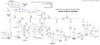
My voltages are close to this; my 12au7 plate is around 391 (I dont have my notes here) using a 1k cathode resistor.

The text in the drawing is small, the power node voltages before the plate resistors from left to right are 335v, 335v, 350v, and 360v for the PI.

I will fill out and post a similar voltage form later from home
 
The 12au7 triodes in push pull are each at about 3.25w with 391v at the plates.
I know even less about cathode biased power tubes, but... How did you calculate the dissipation of the 12AU7?

My voltages are close to this; my 12au7 plate is around 391 (I dont have my notes here) using a 1k cathode resistor.
What would happen if you used a 510 ohm cathode resistor?
 
I started with the closest value on hand at startup: 470Ω. I got almost 5w per triode.
I upped it to 1kΩ after that.

Ohms law, measure the voltage across the cathode resistor, divide by resistor value = current.
current x plate to cathode voltage ( plate voltage minus cathode voltage, but 391 vs. 391-16v isnt much difference) = watts for BOTH triodes, divide by 2.

Doesnt account for unbalanced triodes, but close enough.
 
View attachment 72026

My voltages are close to this; my 12au7 plate is around 391 (I dont have my notes here) using a 1k cathode resistor.

The text in the drawing is small, the power node voltages before the plate resistors from left to right are 335v, 335v, 350v, and 360v for the PI.

I will fill out and post a similar voltage form later from home
In a class A amp like this one, the power tubes should run at 90-100% of rated plate dissipation at all times.
If it's more than 100% of the rated dissipation, I could see that as an issue.

Was there ever a time when the amp didn't sound "dark and muddy?"
Did it just start doing this? or has it always sounded that way?
 
Ohms law, measure the voltage across the cathode resistor, divide by resistor value = current.
current x plate to cathode voltage ( plate voltage minus cathode voltage, but 391 vs. 391-16v isnt much difference) = watts for BOTH triodes, divide by 2.
Thanks jtcnj!
I'm trying to learn how to do the math. What was the voltage across the cathode resistor?
 
In a class A amp like this one, the power tubes should run at 90-100% of rated plate dissipation at all times.
If it's more than 100% of the rated dissipation, I could see that as an issue.

Was there ever a time when the amp didn't sound "dark and muddy?"
Did it just start doing this? or has it always sounded that way?
Start up was end of Dec. 2020. I never really evaluated it thoroughly until recently. So, yes nothing has changed.
The dark and muddy is when driven hard.

I am not fully versed on operating class. I understand a single ended 5F1 Champ circuit to be Class A, and most push-pull circuits to be Class A/B.

Thanks jtcnj!
I'm trying to learn how to do the math. What was the voltage across the cathode resistor?
@16v

The 10K NFB resistor value seems a tad low
I'm following this : https://robrobinette.com/RR2104_Master_Volume_Micro.htm#JCM800_Micro
"The NFB resistor has been reduced to 10k to compensate for the very low output voltage of the power amp."

I'm no desginer; I know the basics and then some..
 
Start up was end of Dec. 2020. I never really evaluated it thoroughly until recently. So, yes nothing has changed.
The dark and muddy is when driven hard.

I am not fully versed on operating class. I understand a single ended 5F1 Champ circuit to be Class A, and most push-pull circuits to be Class A/B.


@16v


I'm following this : https://robrobinette.com/RR2104_Master_Volume_Micro.htm#JCM800_Micro
"The NFB resistor has been reduced to 10k to compensate for the very low output voltage of the power amp."

I'm no desginer; I know the basics and then some..
Might be worth experimenting with a higher value resistor to reduce that NFB, and see/hear what happens... :unsure:
 
I have variable NFB on my Champ build, so I am familiar with the concept.
I am considering experimenting with values.
But I think reducing the NFB will add to the problem. The amp gets plenty more gain as I increase the preamp and / or master. I realize both the PI and power section are affected by loop created by the NFB.

More NFB signal (lower resistor) should sound generally cleaner, while less NFB signal (larger resistor) should be generally dirtier. The "negative" feed back cancels some signal. Not all the frequencies are affected and somewhat shapes the Presence circuit (I think).

Cranking the preamp with the master low(er) gives lots of preamp drive and not the muddy.

Ever switch on a pretty gainy distortion pedal into a cranked / very dirty amp? I get super saturated mud.
The dark and muddy I describe amp only / no pedals is similar to that. Seems something is overdriven in a not good way.
I dont understand load lines and bias / operating point enough to quantify this.

Since the MV is pre-PI, I cant easily separate the PI and power stages. Knowing I am significantly over the max dissipation for the power tube triodes is why I am leaning toward starting there.

Regarding bias, from what I understand colder bias will sound "thinner" vs hotter bias "thicker". What I describe as dark and muddy I wonder if that may be too "thicker". So, my first thought is to thin things out a bit given I am well over max plate dissipation.


My filaments are at 6.9v too so I may be adding a bridge rectifier configured as 2 diodes reverse parallel (see Merlin / Valve Wizard). If running reduced on the variac improves things overall, I may build a bucking transformer, but I digress from the tone issue. But this will affect on all voltages and likely, tone.
 
Regarding bias, from what I understand colder bias will sound "thinner" vs hotter bias "thicker". What I describe as dark and muddy I wonder if that may be too "thicker". So, my first thought is to thin things out a bit given I am well over max plate dissipation
I would definitely be obsessive about this until I got the dissipation situation under control. Right now, I wouldn't know how to do it though... :confused2:. Following this with lots of interest... :cheers:
 
I started with the closest value on hand at startup: 470Ω. I got almost 5w per triode.
I upped it to 1kΩ after that.

Ohms law, measure the voltage across the cathode resistor, divide by resistor value = current.
current x plate to cathode voltage ( plate voltage minus cathode voltage, but 391 vs. 391-16v isnt much difference) = watts for BOTH triodes, divide by 2.

Doesnt account for unbalanced triodes, but close enough.

What I would try is:
Different speaker.
Measure power supply voltages in preamp.
different preamp tubes, there might be a bunk tube.
2. Remove the feedback resistor entirely, now what does it sound like?

Well yeah there is a way but it's a modification.

PPIMV won't help this.
It's a really common problem that happens because of the coupling between the stages.
When the signal is pushed, it tends to mud up and overload.
Happens in many amps...
 

We normally think of a coupling cap between stages as blocking DC voltage.
Actually the coupling cap is charging discharging on every pulse of audio passing through it.
This charge discharge cycle effects the proceeding grid of the next preamp stage.
Attack of guitar note:
The grid is pulled negative when a pulse of audio occurs, (compared to the ideal) and it causes a brief but farty cutoff distortion.
(It causes a muddy attack of the guitar note...)
Decay of guitar note:
With time as the coupling discharges from the audio pulse, the grid of the proceeding stage drifts back to a more normal voltage....and the audio cleans up no longer farty.

So this cycle is happening over and over as you play guitar notes. The harder the signal is pushed, the more the grid is shut off and the more mud you have.

What I'm diving at here:
if you use a different coupling method between the stages
which prevents the charge discharge from affecting the grid...
and the grid stays at a more ideal level all the time without being pulled negative and cut off...
then you have basically solved the fary muddy problem from happening when the amp is pushed hard.
 
I have variable NFB on my Champ build, so I am familiar with the concept.
I am considering experimenting with values.
But I think reducing the NFB will add to the problem. The amp gets plenty more gain as I increase the preamp and / or master. I realize both the PI and power section are affected by loop created by the NFB.

More NFB signal (lower resistor) should sound generally cleaner, while less NFB signal (larger resistor) should be generally dirtier. The "negative" feed back cancels some signal. Not all the frequencies are affected and somewhat shapes the Presence circuit (I think).

Cranking the preamp with the master low(er) gives lots of preamp drive and not the muddy.

Ever switch on a pretty gainy distortion pedal into a cranked / very dirty amp? I get super saturated mud.
The dark and muddy I describe amp only / no pedals is similar to that. Seems something is overdriven in a not good way.
I dont understand load lines and bias / operating point enough to quantify this.

Since the MV is pre-PI, I cant easily separate the PI and power stages. Knowing I am significantly over the max dissipation for the power tube triodes is why I am leaning toward starting there.

Regarding bias, from what I understand colder bias will sound "thinner" vs hotter bias "thicker". What I describe as dark and muddy I wonder if that may be too "thicker". So, my first thought is to thin things out a bit given I am well over max plate dissipation.


My filaments are at 6.9v too so I may be adding a bridge rectifier configured as 2 diodes reverse parallel (see Merlin / Valve Wizard). If running reduced on the variac improves things overall, I may build a bucking transformer, but I digress from the tone issue. But this will affect on all voltages and likely, tone.
Did you ever figure out what it was?

Hotter bias will sound cleaner, and give you the headroom.
Colder bias will have more fizzy distortion, and less headroom.
Overall amps sound better when the bias is hotter. If the amp is biased cold that is the first thing to change.
 
Last edited:
Back
Top