Good to hear that you've got it biased more sensibly & performing better.
Regarding the linked Amp books cathode bypass capacitor calculator, when used for the correct purpose these Ampbooks calculators are great. However, the formula that this linked calculator uses (taken from The Radiotron Designers Handbook, 4th edition) is for a single triode set up as a resistance capacitance coupled voltage amplifier, not for two triodes operating in class AB push pull.
In this " push pull output stage" application, there "is no" RG (the following stage's grid leak resistor) value to plug into the calculator (the calculator doesn't work without a figure here).
RK has two triode's drawing current through it, so its value "appears" to each triode as twice that of it's nominal value.
The common cathode resistor "sees" the RL of each triode in parallel (there are complexities of RL in this application that I wont go into).
So we can see that RG aside, the numbers will be "off".
That said, I've never seen a cathode biased class AB guitar amplifier that features a properly designed cathode resistor/bypass capacitor arrangement.
From my copy of The Radiotron Designers Handbook edition 4;
In a cathode biased class AB amplifier, "each" valve should have a cathode resistor of equal value. Each of these cathode resistors is then bypassed with a capacitor.
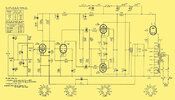
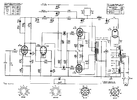
Examples of this type cathode arrangements can be seen in these amplifier circuits from Mullard Circuits For Audio Amplifiers.
The Mullard 5-10 amplifier
View attachment 72408
and an ultralinear design
View attachment 72411
If we look at various designs (both audio & guitar amps), we commonly see cathode bypass capacitor values of 25uf & 50uf, however the roll off point ( or frequency cut off point) of a given cathode bypass capacitor can be calculated using the formula
FC = 1
---------------
(2pi) R C
Now all this said, I really don't think this amp "needs" cathode bypassing, however I've given you the info to go about it properly should you decide you want to, for whatever purpose. Cheers
Edit:
I should have included the relevant info needed to use the formula that I posted above, so here it is;
FC = cutoff (roll off point) frequency.
R = resistor value in ohms.
C = capacitor values in farads.
To get a capacitor's value in farads, the following applies;
"uf" values, divide by 1,000,000
Example; 0.022uf = 0.000000022F.
"pf" values, divide by 1,000,000,000,000
Example; 470pf = 0.00000000047F.
This same formula can be used to calculate the roll off point of treble peakers etc. Apologies for not including this info when I posted the formula last night, it was late & I was tired. Cheers