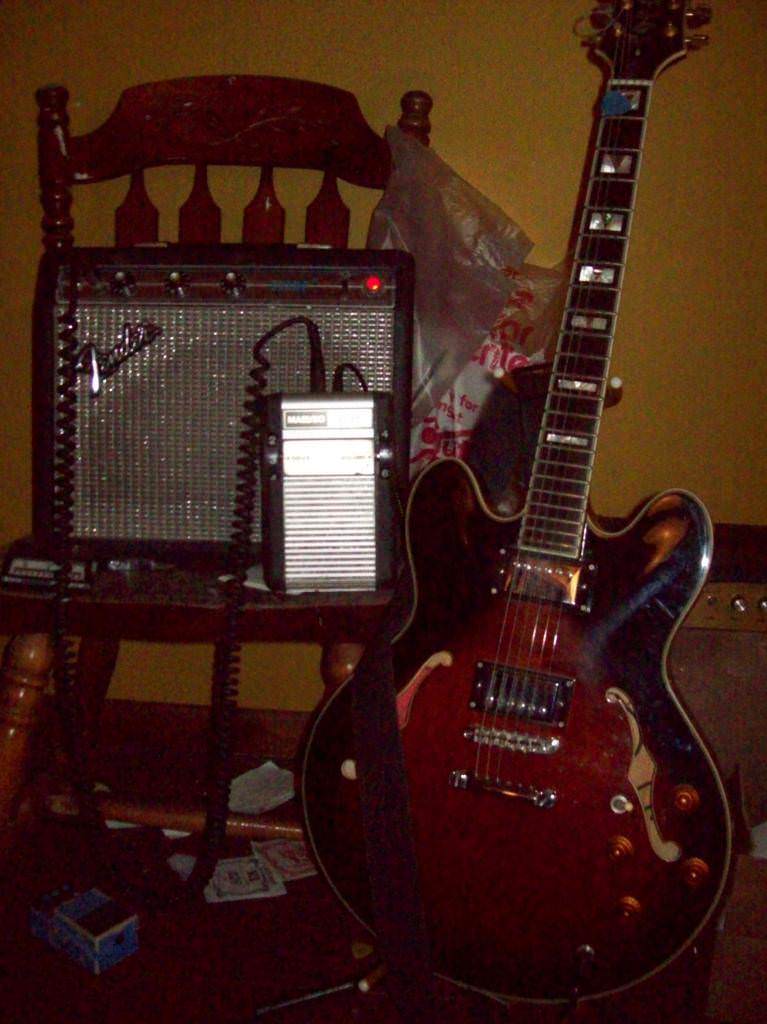
Gawd, I love the tone of that original Epi Wilshire.
I'm sorry I had to sell my "modern" Wilshire off, but I sold it to a guy I really respect, and
he paid me a very fair price for it. He got a WHOLE LOT more guitar than he paid
for, but that's the way it is with Epiphones. He read my description of what all I had
installed in my humble Chinese made neck and body... and he understood what
he was getting. So
he willingly paid me and I reluctantly let the Wilshire go.
As regards the thrust of this thread, to me it's
mildly interesting ... what my
colleagues here perceive about tone. I'm always interested in reading what other
players might write on this endless subject. So I read all of this thread, and thought
carefully about some of the posts. Thanks for giving us all of this. It's pretty rich.
But I have my own ideas of course. Personally, I don't care a fig whether anyone
can generalize about tone differences between hollow body, semi hollow body and solid
body guitars. I normally ignore general statements about tone, whether it has to do with
such and such a year class of guitar, or whether it has to do with maple necks or bolt on
necks... or multiple piece bodies, or bridges that have studs vs bridges screwed into wood...
My normal attitude is that
wood is not like, magnetic... and so has very little effect on the
tone of electric guitars. But I am an acoustic player too, and with acoustic guitars...
tonewood
is everything. Tonewood is crucial when we are amplifying the vibrations of wood parts attached
by tension to strings that are manipulated by fingers and pix.
Tonewood is all we have to present.
With electric guitars we are amplifying the vibrations of steel strings in a magnetic field...
Wood has a small effect on that IMHO. But who am I to contradict someone who believes that
a maple neck adds brightness to guitar tone. I wouldn't contradict that. I own Fender and Gibson
and Martin guitars, and I believe that their construction has some effect on their tone. I own guitars
with maple and with mahogany necks. They don't sound the same, and I don't want them to.
Case in Point: My Step Daughter's Epiphone Les Paul Special ll, with a bolt on neck made out of
whatever, and a plywood (laminated) body made out of whatever. I modded this guitar with lots of
very cool (read that expensive) parts and it sounds killer. It's got lots of sustain, and great tone in
all the frequencies. The wood seems to make little difference IMHO.
Me,
I'm into the individual tone of individual guitars. To me, it doesn't matter what a guitar is made of
if I like the tone, and it doesn't matter to me what a guitar is made of if I DON"T like the tone.
I'd play that Epiphone onstage any time. It sounds so good that it would add an extra cool factor
IMHO... excellent tone from a cheap guitar. That's a punk attitude. I'm too old to be a punk any more.
But hey...
I don't believe that multiple pieces glued together sound worse than one piece bodies.
I don't believe that bolt on necks sound worse than glued in necks...
I don't believe that wood grain and density make much difference to electric guitar tone...
maybe a little, but at band volume and in a mix with other instruments and vocals this
would be insignificant IMHO.
My mind is open on the subject of hollow body electric guitars...
I don't own one.
I do own a semi-hollow body guitar, which I regard as an electric guitar with hollow "wings"
above and below its maple center block. I don't believe those hollow spaces have much
effect on the tone of my Epiphone ES-339 P-90 pro.
But I do love the tone. It's my only P-90
guitar, so I have nothing to compare it with. I had NO OPINION about P-90 pickups before I
became a member of ETSG, and when a newbie there
I read all tone discussions with interest.
I simply regarded P-90 pickups as
obsolete technology from the 1940s... sort of like a P-51 Mustang
fighter aircraft in the age of the Mig 35... but that's just ignorance. The P-90 turns out to be a timeless
design which has been making great music ever since it was announced in 1945. After learning a few
things, I decided I had to have a guitar with P-90s.
The P-90s on my semi hollow ES-339 sound like no other guitar I've ever owned,
so is it the Ken Rose p'ups, or is it the semi hollow design, or is it something else entirely?
This Epi has a mahogany neck, and a maple solid center block, and the top is laminated (plywood)
What gives it its awesome tone?
I don't know, and I don't really care. I'm just glad I made the effort to get this one.
I own four electric guitars now, and each one is completely
different from each of the others. That makes me happy. I love having all these tones at my
finger tips.
I don't expect one guitar to sound like another one.
I don't actually want them to.
I want each instrument I buy to have its own unique tone. So general statements about this instrument
or that one mean nothing to me... I need to hear it. That's how I know.
I'm going to guess that individual tone among various hollow and semi hollow electric guitars
varies because of hand work, and that seems like it should be.