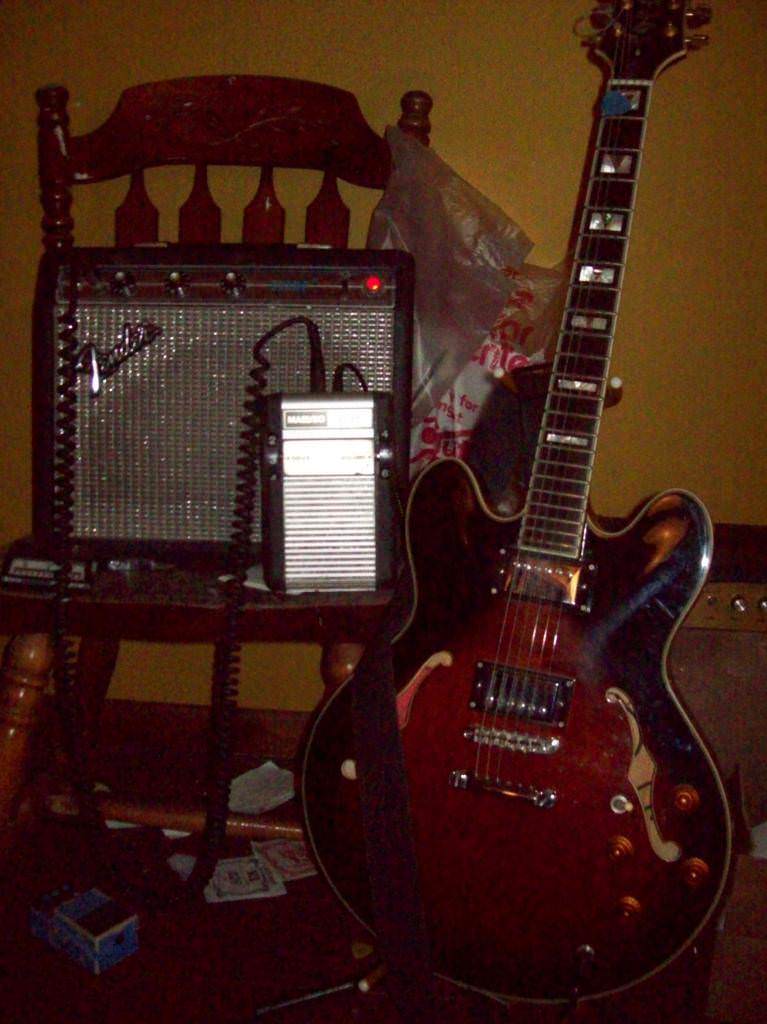
Tonewood v Semi-Hollow

Here we go. 3 solid, 3 semi-hollow guitars. All guitars have 2 humbuckers. All guitars are 24.75" scale. All guitars are set to middle pickup selection. All guitars have the tone and volume pots wide open to remove their influence as much as possible.

Solid V Semi

I’ll admit...I can’t just listen to a clip and tell if a guitar is solid or semi-hollow. My semi-hollow guitar has different pickups from my others, so it’s entirely conceivable that much of what I hear in my own guitars is mostly pickup related.

What I can say is that as you crank things more, you’ll start to get a different responsiveness. Because of the greater risk of feedback, things can get wooly - not airy!

I agree with @mdubya , at vintage gain to clean settings it can be nearly indistinguishable.

Nice playing, by the way!
 
Just a minor correction...

Maxing the volume and tone controls does not minimize their effects.

In the volume pot, the wiper forms an infinitely variable voltage divider, which determines how much of the signal passes downstream. Because of this, it’s tempting to think that the volume pot is essentially bypassed at 10 because the the wiper is connected to the input from the pickup at that terminal. However, the pickup is wired across the entire value of the volume put. Hence, the pickup always “sees” the entire value of the pot, regardless of wiper position. The pot becomes a parallel resistance across the pickup, and downstream circuitry. This is why replacing a 250k pot with a 500k pot will result in a slightly different tonality, even when maxed.

As for the tone pot, at maximum (10), the entire value of the potentiometer is in the circuit, along with the capacitor. The more resistance value you have in the tone circuit, the lesser the influence of the capacitor, minimizing the treble cut. At Zero, the resistance of the tone pot is essentially bypassed, leaving only the capacitor in the tone circuit, maximizing treble cut.

No trying to be a bung-hole, but this stuck out to me!
Wouldn't the pickups sound closer to what they would sound like without a pot if the volume pot was at 10 rather than say, 6?

Wouldn't the pickups sound closer to what they would sound like without a pot if the tone pot was at 10 rather than say, 6?

I did say minimize the effect, not eliminate it.

And you are not being anything but informative
 
Wouldn't the pickups sound closer to what they would sound like without a pot if the volume pot was at 10 rather than say, 6?

Wouldn't the pickups sound closer to what they would sound like without a pot if the tone pot was at 10 rather than say, 6?

I did say minimize the effect, not eliminate it.

And you are not being anything but informative

Yes. You did say minimize, not eliminate.

I will say “Yes” to both questions, as you’ve phrased them here.

It’s just that these sorts of things jump out at me. There’s a lot of misinformation out there regarding guitar electronics, so I tend toward the corrective route.
 
Yes. You did say minimize, not eliminate.

I will say “Yes” to both questions, as you’ve phrased them here.

It’s just that these sorts of things jump out at me. There’s a lot of misinformation out there regarding guitar electronics, so I tend toward the corrective route.
Capacitance is real, and we are keeping it real!!
 
My parents used to give me a similar answer when I asked a question. It went like this:"Because I said so!" Feels like old times.

I know what you mean, but I'm not trying to convince anyone and not looking to be convinced one way or the other. As I said, I know what I know/hear and that works for me...you may need some convincing, but I won't try because I don't care if others are convinced or not. This isn't some religion to me where I feel a need to go on a mission and bring people over to my way of thinking. If you or anyone else needs scientific validation to believe what your ears are hearing, that's all good. If you don't hear it at all that's all good too. We're all doing this for fun anyway!
 
I know what you mean, but I'm not trying to convince anyone and not looking to be convinced one way or the other. As I said, I know what I know/hear and that works for me...you may need some convincing, but I won't try because I don't care if others are convinced or not. This isn't some religion to me where I feel a need to go on a mission and bring people over to my way of thinking. If you or anyone else needs scientific validation to believe what your ears are hearing, that's all good. If you don't hear it at all that's all good too. We're all doing this for fun anyway!
Agreed. I respect your feelings on the topic. After all, music in general is about how it makes us feel. A song is only good or bad in the ear of the beholder, just like an instrument.
 
Agreed. I respect your feelings on the topic. After all, music in general is about how it makes us feel. A song is only good or bad in the ear of the beholder, just like an instrument.

...and your ears are analog by the way.
That's why analog sounds "better".
 
  • Like
Reactions: RVA
One of the more curious things I have read is people claiming they can feel the air pulsing in and out of the F holes on semi and full hollow guitars. :confused2:

Now, I am not saying it isn't true, but my first electric was indeed a full hollow, I have had a semi hollow continually since 1996, and I currently have a small army of semi and full hollow guitars. I have never felt this phenomenon myself. :hmmm:

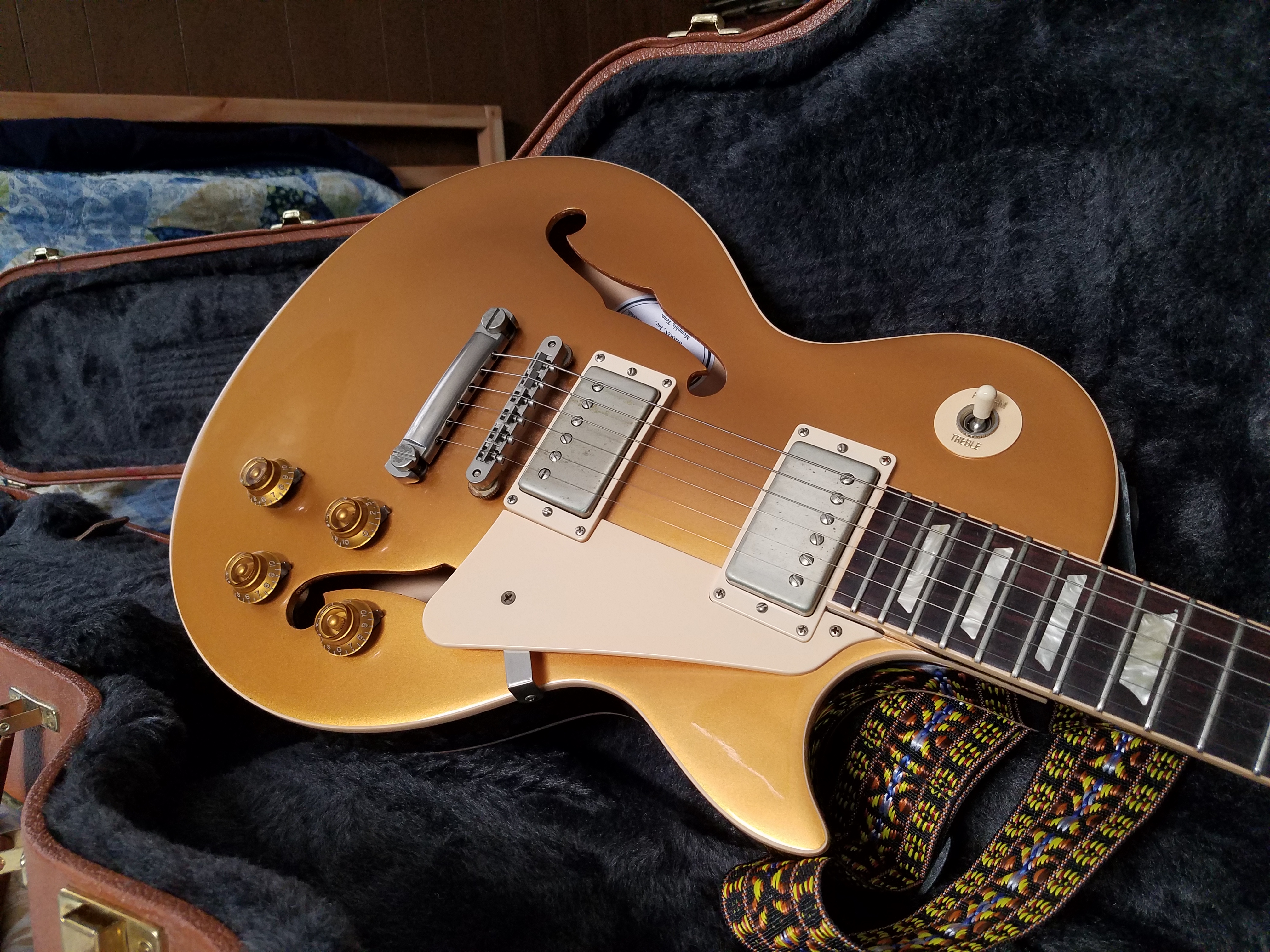
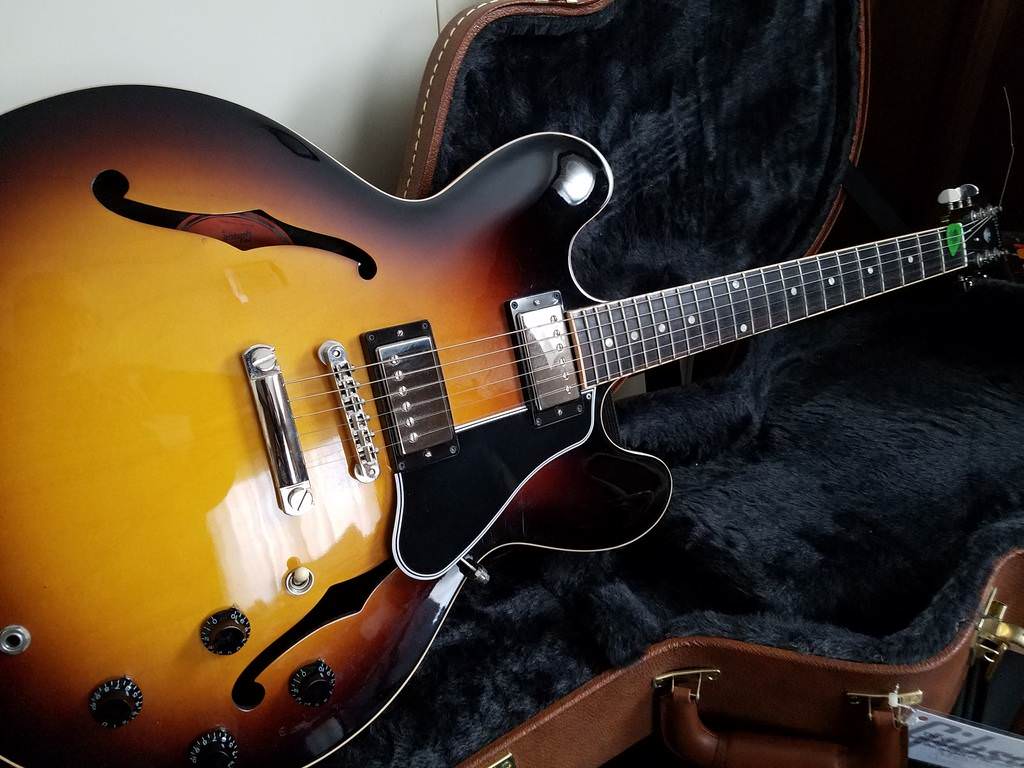
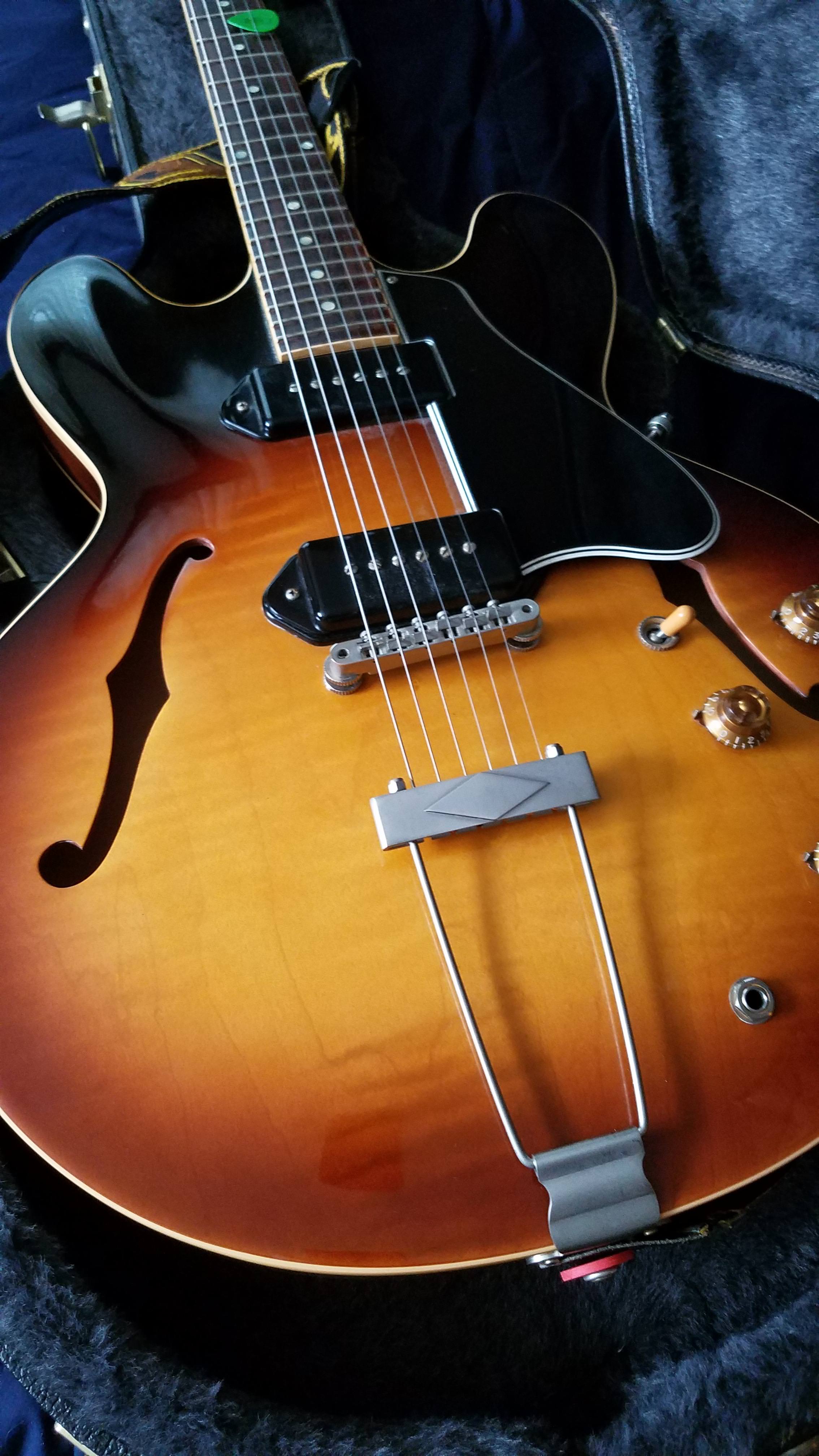
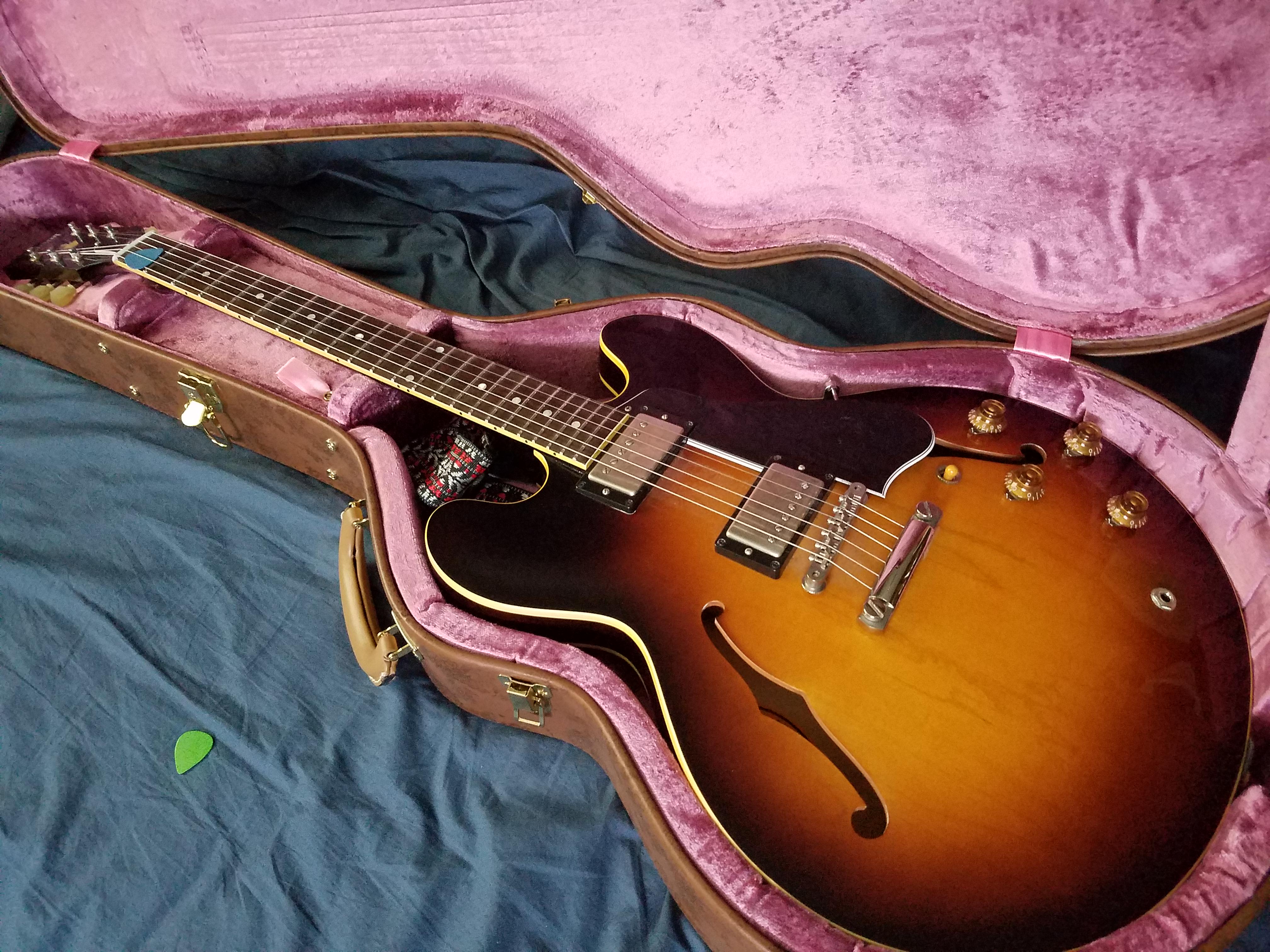
Partial proof and an excuse to post photos:

Y9ypt7f.jpg


9vI6D3L.jpg


e2PafCQ.jpg


gAW6kSo.jpg


l5uzxB0.jpg


Simple physics says I can’t believe that. PV=nRT.
 
My experience has been one of control mainly. Solid body guitars are easier to control, than semi-hollow body guitars, and semi-hollow body guitars are easier to control than full hollow body electric guitars. I do pretty good on electric and semi-hollow body electrics, but I have a hard time controlling a full hollow body guitar (pick attack, volume, etc). I love full hollow body electric guitars and if I kept one around long enough I image I'd get it figured out, but... To me anyways... A full hollow body is tone/vibe monster that is a little trickier control.
 
My experience has been one of control mainly. Solid body guitars are easier to control, than semi-hollow body guitars, and semi-hollow body guitars are easier to control than full hollow body electric guitars. I do pretty good on electric and semi-hollow body electrics, but I have a hard time controlling a full hollow body guitar (pick attack, volume, etc). I love full hollow body electric guitars and if I kept one around long enough I image I'd get it figured out, but... To me anyways... A full hollow body is tone/vibe monster that is a little trickier control.
Plus all that nasty hollow body feed back
 
Control...

I agree. The best analogy my 3 active brain cells
can come up with offhand is that playing a semi hollow
at teeth rattling volume is like flying a very large kite
in high wind. It tries to get away from you.

ES 355
DR 103
4 X EV SRO 12s
Channels jacked together
Channel volumes maxxed, master at 3 o,clock
Look of horror and pain on my face as eyeballs get bounced around
in their sockets and fillings begin to work their way out of my teeth...

Moe10001.jpg
 
Last edited:
Here’s an interesting article.

It’s an interview with Ted McCarty about back when they were developing the Les Paul. It deals with the business side and many other details of Gibson. What is interesting, and germane to this topic is when he discusses the experimentation they went through to settle on the woods used in the Les Paul.

Scroll down about 1/3 of the way to the section entitled, “When did you start work on this project?”


Former Gibson Chief Ted McCarty on Tonewoods and the Problems of 'Top-Heavy' Management | Bacon's Archive
 
Simple physics says I can’t believe that. PV=nRT.

While I believe it is possible, it also points to the psycho-sematic emotional descriptions and experiences guitarists can apply to guitar and amp and music. And, really, if you think it is real, that can make all the difference. Whether it is actually real isn't all that important. :LOL:

Plus all that nasty beautiful hollow body feed back

Fixed. :p

Playing Neil Young on the 330 at low volumes may be more realistic than using a hollow body. Or not.
 
  • Like
Reactions: RVA
but then so does this

Gawd, I love the tone of that original Epi Wilshire.
I'm sorry I had to sell my "modern" Wilshire off, but I sold it to a guy I really respect, and
he paid me a very fair price for it. He got a WHOLE LOT more guitar than he paid
for, but that's the way it is with Epiphones. He read my description of what all I had
installed in my humble Chinese made neck and body... and he understood what
he was getting. So he willingly paid me and I reluctantly let the Wilshire go.

As regards the thrust of this thread, to me it's mildly interesting ... what my
colleagues here perceive about tone. I'm always interested in reading what other
players might write on this endless subject. So I read all of this thread, and thought
carefully about some of the posts. Thanks for giving us all of this. It's pretty rich.

But I have my own ideas of course. Personally, I don't care a fig whether anyone
can generalize about tone differences between hollow body, semi hollow body and solid
body guitars. I normally ignore general statements about tone, whether it has to do with
such and such a year class of guitar, or whether it has to do with maple necks or bolt on
necks... or multiple piece bodies, or bridges that have studs vs bridges screwed into wood...

My normal attitude is that wood is not like, magnetic... and so has very little effect on the
tone of electric guitars. But I am an acoustic player too, and with acoustic guitars... tonewood
is everything
. Tonewood is crucial when we are amplifying the vibrations of wood parts attached
by tension to strings that are manipulated by fingers and pix. Tonewood is all we have to present.

With electric guitars we are amplifying the vibrations of steel strings in a magnetic field...
Wood has a small effect on that IMHO. But who am I to contradict someone who believes that
a maple neck adds brightness to guitar tone. I wouldn't contradict that. I own Fender and Gibson
and Martin guitars, and I believe that their construction has some effect on their tone. I own guitars
with maple and with mahogany necks. They don't sound the same, and I don't want them to.

Case in Point: My Step Daughter's Epiphone Les Paul Special ll, with a bolt on neck made out of
whatever, and a plywood (laminated) body made out of whatever. I modded this guitar with lots of
very cool (read that expensive) parts and it sounds killer. It's got lots of sustain, and great tone in
all the frequencies. The wood seems to make little difference IMHO.

Me, I'm into the individual tone of individual guitars. To me, it doesn't matter what a guitar is made of
if I like the tone, and it doesn't matter to me what a guitar is made of if I DON"T like the tone.
I'd play that Epiphone onstage any time. It sounds so good that it would add an extra cool factor
IMHO... excellent tone from a cheap guitar. That's a punk attitude. I'm too old to be a punk any more.
But hey...

I don't believe that multiple pieces glued together sound worse than one piece bodies.
I don't believe that bolt on necks sound worse than glued in necks...
I don't believe that wood grain and density make much difference to electric guitar tone...
maybe a little, but at band volume and in a mix with other instruments and vocals this
would be insignificant IMHO.
My mind is open on the subject of hollow body electric guitars... I don't own one.

I do own a semi-hollow body guitar, which I regard as an electric guitar with hollow "wings"
above and below its maple center block. I don't believe those hollow spaces have much
effect on the tone of my Epiphone ES-339 P-90 pro. But I do love the tone. It's my only P-90
guitar, so I have nothing to compare it with. I had NO OPINION about P-90 pickups before I
became a member of ETSG, and when a newbie there I read all tone discussions with interest.

I simply regarded P-90 pickups as obsolete technology from the 1940s... sort of like a P-51 Mustang
fighter aircraft in the age of the Mig 35... but that's just ignorance. The P-90 turns out to be a timeless
design which has been making great music ever since it was announced in 1945. After learning a few
things, I decided I had to have a guitar with P-90s.
Caledonia 2016@100.jpg
The P-90s on my semi hollow ES-339 sound like no other guitar I've ever owned,
so is it the Ken Rose p'ups, or is it the semi hollow design, or is it something else entirely?
This Epi has a mahogany neck, and a maple solid center block, and the top is laminated (plywood)
What gives it its awesome tone?
I don't know, and I don't really care. I'm just glad I made the effort to get this one.
I own four electric guitars now, and each one is completely
different from each of the others. That makes me happy. I love having all these tones at my
finger tips.

I don't expect one guitar to sound like another one. I don't actually want them to.
I want each instrument I buy to have its own unique tone. So general statements about this instrument
or that one mean nothing to me... I need to hear it. That's how I know.
I'm going to guess that individual tone among various hollow and semi hollow electric guitars
varies because of hand work, and that seems like it should be.
 
Last edited:
Back
Top