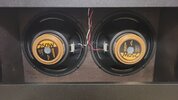
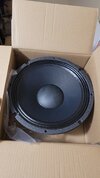
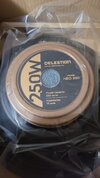
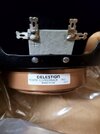
Sure you can blow a 75 watt speaker with a 40 watt amp! But, it all comes down to the content and usage.
If a system is to be used primarily for just speech, you can get away with a much lower wattage speaker because the content doesn't drive the speaker to excessive levels of excursion.
But, often the general recommendation is to use a a speaker (or combination of speakers) that offer AT LEAST twice the rated output of the amplifier. This may need to be even higher if playing loud rock music at high volumes, which can drive a speaker even harder.
I used to use a 30 watt speaker with my 5 watt Marshall amplifier. I use a 75 watt speaker with my 25 watt Rivera.
Honestly, I have to say that I see their point. Celestion has no way of controlling how people are going to use their speakers or if they have spec'd them out appropriately. They have no way to control someone who may mod their amp to produce higher than the rated output. These are just a few issues that can affect a speaker. I get your point. I know it really stinks, but I can see their side, too.
When I purchased the speaker for my Rivera amp from Sweetwater, I was told very clearly that once I plugged it in, I could no longer return it.
Our company probably installs around a hundred speakers a year, or more. We literally have never had a single speaker failure. When used appropriately and when spec'd out according to the amplifier rating, the intended usage, and the anticipated content, they are quite reliable.
Here's what i found interesting in all of this...
I had repeated failures with Creambacks, both 65 and 75 watt variants, including one $320.00 Goldback, which Celestion tech told me was a "top shelf unit" and that i "could not harm it with a 40 watt amp, regardless of settings or volume."
Believe me, i do understand your points, but it was a real drag going through this speaker fiasco on a rig that i was - at the time - using to earn a living. It wasn't the money that bothered me as much as the downtime.
In my conversations with Celestion, i found their ultimate answer to be that their speakers were "never designed for 5 nights a week of useage," adding that "even a professional touring rig would need frequent speaker replacement if subjected to daily/nightly use."
My quest for a reliable speaker for my pair of DSL40C's turned out to be a real science project.
The following speakers, when subjected to the same degree of nightly abuse, worked flawlessly.
WGS Reaper 50 Watt 55Hz
Electro-Harmonix 12VR75 (cheap $45.00 speaker and the best overall i tested)
Jensen Stealth Neodymium 80 watt
Jensen Jet Tornado Neodymium 100 watt
Now, one would assume problem solved, right???
Although these speakers were reliable, they didn’t give me 100% what i was after.
The WGS Reaper 50 Watt 55Hz had a huge, heavy magnet, which made loading DSL40C''s in and out of my car difficult and they have a datker tonal quality that i could not EQ out.
The Electro-Harmonix 12VR75 was all around a great speaker, but the magnet was heavy. I liked the screen vented voice coil and the speaker looked better made than the Creambacks.
Really quick i switched to a 2x12 to try and get some speaker life by sharing the load between speakers.
The Jensen 80 watt/100 watt combo was suggested by Amplified Parts Bradley Woodbury. It was designed to make the 2x12 cabinet lightweight and have speaker voicings that were complimentary.
It was a good combo, but what i didn't like was how the Jensen's colored/altered my tone, so the search continued and i gave away a bunch of speakers.
Finally, i got was put in touch with a retired enginner from Celestion that told me they had secretly developed a coil, cone material and bonding method in the 1970's to help deal with Blackmore's - boosted - 200 watt Marshall Majors.
He related to me how Blackmore was using a Hornby-Skewes Treble Booster in front of his amp to compensate for the Major's inherent lack of gain, and mainly to overdrive the preamp.
He told me there was something special to keep in mind about this: The "Bright" volume control in the "Bright" channel of the Major's preamp not only changed the volume, but, as became common in the so-called Marshall "Plexi" era from 1966 on, also the bass response, so Blackmore was killing with not only volume, but resonance.
Needless to say, they had to come up with something to stand up to what Blackmore was doing, so the firm secretly developed some mis-labled, high wattage speakers, with robust bonding and voice coils, but never announced it publicly.
His reasoning for this was that the firm didn't want to "tarnish the reputation" of its speakers currently on the market.
This concept, he said, was applied, at least to some extent, to the Copperback 250's. He said they were absolutely, without a doubt, the most robust speaker in the Celestion line.
The Copperbacks only weighed 4 pounds and had amazing clarity, with no artificial coloration, so that's how i came to discover them...