Project Carvin V-16: Morphing from PCB to Point To Point Turret Board

That will be better than any Carvin 16 that was ever sold
Especially if it works after I flip the switch, ha ha... :fingersx:

But first I need to properly form the new filter caps. Hopefully, later this morning. Now I'm really getting nervous... :ohno:
 
Yes, excellent. Not too far to go with the cap forming when you took that pic either. Well done. Cheers
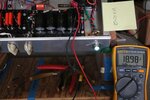
The voltage dropped to 18.98vdc after the first 30 minutes. For the last three hours, the voltage has been stuck and fluctuating at 17vdc. Either one of them new F&T caps are leaking a tiny bit, or there's something else in the circuit drawing some current. The Choke resistor and the other two voltage dropping resistors between the preamp filter cap, the phase inverter filter cap, and the screens cap are active in the circuit. No tubes installed. OT is dead cold. PT is not as cold as the OT.

Later this evening I'm participating at my friends garage jamfest. I'll recheck the dropping voltage when I get back. That should give the cap forming process a total of twelve hours. If the voltages have not improved by then, I'll probably shut the amp off and tomorrow I'll isolate the four filter caps completely away from the circuit and see what happens.
 
The voltage dropped to 18.98vdc after the first 30 minutes. For the last three hours, the voltage has been stuck and fluctuating at 17vdc. Either one of them new F&T caps are leaking a tiny bit, or there's something else in the circuit drawing some current. The Choke resistor and the other two voltage dropping resistors between the preamp filter cap, the phase inverter filter cap, and the screens cap are active in the circuit. No tubes installed. OT is dead cold. PT is not as cold as the OT.
Don't be discouraged, it could take 24 hours or more. The caps "leakage current" will reduce as the caps forms. New caps are "fast formed" at the factory, but really, we can think of this as being akin to the way in which mobile (cell) phone batteries are pre-formed at the factory. We still however need to properly form these batteries by "fully" charging them when we first get a new one.
Also, we do not know how long a "new" cap has sat on the shelf before we got it. It's not unreasonable to expect that it may have sat for 12 months or more before we got it.
The PT being a tiny smidge warmer than "dead cold" is OK, it's got current flowing through it, the OT does not at this point. I'll go back & look through the schematic to make sure the are no "bleeder resistors" or "balance resistors" being used in the HT rail.
If there was no HT fuse between the rectifier & main filter cap in the original amp circuit it would be a good idea to fit one. Cheers
 
Last edited:
BREAKING NEWS... The amp is alive and making joyful noises... :woohoo:.

Forming the new filter caps: Even after 24 hours the dropping voltage remained at 16.7 to 16.9vdc. I shut the amp down and isolated each cap and repeated the forming process for a few minutes, but the results never changed. This is the first time in forming caps that I decided to check on how much voltage the caps were holding. To my surprise, I was seeing readings of just under 600 volts... Yes, 600 volts!!!!! The 30uF caps are rated for 500vdc, and the 80uF cap is rated for 450vdc. The caps never even felt warm. WTF... :confused2:.

Another very minor hiccup with the amp is that I must have the mid/raw pot wired in reverse. Should be an easy fix.

Voltages measured at the plates of all the tubes are in spec. Only slightly higher than the original amp's voltages.

I have not calculated and fine-tuned the bias yet.

I'm happy and relieved, too... :giggle:
 
if your caps are seeing 600V and are rated at only 450V, then in time they will fail.
you will need to address this issue.

It is good news that it is working though. A job Very Well Done. :urock:
 
if your caps are seeing 600V and are rated at only 450V, then in time they will fail.
you will need to address this issue.
This is only happening during the forming of the caps process. But since the caps were charging for 24 hours, they were subjected to those voltages during that time. Once I installed the tubes, the B+ hitting the first filter cap is around 375vdc.

It is good news that it is working though. A job Very Well Done. :urock:
Gracias amigo!
 
To my surprise, I was seeing readings of just under 600 volts...
For future reference, before starting the "forming" process, check the un-loaded rectifier voltage. This means that, after breaking the HT rail between the rectifier & main filter & before installing the 100k resistor, read the positive voltage at the rectifier. If you think that there is a possibility that it will "over volt" the filter caps, "temporarily" install a 2 or 3 watt metal oxide "bleeder" resistor from the rectifier's positive terminal to ground. Figure on using a value of say, 220k to 370k. A lower value will bring the voltage down more than a higher value will. It is important that when the 100k current limiting resistor is installed, the "bleeder" resistor is on the rectifier side of it, otherwise it will draw current through the limiting resistor & therefore mess up the voltage drop across it. Once the filters are conditioned the bleeder resistor can be removed.
Glad the amp is up & running & no issues. Very well done. Cheers
 
For future reference, before starting the "forming" process, check the un-loaded rectifier voltage. This means that, after breaking the HT rail between the rectifier & main filter & before installing the 100k resistor, read the positive voltage at the rectifier. If you think that there is a possibility that it will "over volt" the filter caps, "temporarily" install a 2 or 3 watt metal oxide "bleeder" resistor from the rectifier's positive terminal to ground. Figure on using a value of say, 220k to 370k. A lower value will bring the voltage down more than a higher value will. It is important that when the 100k current limiting resistor is installed, the "bleeder" resistor is on the rectifier side of it, otherwise it will draw current through the limiting resistor & therefore mess up the voltage drop across it. Once the filters are conditioned the bleeder resistor can be removed.
Glad the amp is up & running & no issues. Very well done. Cheers
Do you, or anyone else for that matter, think that those higher than rated voltages kept the caps from forming to the better specs?
 
The excess voltage resulted in the higher leakage current, observed as voltage drop across the resistor.
If the amp doesn't have excessive hum I'd think the caps are ok & formed well enough. Cheers
 
… check the un-loaded rectifier voltage. This means that, after breaking the HT rail between the rectifier & main filter & before installing the 100k resistor, read the positive voltage at the rectifier.
Just for fun, I just did this. The meter showed 487vdc. I don't understand why I saw readings a 100v more?
 
One week later...

Today I ordered a 1x12 combo cab for the amp. Ordered it from Guitar Cabinets Direct. They're located in North Carolina. Picked out the covering, grill cloth, handle, and feet. Cab was $228, and the shipping added $40 more. IMO, the price is pretty fair for a good quality cab. No confirmation yet on long it's going to take to build and ship, but I'm guessing four weeks.

 
One week later...

Today I ordered a 1x12 combo cab for the amp. Ordered it from Guitar Cabinets Direct. They're located in North Carolina. Picked out the covering, grill cloth, handle, and feet. Cab was $228, and the shipping added $40 more. IMO, the price is pretty fair for a good quality cab. No confirmation yet on long it's going to take to build and ship, but I'm guessing four weeks.


I have bought from them before. They have good prices and the workmanship I believe is second to none.
I am very happy with mine.
 
The amp itself is operating smoothly after more than 24 hours of burn-in time. All voltages are generally where they are suppose to be. Bias is set to about 65%. Trannies get warm, but not too warm. Oddly enough, the EQ controls seem to have more range and/or more effect than originally. I did change the value of the Mid control pot from 25K to 250K, which is a nice and simple trick to get the Mid control to double as a tonestack bypass. Even the reverb seems to have gain more depth to it.

While I wait for the new cab, I'm going to take the 12" Weber Blue Dog speaker that was in the original Carvin cab and temporarily install it in a separate 1x12 cab that I have, and start fine-tuning and/or experiment with the overall sound and performance of the amp.

Syscokid's excellent adventure continues...
 
Guitar Cabinets Direct are great to deal with & their products are top notch (I have 4 headcabs made by them). Don't be surprised if the cab is ready for shipping in less time than expected, my last one was by quite a good bit.
Glad the amp is performing well, good job. Looking forward to seeing it completed. Cheers
 
Guitar Cabinets Direct are great to deal with & their products are top notch (I have 4 headcabs made by them). Don't be surprised if the cab is ready for shipping in less time than expected, my last one was by quite a good bit.
Glad the amp is performing well, good job. Looking forward to seeing it completed. Cheers
Right after my previous post about the ETA for the cab, I noticed I already had an email from GCD. It read at the end, that the cab will be shipped tomorrow or the following day! Holy Cow!! I thought that with the unusual tolex/covering that I picked out, that it wouldn't be something that they have in stock, and would have to wait till they can get to my order.
 
Back
Top