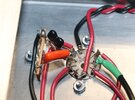
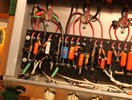
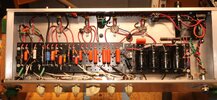
Project Carvin V-16: Morphing from PCB to Point To Point Turret Board

The eyelet board is made of Black compressed paper basicly, where the turret board will be a fiberglass G-10 board.
They are a lot more stable. And because I can and they look better I think. I will add extra turrets as test points also.
Good point. I forgot about the old school "bacon" boards. At least that's what they'll look like as they age! But I'm used to the black G-10 glass epoxy boards with brass eyelets that come with the amp kits from Allen Amps. Those are really nice. Eyelets have some advantages over turrets, and turrets have some advantages over eyelets. But I agree with you that turrets makes the board circuitry look nicer.

BTW, the boards I got from AES are 3mm thick. Very stiff!
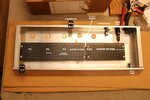
 
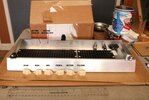
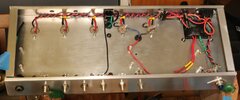
Playing with the layout, now that I know how much board is going into this. Speak up or forever hold your peace...

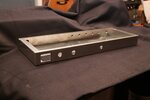
IMG_1879.JPG

IMG_1881.JPG

I'm planning on repurposing those Carvin Chickenhead knobs... :love:… I loves chickenhead knobs. They look cool and make the most real world sense.
 
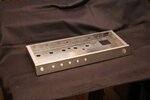
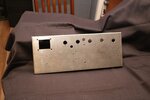
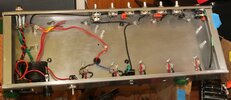
I am definitely in the Two Steps Forward & One Step Back category, when it comes to progress on this amp project. Anyways, I closed my eyes and randomly started drilling various hole sizes... It looks halfway decent:
IMG_1882.JPG


IMG_1883.JPG


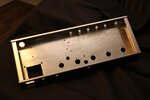
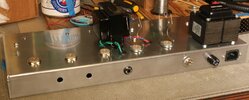
The rectangular hole on the left for the AC socket, is a massive screw up on my part:
IMG_1884.JPG
I could not cleanly cut this part worth a poop! After cleaning and squaring it off from the abortion, it is now too oversized for a clean look even though I can still secure the IEC socket. Two options that I can think of: 1: Create a rectangular washer/beauty ring to cover up the gaps? Or.... at the Rancho Burro Donkey Sanctuary | that I volunteer at, the owner Mr Jim, has already offered help with my project. The man has a nice "Metal" shop... :dood:… and says he could professionally square-off that hole and tack in a new piece! He can also weld aluminum in his shop, and I'm planning on taking advantage on that, and have him weld where the front and back panels fold up and meet the side panels for premium rigidity


IMG_1885.JPG

The holes for the grounding lugs have not been drilled yet. I'll wait till I semi-assemble the chassis' components and then decide where I want dem lugs to get screwed! I'm thinking at least 5 grounding points... :hmmm:
 
dude, everything looks good. cutting those square holes are always a bear for sure.
I received your package , but have not opened it yet. Been spending most of the past several day
fighting a repertory infection.

Keep up the good work!
 
That is gotta suck. I thought living in all that Arizonian dry air is suppose to prevent crud like that!

yeah thats the story your told, but with all the snowbirds coming in now, and . . . well lets just say aahhh :poo: it happens anyway.
I guess I was at the wrong place at the wrong time.
 
Another question...
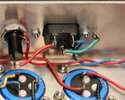
This pic is from another build of mine. Is grounding the AC socket OK like this?
IMG_1660 - Copy.JPG
 
Update on some progress. Finally started installing some of the components and the dreaded heater wiring...
IMG_1917.JPG
The yellow zip ties are only there temporarily.


IMG_1918.JPG

IMG_1919.JPG


THIS IS MY FIRST ATTEMPT AT AN ARTIFICIAL CENTER TAP. Does this look OK????????
IMG_1922.JPG
The black ground wire attached to the pair of resistors is connected to the furthest ground point and sharing the gounds with the input jack and V1b cathode. I am going to add an insulating sleeve on the lower resistor's long lead.
 
Hi Sysco, sorry I haven't checked in of late. Regarding the earth at the mains socket, read the resistance from the IEC sockets ground lug to the chassis. Our standards here specify no more than 2 ohms, but I strive for much better. I have used like you've done above, so long as it's meeting standards it's fine. The heater's artificial CT is also fine.
I wouldn't do the input socket like that though. I have just woken up (on 1st coffee now) so may be wrong, but I think there may be a mistake in how you've done it. I'll finish this coffee, get a Cliff jack socket out (so I can take pics) & get back to you. Cheers
 
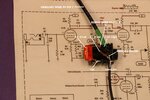
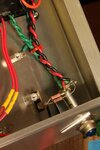
Can any of you amp nerds verify my setup on the Cliff jack, please?
View attachment 34003

View attachment 34002
Ok, I've nearly finished my 2nd large coffee so am in much better shape. It does appear that the above is not quite right. It also appears from the schematic that they've drawn a switching "stereo" jack socket, but only wired it as a switching "mono" socket, which can make it confusing.
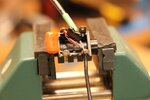
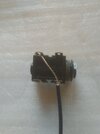
So, we'll start with the ground wiring of the switching "mono" Cliff jack socket. It should be wired like thisIMG_20191114_064822.jpg
Here the lead is tied to the "sleeve" lug of the socket & carries diagonally across the socket to the "tip switch" lug. The reason for this is so that when no jack is inserted into the socket, the input to V1a is grounded.
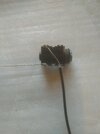
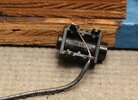
Ok, moving on to the jack socket's "tip" lug. Looking at the schematic diagram we see that the 0.01uf cap is tied to it. Now, you can either connect the cap directly to the lug, where the un-insulated wire is attached in this picIMG_20191114_064953.jpg though my choice would be to connect the shielded cable's inner conductor here & place the cap as close as possible to the V1a socket.
This brings us to the 10pf cap & 2.2Meg resistors to ground. Note that on the schematic these two components are attached to the V1a grid pin side of the 0.01uf cap, rather than the jack side of it. I would connect these two components (10pf cap & 2.2meg resistor) directly to the V1a socket grid pin, then ground them back at the input jack socket's chassis ground. Hope this helps. Cheers
 
Ok, I've nearly finished my 2nd large coffee so am in much better shape. It does appear that the above is not quite right. It also appears from the schematic that they've drawn a switching "stereo" jack socket, but only wired it as a switching "mono" socket, which can make it confusing.
So, we'll start with the ground wiring of the switching "mono" Cliff jack socket. It should be wired like thisView attachment 34405
Here the lead is tied to the "sleeve" lug of the socket & carries diagonally across the socket to the "tip switch" lug. The reason for this is so that when no jack is inserted into the socket, the input to V1a is grounded.
Ok, moving on to the jack socket's "tip" lug. Looking at the schematic diagram we see that the 0.01uf cap is tied to it. Now, you can either connect the cap directly to the lug, where the un-insulated wire is attached in this picView attachment 34406 though my choice would be to connect the shielded cable's inner conductor here & place the cap as close as possible to the V1a socket.
This brings us to the 10pf cap & 2.2Meg resistors to ground. Note that on the schematic these two components are attached to the V1a grid pin side of the 0.01uf cap, rather than the jack side of it. I would connect these two components (10pf cap & 2.2meg resistor) directly to the V1a socket grid pin, then ground them back at the input jack socket's chassis ground. Hope this helps. Cheers
Thank you, sir. A few minutes ago, I just got finished with all of the wiring. But in light of what you just described about the way I wired up the input Cliff jack, I'm going to have to correct this. I never would have figured this out on my own. Maybe I can relocate the two caps and resistor from the input jack onto a tag strip near the V1 socket.
 
Back
Top