Project Carvin V-16: Morphing from PCB to Point To Point Turret Board

syscokid

Ambassador of War & Peace
Country flag
I want to gut the chassis and all its components of my Carvin Vintage 16, and rebuild it from a PCB design into a Point 2 Point/turret board design. I've successfully this conversion on my '82 Marshall JCM800 4104 over 9 years ago, but this new idea is going to be much more of a challenge. I would greatly appreciate any help with this project

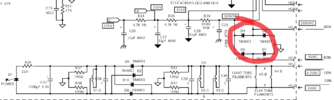
I need to draw up a layout of the new furnishings, but right off the bat I do not understand what is happening in the heater circuit of the Vintage 16. In the following cropped pic of the official schematic I have highlighted in red all the components that I've never seen before in an old school heater circuit for guitar amps.
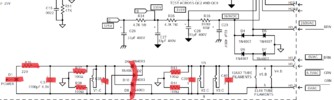
Carvin Vintage 16 Heater HIGHLIGHTS A.png

Many questions:

What are those 4 diodes doing in between V1 and V2? Converting the heater current from AC to DC?

Diode D1 looks special. I don't understand the arrow symbol next to the diode symbol…?

Caps #37, 38, 39, & 40 look like they serve the same function, but why are they there?

Resistors #37, 38, 43, & 44...????

Resistor # 39...?

Link to full schematic in pdf:
V16 Schematic.pdf
 

Attachments

I have a 2002 Rev. C Carvin Vintage 16. On mine, the D1 is a white/clear LED for the power indicator, V1 is using DC for the heater filament and the rest of the tubes are using AC for their heater filaments. By the looks of it they are using 100 ohm as an 'artificial' center tap to ground, something a lot of people do when there is no 6.3vac center tap, which kind of helps keep the hum down. My amp is probably that way too, but schematics don't always match the amps and I didn't physically check mine to verify it. Hope this helps...
Edit:
My board is matching up with the schematic and has the 100 ohm resistors to ground (artificial center tap).
 
Last edited:
I have a 2002 Rev. C Carvin Vintage 16. On mine, the D1 is a white/clear LED for the power indicator, V1 is using DC for the heater filament and the rest of the tubes are using AC for their heater filaments. By the looks of it they are using 100 ohm as an 'artificial' center tap to ground, something a lot of people do when there is no 6.3vac center tap, which kind of helps keep the hum down. My amp is probably that way too, but schematics don't always match the amps and I didn't physically check mine to verify it. Hope this helps...
Edit:
My board is matching up with the schematic and has the 100 ohm resistors to ground (artificial center tap).
Thanks, Drumoid. Mine is 2002 Rev. C, and all those components are there, too!

D1 is a Light emitting diode or LED power on indicator most likely.
D9 D2 D10 D8 is your full wave rectifier.
So, the amp has two rectifiers? The rectifier on the heater circuit is there to change the filament circuit from AC to DC for the first preamp tube to help reduce hum? The second rectifier is there to convert AC to DC for the B+?

Carvin Vintage 16 Heater Circuit - Highlight B.png
 
I took another look at the schematic.

Diodes D4, D5, D6, and D7 seem to be a full wave bridge rectifier (power supply has no center tap, like the filament supply). Junctions D4/D5 and D6/D7 take the AC in. Junction D5/D7 provides negative DC, which is sent to ground. Junction D4/D6 is the positive DC supply. Junction D4/D5 alos provides AC to the negative bias supply.

Diodes D9, D2, D10, and D8 appear to be another full wave bridge rectifier used the in the heater filament supply providng DC juice for the V1 filament voltage supply. Junctions D9/D2 and D8/D10 are taking in AC. Junction D9/D10 is providing positive DC and junction D8/D2 is providing negative DC.

I think I got that all straight anyways - lol...
 
If I can relocate the tubes by spreading them out and retro fit a larger circuit board with turrets, I would also be able to simplify the heater wiring by changing V1 to AC current for the heaters instead of DC. Also if I change this part of the circuit, LED diode D1 would have to be reconfigured because it's probably designed to operate on only DC voltages... :unsure:

I guess Carvin designed the heaters like this because of condensed size of the pcb that also carry the tube's heater current through the pcb's tiny tracks and extremely close proximity to all the other sensitive components on the same pcb. All in the name of reducing injected hum... :unsure::unsure:
 
As I work my brain into trying to figure out how to set up this conversion for this project, I wanted to verify the voltages surrounding that LED pilot light (Diode D1) and heater filament voltages for V1. Yes, they are DC: Pins 4 & 7 are 3.18vdc/Positive, and pin 9 is 3.18vdc/Negative. While the chassis is on the bench, I decided to poke around for other voltages at different locations. Then it dawned on me: The JJ EL84's in this amp are over 10 years old. That's pretty old for some power tubes!

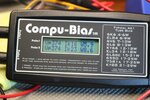
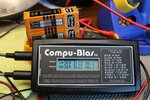
I hooked up my bias measuring meter, called the Compu-Bias. An EL84 is a 12 watt tube. The chart to the right of Compu-Bias display shows plate dissipations of 50%/Cool to 75%/Hot for each particular type of tube. Power tubes should be closely matched. As you can see from the following result, these are not even close... ha ha!!! Maybe they drifted apart after all these years, and it's now time to divorce them from the amp.
10+ Year Old JJ EL84's.JPG


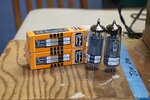
To my surprise and poor memory, I found these in my stash... :woohoo:
Stash Surprise.JPG
Don't know who makes these for TAD, but they are not rebranded regular JJ's.


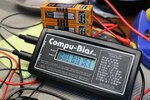
Look how evenly matched these are. But the original bias setting is too cold:
Original Bias with New EL84's.JPG


Adjusted the amp's bias trimpot to a nice and warm 65%... or 8 watts:
Bias Adjusted to 65%.JPG

The difference in the amp's performance is like night and day. Definitely love what I'm hearing. Some of the difference might be due to replacing old power tubes with new ones. Other differences is due to the different construction of the this type of EL84.

Anyways.… Back to the drawing board...
 
This project will more than likely take some time. I will need to be sure and have it down on paper before I purchase parts and start opening new holes in the chassis. I DO NOT HAVE A PROPER EDUCATION OR OVERWHELMING KNOWLEDGE ON ELECTRONICS. I'm posting this project for anyone here that might be interested, but also to open up to other's ideas, recommendations, and more knowledge. With that said, here's more Porn and my thoughts:

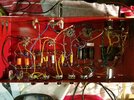
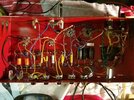
This is what I'm dealing with. The red outline is my idea for a new board with turrets:
IMG_1823.JPG


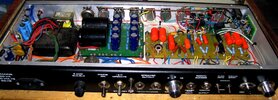
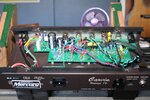
This pic clearly shows the components that are secured to the back of the chassis. The black 10-pin ribbon cable is connected to the single 8 ohm speaker jack and a pentode/triode switch. The pot is for the add-on Raw control mod (Tonestack bypass). This pot might be eliminated if I can figure out how to incorporate the raw control with the amps original mid control. Those 2 little green pcb's will be eliminated.
IMG_1825.JPG


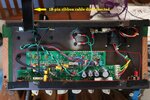
This next pic shows the pcb mounted mini-pots and input jack. That full-size dual pot with the yellow caps is another mod that alters the original master volume from pre phase inverter MV to post phase inverter MV. All the tube sockets, pots, and input jack will be chassis mounted instead of pcb mounted.
IMG_1826.JPG


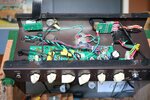
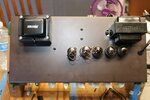
Look at all that prime real estate in between the transformers!
IMG_1827.JPG


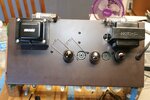
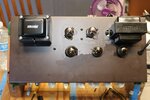
This is a mock-up of my idea to use the 5 existing holes for the tubes and spread out the 3 preamp tubes and relocate the 2 power tubes between the trannies.
IMG_1828.JPG


And with some silly photo editing, you get the picture...
IMG_1827Copy.JPG


It's very important to me that the outside of the amp looks as normal as possible.
 
Last edited:
I agree with yall regarding the 2 sets of diode rectifiers, B+ for one set, v1 filaments for noise for the other, and the 100 Ω artificial center taps.

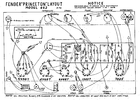
Here is where my brain is used to Fender layouts
How big is that jewel?
You could put a bulb socket there and run your 100Ω pair for the filament artificial center tap. You dont need the 2nd pair.

I probably move the OT - or study how the B+ routes to the OT center tap.
I probably set it up like my 6G2 Brown Princeton because I've been there done that and it works; including using a small separate board (I use terminal strips) for the bias w/ adjustment pot (next to the first pot on the right, closest to jewel).
Mine uses radial power filter caps not the can, and they are very local to the OT.

YOurs is very similar except you have both triodes of v2 for the reverb drive and recovery.


fender_princeton_6g2_layout.gif20190909_191253.jpgstart up 2.jpg

I dont recall why my pin 3 power tube + leads are so long and fly in,,,,, and,,,,
NFB! gotta wait to see if the phase is correct or you get the bigly piggie squeallies.

I mean the foot print could be similar, the circuit is different.
mIne has the trem on 1 v2 triode and the cathodyne PI on the other, your LPT PI uses both v3 triodes.
 
Last edited:
How big is that jewel?
You could put a bulb socket there and run your 100Ω pair for the filament artificial center tap. You dont need the 2nd pair.
Excellent! The Jewels match up. It would be perfect. The whole bracket assembly for the 6.3vac indicator light should pop right in. I can then run the PT's green heater wires straight to the bulb, then directly connect to the power tubes. And of coarse, throw in one of those artificial center taps right at the light bulb assembly. I'm calculating that this new layout would eliminate 11 components... :)

I probably move the OT - or study how the B+ routes to the OT center tap.
I really hope this won't be necessary!

Mine uses radial power filter caps not the can, and they are very local to the OT.
I hope you meant axial and not radial. But yeah, axial caps in the flat position are so much easier to service.

This is excellent work, jt! This is a very well thought out and efficient layout... (y)
start up 2.jpg
 
This project will more than likely take some time. I will need to be sure and have it down on paper before I purchase parts and start opening new holes in the chassis. I DO NOT HAVE A PROPER EDUCATION OR OVERWHELMING KNOWLEDGE ON ELECTRONICS. I'm posting this project for anyone here that might be interested, but also to open up to other's ideas, recommendations, and more knowledge. With that said, here's more Porn and my thoughts:

This is what I'm dealing with. The red outline is my idea for a new board with turrets:
View attachment 31311


This pic clearly shows the components that are secured to the back of the chassis. The black 10-pin ribbon cable is connected to the single 8 ohm speaker jack and a pentode/triode switch. The pot is for the add-on Raw control mod (Tonestack bypass). This pot might be eliminated if I can figure out how to incorporate the raw control with the amps original mid control. Those 2 little green pcb's will be eliminated.
View attachment 31312


This next pic shows the pcb mounted mini-pots and input jack. That full-size dual pot with the yellow caps is another mod that alters the original master volume from pre phase inverter MV to post phase inverter MV. All the tube sockets, pots, and input jack will be chassis mounted instead of pcb mounted.
View attachment 31313


Look at all that prime real estate in between the transformers!
View attachment 31314


This is a mock-up of my idea to use the 5 existing holes for the tubes and spread out the 3 preamp tubes and relocate the 2 power tubes between the trannies.
View attachment 31316


And with some silly photo editing, you get the picture...
View attachment 31315


It's very important to me that the outside of the amp looks as normal as possible.

You got a wheelbarrow??? You gonna need one for your nuts!!!
 
Back
Top