Project Carvin V-16: Morphing from PCB to Point To Point Turret Board

Great project Sysco, I'll be watching this one. Regarding the indicator lamp, I prefer to power this off the AC power supply (120VAC) rather than the 6.3VAC heater supply. These lamps are commonly available in all varieties & sizes, down to LEAD bezel sizes & as the indicator lamp is usually right beside the power switch it makes it really easy (& neat) to wire it in. I wouldn't consider moving the OT. The way the transformers are positioned & oriented is the best way they can be for the least amount of coupling between them. There is a lot of unused chassis real estate between the transformers, so I would consider placing the power tube sockets between them with the phase inverter socket either centrally mounted between the two power tube sockets, or slightly in front of them. This would also free up a lot of space around the pre amp tubes. For adequate cooling, tubes should always have at least a tubes width between each socket. Pay attention to how you design your grounding, whether using localised grounds, star grounding or a single ground bus. The "grounding" should follow the current flow through the amp (& this includes the heater supply's faux center tap). Take a look at Carvin's ground scheme for ideas. Hope it works out well for you. Cheers
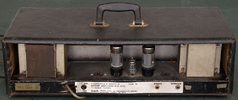
 
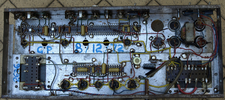
Hi Sysco, to give you a visual idea of how to mount the power tubes & PI between the transformers, here a couple of pics of an old Aussie made 100 watt head I pulled off the web. Aside from the amp looking like it needs a good cleaning & service, it does show this type layout quite well15684113786501615428428110303460.png
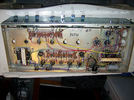
Here you can see the PI mounted between the power tubes (outter two tubes missing).156841132823255143397735808392.png
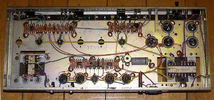
Here you can see the long tail pair PI & power tube wiring & circuitry between the transformers, with the pre amp tubes mounted across the center of the chassis. Hope this helps. Note the use of mustard coupling caps. This was common in Aussie made amps. Cheers
 
Last edited:
Hi Sysco, to give you a visual idea of how to mount the power tubes & PI between the transformers, here a couple of pics of an old Aussie made 100 watt head I pulled off the web. Aside from the amp looking like it needs a good cleaning & service, it does show this type layout quite wellView attachment 31387
Here you can see the PI mounted between the power tubes (outter two tubes missing).View attachment 31388
Here you can see the long tail pair PI & power tube wiring & circuitry between the transformers, with the pre amp tube mounted across the center of the chassis. Hope this helps. Note the use of mustard coupling caps. This was common in Aussie made amps. Cheers
Muchas gracias Señor Ivan... (y).

Ha ha... the only Australian amp company that I know about is M.I. Audio. Are they still around?
 
Muchas gracias Señor Ivan... (y).

Ha ha... the only Australian amp company that I know about is M.I. Audio. Are they still around?
Yes, MI Audio are still around (Sydney, NSW), producing amplifiers & FX pedals etc. There are several others producing amps, though nothing like on the scale of the 50's to 70's era. If you go to the "Aussie Guitar Gearheads" forum site & check the "Aussie Made Amplifiers" sub forum you'll find a quite a few. Cheers
 
156841132823255143397735808392.png

Here you can see the long tail pair PI & power tube wiring & circuitry between the transformers, with the pre amp tubes mounted across the center of the chassis. Hope this helps. Note the use of mustard coupling caps. This was common in Aussie made amps. Cheers
This is such a cool pic! It looks like an old dinosaur... a badass dinosaur! The chassis looks hugemongus. Never seen the heater wires get wrapped around the perimeter of the tubes like that. Have you, or anybody else here, worked on those type of terminal boards?????
 
This is such a cool pic! It looks like an old dinosaur... a badass dinosaur! The chassis looks hugemongus. Never seen the heater wires get wrapped around the perimeter of the tubes like that. Have you, or anybody else here, worked on those type of terminal boards?????
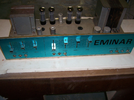
Over the years I have serviced & repaired a few different models of these (Eminar) amps & PA's. The terminal (or tagstrip) board used in these is still readily available & is quite good, for ease of construction & also service/repair.
These amps had some good points & some bad points. Good points are the method of circuit construction (using the tagstrip) & the transformers which were really good, hefty units. Later models like this 100 watt15684279593055275033912973612862.png15684285452956926561711175083059.png or this 150 watt15684287682107114763752538571131.png used a power transformer featuring one HT winding for the power tube plate supply (delivering over 600VDC) & a lower voltage HT supply for the power tube screen grids, PI & pre amp, as can be seen in this schematic15684281684925171866540667117097.png
The output transformers had similar hefty sized core's & interleaved primary/secondary windings, the only downside being that impedance switching meant soldering the necessary links on the OT's tagboard.
Bad points were the chassis being constructed from very thin (like 1mm thick) sheet metal, later models using sliders instead of pots (easily knocked around & broken,, hard to clean/maintain & even harder to source for repairs) & the headcab being constructed from chipboard (particleboard) & also being way undersized (especially height-wise). Notice in the very first pic that the top of the headcab barely clears the transformers & power tubes. The top of the cab would warp from the heat.
Ok, rant over. Cheers
EDIT: Larry from the Metroamp forum (& also the "La" of "La/Mar" PPIMV fame) favors this type tagstrip for amp building. Cheers
 
Last edited:
… or this 150 watt
15684287682107114763752538571131.png
used a power transformer featuring one HT winding for the power tube plate supply (delivering over 600VDC) & a lower voltage HT supply for the power tube screen grids, PI & pre amp, as can be seen in this schematic...
HOLY ANODE VOLTAGES! What type and brand of power tubes were sucking up over 600vdc's? Was this one of those PA amps: Cleans at massive volumes?

EDIT: Larry from the Metroamp forum (& also the "La" of "La/Mar" PPIMV fame) favors this type tagstrip for amp building.
Yeah, a lot of my amp nerdiness come from those boyz over there. And Larry, aka novosibir, has straighten me out a couple times.
 
HOLY ANODE VOLTAGES! What type and brand of power tubes were sucking up over 600vdc's? Was this one of those PA amps: Cleans at massive volumes?


Yeah, a lot of my amp nerdiness come from those boyz over there. And Larry, aka [URL='http://w
HOLY ANODE VOLTAGES! What type and brand of power tubes were sucking up over 600vdc's? Was this one of those PA amps: Cleans at massive volumes?


EL34's, most probably originally Mullards or Philips/Miniwatt's (Philips/Mullard set up manufacturing plants for valves, mustard capacitors etc, etc here in Oz). EL34's have a design maximum anode rating of 800VDC & so handle voltages like the 650-ish VDC that the amps put on them quite well. The screen grid (grid No. 2) has a design maximum rating of 500VDC. Note the HT-2 screen supply of 340VDC. The PA amps, guitar amps & bass amps all had similarly designed power amps & supplies, so yes, high headroom & loud. Guitar amps had to be pushed HARD to get some crunch. They also made some 6L6 amps that had similar HT designs.
There is an EL34 100 watt PA head available at the moment (reasonably priced) that I'm considering grabbing to harvest the transformers from, maybe put a SLO or Mesa mk2 lead channel into this type power amp. Sorry for the de-rail. Cheers
 
Last edited:
No progress last week while I was sucking up some crisp mountain air at Lake Tahoe. Last few days though, this is what I got...

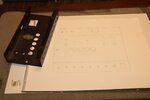
Traced the chassis and all the openings for trannies, screw holes, socket holes, etc:
IMG_1832.JPG


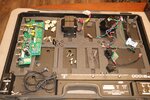
No soldering involved for gutting out the chassis:
IMG_1833.JPG


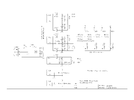
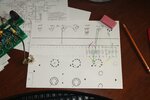
Beginning a very rough sketch of the future layout. First will be the preamp including the phase inverter. When I think I got the board for the preamp figured out, I'll then tackle the power supply, rectifier, and filter caps on a separate board. The heaters will be last. My lack of proper education and complete understanding of circuits, plus the fact that the aftermarket doesn't cater to these amps, is sometimes making me feel like giving up on this project. Little by little, and it should come around:
IMG_1836.JPG
 
@syscokid , since you are going this far, if you would like to experiment with the amps voicing, here is a link you may find interesting.
The first link is A LOT of theory. And I mean A LOT but I know you will be able to follow it . You do have the background to follow it.
The second link is really pretty cool. It is a graphical display of what happens when you change different components in different style tone stacks
Amp Voicing
Ducan's Tone Stack Calculator
 
Two very good links Mr ChasFred. Also worth checking out Sysco, the thread "calculating RC time constants & why you should" in the "Repairs Restorations & Mods" section over on the Metroamp Forum. Here's a link to the ampbooks Cathode Bypass Capacitor Calculator that may be useful
Use the menu to check out other ampbooks calculators, tutorials etc. Hope this is of help. Cheers
 
@syscokid , since you are going this far, if you would like to experiment with the amps voicing, here is a link you may find interesting.
The first link is A LOT of theory. And I mean A LOT but I know you will be able to follow it . You do have the background to follow it.
The second link is really pretty cool. It is a graphical display of what happens when you change different components in different style tone stacks
Amp Voicing
Ducan's Tone Stack Calculator
"Amp Voicing" by Rob Robinette... that guy's whole website is full of cool amp info. He really hates solid state! Earlier this year I donated $20 to his site for his efforts.

"Duncan Tone Stack Calculator"... Yes, yes, yes! Excellent visual tool. You can see how your bass, mid, and treble controls are going to respond in the circuit. Definitely a favorite of mine, and it's locked and loaded on my computer.


Two very good links Mr ChasFred. Also worth checking out Sysco, the thread "calculating RC time constants & why you should" in the "Repairs Restorations & Mods" section over on the Metroamp Forum. Here's a link to the ampbooks Cathode Bypass Capacitor Calculator that may be useful
Use the menu to check out other ampbooks calculators, tutorials etc. Hope this is of help. Cheers
Between you and ChasFred, these are all excellent links providing excellent amp circuit info. I am familiar with the Ampbook's site, and its calculators and other resources and tutorials. Same goes for that "Calculating RC time constants & why you should" thread at the good ol Metroamp Forum. I remember reading the beginning of that thread many years ago. At the time, that subject was so over my head that it caused my economy brain to overheat... ha ha! I shall revisit that thread again, thanks... (y)

Right now all im concerned about is replicating the current circuit of this amp onto a turret board construction. Any adjustments to the current circuit will be considered later. And any adjustments should be easier accomplished due to the retrofit of turret boards... I hope!
 
I would have liked to see him change out that PC mount type octal valve socket for a proper solder lug type. Otherwise, cool little conversion. Cheers
 
Back
Top