Project Carvin V-16: Morphing from PCB to Point To Point Turret Board

Great job Sysco, really good. Glad you got the circuit tuned to your liking, that there is an accomplishment.
Mojotone make up custom faceplates. Also Modulus Amplification in the UK. On their site they show how to make up the digital representation of the faceplate required for them to laser engraved one up for you. Hope this helps. Cheers
 
That came out great, nice work!!
Congrats on the amp and the experience and knowledge gained!

Every time I work on these I find new ways to screw up or forget things I learned the last go round.
Eventually everything seems to come together.
 
Pin 2 negative feedback
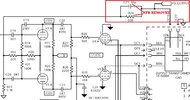
Thanks, but I still don't understand. The Carvin Vintage 16 originally had a negative feedback loop, but one of the Hasse mods involved removing the NFB completely. Therefore, the Hasse mod called for C21 and R24 to be removed. The new amp (Spiffy XVI) remains without any NFB. Is C19 somehow related to the original NFB?


Stock Carvin Vintage 16 schematic:
Stock Phase Inverter with Feedback.JPG
 
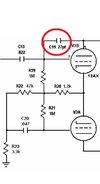
My guess is the 27pf capacitor is blocking that frequency out.
Yup, you're right. A couple hours ago I removed the C19 cap, and the amp got a little bit brighter. It acts like one of them fizz or snubber caps that some amps have between the two plates of the long tail phase inverter tube. Which is what I added to this amp's circuit earlier today. I'm going with a 100pF silver mica cap, for now. And I think I'm going to leave off the C19 cap, and tomorrow I want to try a bypass cap at the 220k plate resistor of V1b

In the last couple of days, I've been experimenting with the amp's higher frequencies and trying to get them sounding a little bit sweeter.
 
Yup, you're right. A couple hours ago I removed the C19 cap, and the amp got a little bit brighter. It acts like one of them fizz or snubber caps that some amps have between the two plates of the long tail phase inverter tube. Which is what I added to this amp's circuit earlier today. I'm going with a 100pF silver mica cap, for now. And I think I'm going to leave off the C19 cap, and tomorrow I want to try a bypass cap at the 220k plate resistor of V1b

In the last couple of days, I've been experimenting with the amp's higher frequencies and trying to get them sounding a little bit sweeter.

Dude you are really stepping up. Kudos to you Sir.
 
Dude you are really stepping up. Kudos to you Sir.
Thanks, CF... Kudos are much better than Cooties :giggle:. It's all fun, and it keeps my mind active.

On my imaginary blackboard, "Things left to do or try":
1: Add a bypass cap to the V1b 220k plate resistor.
2: Add a larger valued bypass cap (22uF) on a switch, to V1b cathode.
3: Replace the stock Carvin OT with a Mercury Magnetics OT... this is a big maybe.
4: Replace the Weber ceramic speaker with an alnico speaker version... another big maybe!
5: And, a proper faceplate at the front chassis controls.
 
The C19 27pf cap is an application of "local" negative feedback, being local to just that tube, & your right in that it does the same sort of thing as a "fizz" cap in taking out extreme highs.
Removing C21 & R24 breaks the "global" negative feedback loop (global in that it encompasses the entire power amp, from output to PI). This "global" negative feedback is what is commonly referred to as NFB, but by no means the only form of feedback. Local feedback can be taken around any stage & is especially useful for tidying up overdriven waveforms (as is done in a Laney AOR pre amp).
Good to see that you learning. Cheers
 
Good to see that you learning.
Not bad for an old dog, huh?

From what I've been hearing out of this amp, I prefer the 100pF fizz cap between the plates of the PI, rather than the 47pF fizz cap between plate and grid of only one side of the triode.

Last night I also tried bypassing either of the plate resistors of V1 with different cap values, but everything I tried either made no difference or neutered the amp too much. This is all good though, because the Cut control works very well with this amp that also has no NFB loop.

I also tried adding a 22uF cathode bypass cap in parallel to the 1.5uF cap of V1b and definitely like what I hear. More girth to the clean tones, and still doesn't muddy-up the amp's overdriven tones. I will be putting this extra cap on a switch so I can have best of both worlds.
 
I'm not a fan of plate bypass caps early in the pre amp either. Regarding the "switchable" 22uf cathode bypass, you may find it pops when switching it in. To prevent this you can try wiring the 22uf cap as a partial bypass, where a resistance is place between the cap & cathode. Increase the value of the resistance until you are no longer hearing the effect of the cap being there. Then, to switch it in, use a SPST switch to "short" the resistor, thus connecting the cap straight to the cathode. Hope this helps. Cheers
 
Last edited:
I'm not a fan of plate bypass caps early in the pre amp either. Regarding the "switchable" 22uf cathode bypass, you may find it pops when switching it in. To prevent this you can try wiring the 22uf cap as a partial bypass, where a resistance is place between the cap & cathode. Increase the value of the resistance until you are no longer hearing the effect of the cap being there. Then, to switch it in, use a SPST switch to "short" the resistor, thus connecting the cap straight to the cathode. Hope this helps. Cheers

Unfortunately I'm not confident that I understand this completely... Shorting the resistor?

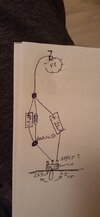
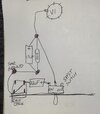
Here's a couple of my illustrations on the layout of a 2-in-1 cathode bypass cap switch:
1:
20200127_201224-477x1032.jpg
EDIT: THE TUBE'S CATHODE PIN SHOULD BE #8. I MISTAKENLY WROTE A 7.


2:
20200127_205458-742x845.jpg

I'm favoring #2.

Is there a better method?
 
Last edited:
Since your using 100k plate resistors the rule of thumb is 100k/1K5/25uf
If you want to play with the gain Vox AC15 used 150K/2K2/25uf
Fender Brown face Deluxe 220K/3K3/25uf high gain.
Pin 3 & 8 Cathode bias your 909R is basically a 1K low current draw
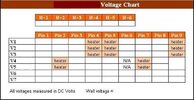
First step is to voltage chart your amp then adjust the dropping string to get the desired voltages

Voltage Chart.JPG
 
Back
Top