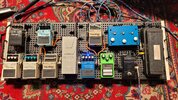
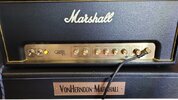
New Borrowed Mesa Fillmore 50 Day!!!!

Can the Mesa players interject???

Only thought that jumps out at me is that its a bit of an apples and oranges comparison.

First, a broken-in 2x12 cab vs. a brand new single 12 combo? As far as moving air that's as big a difference as putting the 2x12 up against a 4x12 to me, plus you're getting the low-end extension of the broken-in speakers. I just don't see a way you will replicate the sound and feel of a separate 2x12 with a combo - combos are a compromise IMO; you do them for weight, size, cost, or ease of movement, not because they are going to compete sonically with a head/cab setup.

Next thing is, why are we comparing the sound of one amp to the sound of another? They are different things and are going to sound, feel and react different. No shame in preferring a Marshall but if that's the sound you've hung your hat on don't go looking to replicate it with a Boogie. Boogies are their own thing, which is decidedly NOT a Marshall. Those of us that love them do so largely for that reason - freaking everyone sounds the same (Marshall) so its great to have a sound that is definitely not that. Even the "thumpiest" Boogie mode (EXTREME, which has zero negative feedback and more gain) won't sound like a Marshall, even as the low end loosens your bowels.

Some Mesa circuits will do that thing you describe. Try a Triple Crown or a Badlander. But it ain't a Boogie, so I'd say its either love that sound or move on.
 
Gotcha, Rob. As you know, I am kind of green to Mesa's and of course your new direction opens us all up to learning more pro's and con's of them and other amps to fill certain niches or not.

Me too. If it wasn't for @Don O's kindness in allowing me to check this out under live performance conditions, it is doubtful I would have ever been able to really, truly test one of them!!!!
 
Only thought that jumps out at me is that its a bit of an apples and oranges comparison.

First, a broken-in 2x12 cab vs. a brand new single 12 combo? As far as moving air that's as big a difference as putting the 2x12 up against a 4x12 to me, plus you're getting the low-end extension of the broken-in speakers. I just don't see a way you will replicate the sound and feel of a separate 2x12 with a combo - combos are a compromise IMO; you do them for weight, size, cost, or ease of movement, not because they are going to compete sonically with a head/cab setup.

Next thing is, why are we comparing the sound of one amp to the sound of another? They are different things and are going to sound, feel and react different. No shame in preferring a Marshall but if that's the sound you've hung your hat on don't go looking to replicate it with a Boogie. Boogies are their own thing, which is decidedly NOT a Marshall. Those of us that love them do so largely for that reason - freaking everyone sounds the same (Marshall) so its great to have a sound that is definitely not that. Even the "thumpiest" Boogie mode (EXTREME, which has zero negative feedback and more gain) won't sound like a Marshall, even as the low end loosens your bowels.

Some Mesa circuits will do that thing you describe. Try a Triple Crown or a Badlander. But it ain't a Boogie, so I'd say its either love that sound or move on.

True, all things in music are a compromise. Good points too on the response of a broken in speaker vs. a new one. For me, I don't really consider that breaking in thing a big concern for me, because I can easily rack up 30-40 hours of speaker time in 7 days, but your comment does indeed make sense.

I expected the Mesa to sound different. What I did not expect was that even when the bass knob is cranked the the low slider on the GE-7 is maxxed out, you still don't get a "thump" out of the Mesa on the bottom end. This is most noticeable on palm muted F#'s such as the into to Judas Priest's "Youve Got Another Thing Comin," but having said that, the Mesa does retain a very balanced tonal spectrum with plenty of midrange to easily cut through the mix.

So, what I think I have identified in this experiment is that I tend to like cranked bass EQ with a swirling, chainsaw-esque midrange that not only cuts through the mix, but the resonance (even from a 1x12 DSL40C) literally hits you in the chest if you are in front of the amp.

This is especially useful when playing with a midrangey bassist and it gives whatever song you are playing a much stronger and articulate bottom end.

Now, @Mitch Pearrow SJMP has been in attendance at our rehearsals at primo in Riverside and I was running a DSL40C with a 107db Electro-Harmonix 12VR75 and I was up against our other guitarist's 100 watt Carvin Full Tube Stack. Now, this is no measure of sound quality, but let me say this. Our guitarist at the time (Todd) liked to keep edging up the volume levels. Everyone else responded in kind and the bassist was running an Ampeg Refrigerator, so we were so loud that Kurt the manager came in to see what we were running.

It was near the end of the rehearsal (last song) and I said "F*** it" and cranked my DSL40C (Master Volume was on 8 so I rolled on the FV30L) and I noticed Todd reaching for his amp's volume knob repeatedly. After that song he said, "Dude, WTF!!! I was totally cranked and you were killing me with that stupid ass Russian speaker thing you got on the other side of the stage!!!' He could not believe his 100 watt tube full stack was obliterated by my DSL40C 1x12 Combo.

Now, dick measuring contests happened occasionally, and that's one reason why we dropped that guy and moved on, so I am not saying this to look cool or whatever, but to be able to produce that level of resonance and never have it overwhelm the speaker with the bass frequency and still be able to dial in enough mids to rise up over that bass response, almost as if you were actually running tow amplifiers, is something that appeals to me.

That's not saying that the midrange tone of the mesa is not appealing. People who know me on FB have heard the short video we shot at rehearsal on Saturday and the Fillmore totally stunned everyone with it's punch and small packaging. There really is nothing I have negative to say about the Mesa Fillmore. Nothing at all. But, to my ears, it sounds thin in the mix and a lot of that has to do with how all our bass players seem to intrude into the guitar's sonic register with a really, twangy, midrangey kind of sound.

I get 2 hours of prep time on Saturday's before the student band assembles, and I frequently take this time to do a 2 hour warm up of various songs, riffs, etc. 2 weeks ago, I was jamming in the rehearsal space and the director came in and said, "Who was playing bass with you>" I replied, "Nobody." He was stunned and said, "Hit a chord," and I busted out the main riff to "Wicked Sensation" and he said, "Geez, that thing is pushing air like a bass!!! The pictures on my office wall were rattling, yet the mid range is cutting like a chain saw. What have you got in that Origin????"

Ya, OK, that's a cool compliment, but let me tell you that we have been playing out live and the bass player stepped on his cable and pulled it out of his bass for a minute, and when we went back and listened to the video they shot, my amp was kepping up the lower end to where it wasn't a night and day difference.

I like having that sonic authority in a live mix. and it really adds a fullness to the overall spectrum.

I'm not sure that I can shake that, Man...
 
Can't speak for the Fillmore. The TC100 sounds quite Marshally but still required some low amd High EQ with graphic. I use the built in on the MrkV 35 and it does very well. I use a V curve and it gives the little open back 112 some thump. Very open sounding, midrange control seems to do quite a bit. Tons of gain, channel 1 can be Clean, Fat clean or crunch which can go way over the top.
Channel 2 can get extreme. Solo boost knobs for each channel. Light, small, killer little amp, I think.
I am going to use mine quite a bit methinks as it is so compact yet versatile.
 
Can't speak for the Fillmore. The TC100 sounds quite Marshally but still required some low amd High EQ with graphic. I use the built in on the MrkV 35 and it does very well. I use a V curve and it gives the little open back 112 some thump. Very open sounding, midrange control seems to do quite a bit. Tons of gain, channel 1 can be Clean, Fat clean or crunch which can go way over the top.
Channel 2 can get extreme. Solo boost knobs for each channel. Light, small, killer little amp, I think.
I am going to use mine quite a bit methinks as it is so compact yet versatile.

Here's my EQ with the Fillmore (Right EQ is primary)

20211211_120139.jpg

Nothing wrong with it at all, just very "light" in terms of sonic authority, but I'm probably expecting too much from it....
 
Here's my EQ with the Fillmore (Right EQ is primary)

View attachment 76912

Nothing wrong with it at all, just very "light" in terms of sonic authority, but I'm probably expecting too much from it....
Not being familiar with that amp, I can see where you need low end plus Marshall mids. That is where an EQ is essential for Mesa IMO because the EQ stack is before the gain.
 
I did quite a bit of that before even trying a Mesa.

The Mesas really are great amps. What I miss is the stage-dominating, sonic authority of a Marshall. People hear my Ivanberg rig in another room at the rehearsal studio and ask if I'm playing with a bass player. The resonance is so big and fat that the amp 'thumps' you with bass response, but the mid range 'edge' comes out almost as an overtone. It really sounds like two amps running at the same time.

We are playing a 6 hour Christmas party (80's themed) on December 18th, so that will give me a better opportunity to evaluate the Mesa Fillmore over an extended period.

I found some interesting things in the manual that now make the lack of bass response, even when cranked, now manes sense. It's not a defect, but rather how they've designed the amp.

Its interesting as I read how they describe the circuitry of the Mesa Fillmore. "The Fillmore tends to favor Treble and Presence." They also desribe bass as some sort of almost voodoo thing that you should avoid. The manual states that the Fillmore applies provide only "higher bass frequencies" and that "as gain goes up Bass must come down."

The real light bulb moment was when I read how they designed the amp to reduce low end response. The manual states "Internal switching that revoices the frequency and amount of bass present for each circuit..."

This is all starting to make sense.
 
Everything you say makes perfect sense except the comment about bottom end.

Even rolled up all the way this amp doesn't really seem to boost the bottom end.

Cuts through the mix fabulously and, TBTH, nobody probably needs the kind of bottom end resonance that I favor, but it was unusual that when low frequency was dimed, the amp really didn't respond...

However, as I started reading a 115 page post over on TGP about the Fillmore 50, I kept seeing statements like "as you increase gain, bass is automatically pulled down to keep things tight and focused."

This does make sense to me in terms of how the amp behaves.

It depends on how clean the sound is.
At clean settings, you will hear the bass control working more / having more effect.

When the gain is cranked, it reaches a limit where saturation occurs.
Once saturated the bass control will have a lot less effect because the circuit is peaking into distortion. There is no more headroom it creates a brick wall.
This is typical for a lot of modern guitar amps...

But truthfully Marshall Mesa Fender all uses the same tone stack design.
Fender and Mesa tend to be more bass heavy.
Marshall vintage tended to be bass heavy a lot like Fender.
Marshall modern tends to lay off the bass to avoid the low frequency saturation (or muddy overload).
So in the modern Marshall the lows are cleaner less saturated, and the higher the frequency the more saturation.
It's like this: /
high frequencies have the most saturation. The higher it goes the more it saturates.
The lower the frequency, the less saturation.
Clean lows, crunchy highs, is the basic framework of the British modern amp sound.
 
Last edited:
It depends on how clean the sound is.
At clean settings, you will hear the bass control working more / having more effect.

When the gain is cranked, it reaches a limit where saturation occurs.
Once saturated the bass control will have a lot less effect because the circuit is peaking into distortion. There is no more headroom it creates a brick wall.
This is typical for a lot of modern guitar amps...

But truthfully Marshall Mesa Fender all uses the same tone stack design.
Fender and Mesa tend to be more bass heavy.
Marshall vintage tended to be bass heavy a lot like Fender.
Marshall modern tends to lay off the bass to avoid the low frequency saturation (or muddy overload).
So in the modern Marshall the lows are cleaner less saturated, and the higher the frequency the more saturation.
It's like this: /
high frequencies have the most saturation. The higher it goes the more it saturates.
The lower the frequency, the less saturation.
Clean lows, crunchy highs, is the basic framework of the British modern amp sound.

'Bass Heavy?" Compared to what I wonder??? Maybe on the 'Clean' channel perhaps....where you reall don't need it, IMHO.

look at my actual settings from a recent performance. Master on '7-1/2' and bass/mids cranked.

Greg Modded origin 50 10-08-2021 - Small.jpg

I've blown up Vintage 30's and Creambacks with this amp even before Greg added the Ivanberg mods. The Ivanberg mod made all the controls 1000 times more reactive.
There are only 3 speakers that can handle this much bass frequency and not blow up, or just sound flabby/farty:

1. Celestion 70/80 (these really are great speakers. 80 watts and flat response. They don't color your tone)

2. Celestion 250 watt Copperback (zero coloration to your tone. Unsinkable!)

3. Custom 100 watt WGS Reaper 55Hz (Can't blow these up even when using them with a bass amp!)
 
Last edited:
The Mesas really are great amps. What I miss is the stage-dominating, sonic authority of a Marshall. People hear my Ivanberg rig in another room at the rehearsal studio and ask if I'm playing with a bass player. The resonance is so big and fat that the amp 'thumps' you with bass response, but the mid range 'edge' comes out almost as an overtone. It really sounds like two amps running at the same time.

We are playing a 6 hour Christmas party (80's themed) on December 18th, so that will give me a better opportunity to evaluate the Mesa Fillmore over an extended period.

I found some interesting things in the manual that now make the lack of bass response, even when cranked, now manes sense. It's not a defect, but rather how they've designed the amp.

Its interesting as I read how they describe the circuitry of the Mesa Fillmore. "The Fillmore tends to favor Treble and Presence." They also desribe bass as some sort of almost voodoo thing that you should avoid. The manual states that the Fillmore applies provide only "higher bass frequencies" and that "as gain goes up Bass must come down."

The real light bulb moment was when I read how they designed the amp to reduce low end response. The manual states "Internal switching that revoices the frequency and amount of bass present for each circuit..."

This is all starting to make sense.

See, I don't even want an amp like that if I am playing with a band. No point in getting into a low-end competition with the bass player - you will lose that one every time. I'd much rather attenuate the low end and use the headroom I gain for other things.
 
See, I don't even want an amp like that if I am playing with a band. No point in getting into a low-end competition with the bass player - you will lose that one every time. I'd much rather attenuate the low end and use the headroom I gain for other things.

Funny thing that almost ever bassist I would with in the clubs has a super mid-rangey EQ and my low end on the guitar cab adds more bottom end than they do.
 
You can attenuate the lows and cra k mids and highs. And they will hear you, but I want to be felt.

I routinely have people ask why my amp is louder than the other members yet doesn't hurt their ears. It's all about exploited frequency...it's having more mid and top end along with a .assive bottom end that is always sharp and focused.

I'm not into guitars that sound like an AM Radio.
 
See, I don't even want an amp like that if I am playing with a band. No point in getting into a low-end competition with the bass player - you will lose that one every time. I'd much rather attenuate the low end and use the headroom I gain for other things.

This kinda stuff always makes me smile...

from: Art Vasquez <melodysandmayham@****.com>to:"Robert Von Herndon" <RobertVonHerndon@*****.com>
date: Aug 23, 2021, 8:22 PM
subject: Your live tone
:mailed-by:hotmail.com signed-by:hotmail.com security:
Standard encryption (TLS) Learn more
cleardot.gif

:Important according to Google magic.

Hey Rob. We met after your 08/20 performance at Mill Creek and you gave me your card. I wanted to ask you about your amp rig. I've never heard any guitar sound that big in a club before. Its not so much that its loud its just that it fills up the room and you can feel every note even on the single strings. If you could share your setup and settings that would be awesome.

 
Back
Top