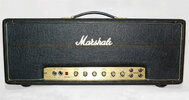
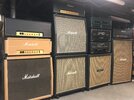
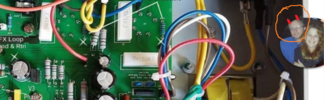
The Origin amps have their roots in the JMP amps.
The JTM amps had a "shared cathode" arrangement (meaning the cathode of both triode's (one for each channel) were tied together, thus "sharing" the cathode resistor & bypass capacitor). Coupling caps were the same value for each channel (0.022uf). The only thing that made the bright channel brighter was the use of a "treble peaking" capitor across the "mixer resistor" of the bright channel. These "mixer resistors" combine the signal coming out of V1 of both channels before it is applied to V2a. As such, there is not so much of as a tonal difference between the two channels as there is with the JMP's.
The JMP series amps saw several circuit changes that effectively made the bright channel a good bit brighter.
Firstly, the V1 cathodes were split apart. The "normal" channel's cathode retained the previous resistor & bypass capacitor values (or the bypass cap value was made even larger), however the "bright channel" was given a much smaller value cathode bypass capacitor value of 0.68uf, resulting in a frequency roll-off below (approximately) 720hz. The bright channel coupling capacitor was changed to a smaller value of 0.0022uf, again rolling of low end. The treble peaking cap across the mixer resistor was retained. This all resulted in the bright channel of the JMP's being noticeably more "upper mid & treble accentuated" than the previous JTM's bright channel.
Another change encorporated in the JMP's was the inclusion of a 0.68uf cathode bypass capacitor on the V2a cathode (again rolling off around 720hz), making the JMP's "as a whole" more upper mid & treble accentuated than the JTM's.
We all know how to "blend" the two channels on the 4 hole amps. The Origin amps input you guitar to both channels & the "tilt" control is used to blend them. Cheers
Fascinating!!!!!
How would the higher gain/Mu Gold Lion B759 affect this amp???