
syscokid
Ambassador of War & Peace

I must be missing something here, but why not use a single 10K?It's dropping the supply voltage & would also be dissipating current drawn by the screen grids, thus keeping the supply "stable". Cheers

I must be missing something here, but why not use a single 10K?It's dropping the supply voltage & would also be dissipating current drawn by the screen grids, thus keeping the supply "stable". Cheers

I'll just jump in here SG John, to make sure you get this part of the circuit assembly done correctly.
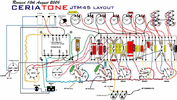
Ok, the resistor that goes between the 27k (NFB series) resistor & the 8uf bias supply filter cap (filling the two empty turrets) should be an 8k2/1W resistor.
The 1k/5W Ohmite should be mounted between the empty turret on the "valve socket" side of the board & pin 6 of V4.
What value is the Vishay Dale metal film resistors in the bias circuit?? I "may" have a 1/2 watt Piher in this value, so as to maintain the "period correct" theme. If I do I'll mail it to you. Cheers
Nice work on the amp, as usual.
Points awarded for use of Wurth CU800 or 1100...
Ok, the resistor that goes between the 27k (NFB series) resistor & the 8uf bias supply filter cap (filling the two empty turrets) should be an 8k2/1W resistor.
That would work!I have an 8.6K 1 watt Allen-Bradley Carbon Comp resistor in my tray of stuff. Will this work, or does it need to be 8K2/8.2K?
Thanks
your soldering arent you ?????? ARENT YOU?????? !!!!!!!!...... the indignation the utter ..........OH I just cant speak to you right now!


As Sysco said, it will be ok.I have an 8.6K 1 watt Allen-Bradley Carbon Comp resistor in my tray of stuff. Will this work, or does it need to be 8K2/8.2K?
Thanks

your soldering arent you ?????? ARENT YOU?????? !!!!!!!!...... the indignation the utter ..........OH I just cant speak to you right now!


your soldering arent you ?????? ARENT YOU?????? !!!!!!!!...... the indignation the utter ..........OH I just cant speak to you right now!
It's inevitable... It will happen... It'll suck you in like a black hole...I actually avoided falling down that rabbit hole...

It's inevitable... It will happen... It'll suck you in like a black hole...
That's a good choice to start with when considering power and simplicity. IMO, I consider a 50 watt JCM800 even more simple than the 4-holer, tube rectified, JTM45. Lots of info and support for any of these circuits, too...I will build no smaller than a 45 watt...


This is so bizarre to me. What is the purpose of this "flying" resistor?
Awesome... (This is the second time today that I have used the word "Awesome")...
Regarding the first statement;Amp Trivia
The resistor is added to limit the screen current of the output tubes.
Not many people realize this: The design of the tubes was changed.
The tube was made more efficient and this increased the screen grid current.
EL34s especially - it (the screen) can draw so much current that the fuse will blow when the amp is cranked up loud.
Older Tubes: The screen does not draw more current. The older tubes were less efficient.
This change was probably made to make newer tubes more competitive with transistors. The tube design change was made in late 60s early 1970s.
But, when you install the newer tube in the older design amp, the screen current limiting needs to be increased.
Here is a (Ceriatone) JTM45 layout that may be of use in showing the positioning of theses 8k2 & 1k resistorsView attachment 49331
Hope this helps.
Regarding the first statement;
This resistor, & screen grid resistors do not "limit" screen current directly. They cause a drop in voltage at the screen grids by means of ohm's law
V=IR
where V = the voltage drop "across" the screen grid resistor, I = the (screen grid) current flowing in the screen grid resistor, & R = the resistance of the screen grid resistor.
To put this into layman's terms, the more screen grid current that flow in the screen grid resistor, the greater the voltage drop "across" the screen grid resistor.
Now to put this into "tube workings".
When the anode (or plate) draws heavy current during applied signal half cycles, the positive DC potential (voltage) on the anode falls, enough that it leaves the screen grid as the "most positive" element within the tube. As such, the screen grid draws "more" current than it would if the plate was at higher potential than it. This "excess" current flowing in the screen grid resistor causes an increase in the voltage drop "across" the screen grid resistor, thus lowering the positive voltage on the screen grid. Lowering the voltage on the screen grid causes it to draws less current. The 1k resistor, being "in series" with the screen grid resistors, works in the same way, taking care of any screen grid current that flows right through the 470 ohm screen grid resistors.
As to the part about the design of the tubes being changed in the late 60's early 70's to make them more efficient, probably to compete with transistors.
Good grief.
Sorry man, but really,,,where did you pluck this little titbit from???
You mentioned the EL34. Well the "gold standard" of EL34's has widely been thought to be the Philips/Mullard EL34 (they did design it after all), from the early metal based variants & xf1 from '49 & the 50's, dual getters xf2's from the 60's, single halo getter xf2's from the early 70's through on to the "staple plate" xf3, xf4 & xf5 variants from the late 70's & early 80's, these tubes shared the same electrical characteristics, from beginning of production in '49 through to end of production in '82. Check the data sheets if you don't believe me. They MOST DEFINITELY DID NOT become "more effecient" throughout the 60's (xf2 double getters) & 70's (single halo getter xf2) era. What "did" happen during this period from 70's through to '82 is that they began to "cut corners" to reduce production costs, which reduced tube life expectancy, but "were made more efficient"??? No way. Hell, even "new production" tubes that are a "true EL34" share similar electrical characteristics & are no more efficient than "old production" types, & the same can be said of KT66's, EL84's, 6L6's etc etc.
In all of this, we must remember of course that not all new production EL34's ARE a "true EL34, just as not all new production 6V6's are a "true 6V6" etc etc etc, & if we look to the manufacturers of said tubes they confirm this. Example (off the top of my head), the Shuguang EL34A "is" a true EL34 pentode, while the Shuguang EL34B "is NOT" a true EL34 at all & is in fact a tetrode type design.
That newer tubes suffer screen grid failure moreso than the older types has absolutely f_ _k all to do with "effeciency" & is simply a result of them being made to a lesser quality than they were in the valve "heyday".
Tell me, how do "you" define the efficiency of a power tube?
Ok, rant over. Cheers
I just explained to you the workings of the screen grid resistors. Hit the valve text books to ascertain this if you don't want to take my word for it. Damn, after I explained it, even a basic grasp of ohms law should lead you to understanding that I am correct in this.According to what Dudley Craven taught me, the resistor limits the screen current.
According to what Dudley Craven told me, the design of the tubes was changed.
From what Dudley explained to me, the amplifier was designed with the old style (less efficient) valves.
And from what Dudley told me, if the newer style tube is used in the older design amplifier more screen current limiting resistors must be added.
Dudley also taught me how to bias Marshall amplifiers.
He always used a scope to adjust the bias.
And from that day, I have always used a scope according to his directions.
Funny, but I have never really used a bias meter...
If Dudley were still around, I could ask him to define "efficiency" of the output tube. I only used his words to describe it.
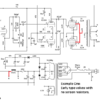
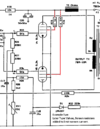
View attachment 49333
View attachment 49334
Here is a (Ceriatone) JTM45 layout that may be of use in showing the positioning of theses 8k2 & 1k resistorsView attachment 49331
Hope this helps.
It's a good thing that some important info came along before you flipped that power switch. Two days ago, I never heard of a "flying resistor". All I knew about the JTM45 is that it's a Marshall with a tube rectifier and it's a direct descendant of the Fender Bassman. The info shared here by TTR's resident amp gurus are priceless...Thanks for that layout, I actually thought they were reversed. I thought the 1K, 2W went on the turret board, and the 8K2 went between the turret and V4. Or, so it seemed from the photos.
.
