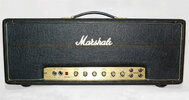
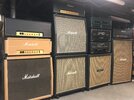
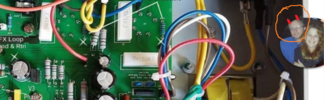
New amp build finally started. JTM45 with KT66.

The Origin amps have their roots in the JMP amps.
The JTM amps had a "shared cathode" arrangement (meaning the cathode of both triode's (one for each channel) were tied together, thus "sharing" the cathode resistor & bypass capacitor). Coupling caps were the same value for each channel (0.022uf). The only thing that made the bright channel brighter was the use of a "treble peaking" capitor across the "mixer resistor" of the bright channel. These "mixer resistors" combine the signal coming out of V1 of both channels before it is applied to V2a. As such, there is not so much of as a tonal difference between the two channels as there is with the JMP's.
The JMP series amps saw several circuit changes that effectively made the bright channel a good bit brighter.
Firstly, the V1 cathodes were split apart. The "normal" channel's cathode retained the previous resistor & bypass capacitor values (or the bypass cap value was made even larger), however the "bright channel" was given a much smaller value cathode bypass capacitor value of 0.68uf, resulting in a frequency roll-off below (approximately) 720hz. The bright channel coupling capacitor was changed to a smaller value of 0.0022uf, again rolling of low end. The treble peaking cap across the mixer resistor was retained. This all resulted in the bright channel of the JMP's being noticeably more "upper mid & treble accentuated" than the previous JTM's bright channel.
Another change encorporated in the JMP's was the inclusion of a 0.68uf cathode bypass capacitor on the V2a cathode (again rolling off around 720hz), making the JMP's "as a whole" more upper mid & treble accentuated than the JTM's.

We all know how to "blend" the two channels on the 4 hole amps. The Origin amps input you guitar to both channels & the "tilt" control is used to blend them. Cheers

Fascinating!!!!!

How would the higher gain/Mu Gold Lion B759 affect this amp???
 
They arrived like that. Tried straightening a couple.
Oh, that's a pain, much, much apologies.
If you see the completed board pic in our conversation, you'll see that they "were" aligned before shipping.
If you grip the large boss at the base of the turret firmly (not the shank, it will shear) you can carefully twist axially into alignment.
When staking the turrets I often have do this, as the anvil provide no means of aligning the turrets, plus the board has to be upsidedown. As such, final axial alignment is done after staking each turret.
If you look closely you'll probably see where I've "gripped" some of the turrets to do this. Cheers
 
Oh, that's a pain, much, much apologies.
If you see the completed board pic in our conversation, you'll see that they "were" aligned before shipping.
If you grip the large boss at the base of the turret firmly (not the shank, it will shear) you can carefully twist axially into alignment.
When staking the turrets I often have do this, as the anvil provide no means of aligning the turrets, plus the board has to be upsidedown. As such, final axial alignment is done after staking each turret.
If you look closely you'll probably see where I've "gripped" some of the turrets to do this. Cheers


No biggie. I knew that you would be staking them upside down, and was impressed with how many were straight. I was taking my time on all the work thus far, so hopefully I haven't had any issues (yet!). Tomorrow night I'll probably mess with the red heater wires and green jack wires. This was a busy weekend, and don't feel like picking up a soldering iron now. Also forgot to get a resistor to form the cap you sent me. I was hoping it would be here this past Friday, but it isn't here yet. Expect a pm when it arrives.
 
Fascinating!!!!!

How would the higher gain/Mu Gold Lion B759 affect this amp???
Mu = "voltage gain". To explain this, if a triode has an mu of 20, a 1 volt signal applied to its control grid is amplified to a 20 volt signal at its plate.
As such, a higher mu triode in V1 will be more sensitive & hit V2a harder than a lower mu triode.
Valves, or tubes, are a man made electro-mechanical device & as such, there is quite a bit of variation in them. Very few actually 100% meet design specs.
The only "real" way to know how a given tube will sound/perform in a given amp is to plug it in & see. Cheers
 
Mu = "voltage gain". To explain this, if a triode has an mu of 20, a 1 volt signal applied to its control grid is amplified to a 20 volt signal at its plate.
As such, a higher mu triode in V1 will be more sensitive & hit V2a harder than a lower mu triode.
Valves, or tubes, are a man made electro-mechanical device & as such, there is quite a bit of variation in them. Very few actually 100% meet design specs.
The only "real" way to know how a given tube will sound/perform in a given amp is to plug it in & see. Cheers

That's the answer I needed. B759 Gold Lions produce unusable amounts of gain in a DSL40C, but I think will be just the boost needed in the JMP-esque circuitry of the Origin 50H.
 
JMPs are fun. Got three of the four variations. 1978, 2203, and 2204.

View attachment 48800

I could never have that many amps, or guitars. I find surplus gear a huge distraction to my daily practice regiment. I am getting rid of two DSL40C's and replacing them with a single Origin 50H and a custom 2x12 cabinet.

I also have to choose gear that will fit in my Mustang...everyday.
 
I could never have that many amps, or guitars. I find surplus gear a huge distraction to my daily practice regiment. I am getting rid of two DSL40C's and replacing them with a single Origin 50H and a custom 2x12 cabinet.

I also have to choose gear that will fit in my Mustang...

I find no distraction. Only distractions are real life. For the rare occasions that we have gigs, I have a Honda Element to schlepping stuff. I can fit way too much stuff in there.
 
I find no distraction. Only distractions are real life. For the rare occasions that we have gigs, I have a Honda Element to schlepping stuff. I can fit way too much stuff in there.

Having the right vehicle is a big factor. When I gigged with a 2203/1990, (my main rig for years) I had a Surburban that I hated - and kept only for the purposes of transporting that rig.

I have gradually downsized over the years, selling my 2203/1990 in 2015.

Music takes on a different perspective when its your sole source of income.

Distraction...

When I was going through the Gibson purchase fiasco - between 2016 and 2018, my frustration and my search took up a tremendous amount of my time, cutting into my 4 hour per day minimum practice schedule.

I was, instead, researching, reading, complaining, etc., and practicing less and less. Then, I embarked on designing/patenting/trademarking my own headstock/name/guitar line...another huge distraction, then i almost started building an 18 watt Mojotone amplifier kit, which would have been another huge distraction.

My first love is music, but it is also my sole source of income, and I have to carefully balance having adequate time to support all my musical obligations.

Its stressful at times, but TBTH, I have a wonderful life...
 
:what:!
The forked extensions are very fragile... Don't ask how I know... :BH:
They are very fragile, & the "cut out" area is not always exactly centrally located on the top of the turret, making one extension thinner than the other, making the thinner one even more fragile. I have broken them off just removing components. Cheers
 
Back
Top