You are using an out of date browser. It may not display this or other websites correctly.
You should upgrade or use an alternative browser.
You should upgrade or use an alternative browser.
Do Power Tubes Have a Particular Sound???
- Thread starter Mr Grumpy
- Start date

SG John
Ambassador of Cool Guitars and Amps.

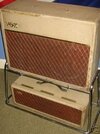
I have one of those original Vox 1959/1960 AC30/4's and it is a lovely sounding Amp. It's the only amp that will keep up with the 55' Fender bassman. But it's got the ef86 preamp tube and no negative loop. So do the Vox AC10's and AC15's. One night I was jamming with another guitar player who was using a Marshall stack while the bass player used a Randal stack. After a couple of tunes they both asked me to turn down since the AC30/4 was overwhelming the stage. I looked down and said I was only on 3 and using 2 Vox Blue speakers! They said whatever it's still blowing us away. Old Mullards for me any day. Vox only made that amp for less than a year while I couldn't believe that I even found one in England. The guy who sold it to me always laments that if he knew what he had he never would never of sold it in the first place. But to the original question in most of my old amps I can hear and especially " feel ", through my hands different brands of tubes. Not that I could guess the brands by ear but I can discern a difference. When I have a tube listening party I use a welders glove to swap out different tubes w/o turning anything off
The copy of a '62ish AC30 that Bob Detorre made me to replicate Rory Gallagher's amp has that EF86 circuit. The amp was an animal when I first bought it. Now with two Goodmans Audiom 60 speakers in it, and a full compliment of Telefunken EL84 tubes, Amparex EF86, and then assorted Brimar, Mullard, and RCA 12ax7 and their variants it's a monster. Like you said, you can really feel that amp.
Last edited:

Vox AC30
Well-Known Member
A good amp becomes one with your central nervous system! I know exactly what your talking about John, you don't even need a Klon with certain amps though it is hard to find good old EF86's now that can handle being in that amp since, in a combo the speakers rattle the hell out of the insides of the tube. That's why the AC30/4's were barely made a year. I think I prefer Gain over overdrive or distortion
OP

Mr Grumpy
Ambassador of Comings and Goings

When I have a tube listening party I use a welders glove to swap out different tubes w/o turning anything off
:retreat:
OP
Mr Grumpy
Ambassador of Comings and Goings
Lots of very interesting comments here, many thanks.
&, as usual, folks have quite wide viewpoints.
I should certainly practice far more than I tinker, but I won't and never will...
For no great reason other than it's a thing to do, learning experience, and fun to find out about, I'll get some new tubes in both positions. :dood:
&, as usual, folks have quite wide viewpoints.
I should certainly practice far more than I tinker, but I won't and never will...
For no great reason other than it's a thing to do, learning experience, and fun to find out about, I'll get some new tubes in both positions. :dood:
OP
Mr Grumpy
Ambassador of Comings and Goings
What's kinda confusing though is the different power ratings of EL84 tubes.
Had a Carvin BelAire - Quad of EL84's = 50 watts
But in an AC30 that same quad produces 30 watts.
Had a Dr. Z Carmen Ghia - Pair of EL84's = 18 watts
Also had a Mesa F30 at the same time - Pair of EL84's = 30 watts.
My current Mesa, a Rectoverb 25, also a pair of EL84's but rated at 25 watts.
This amp is operating in Class A. That EL84 is running balls-out all the time. The EL84 is rated for 12watts of dissipation, but when operating in Class A it has an output rating of 5 to 6 watts.
A lot of interesting info in those two posts that I hadn't thought about it, but it does help to make sense of why the little 5 watter can get some creamy-snarl power tube loveliness.
The Russian EL84M is a good choice for longevity it's a 5,000 hour service life tube.
the Russian 6p14p-EV equivalent get good reviews and are pretty cheap.
I took @67plexi ’s advice on these a while back...I have a few running, happily, in my EL84 amps now.
I might well go for one of them too, good price and can do a comparison (without the welding gloves, and letting the amp cool right down!
 )
)I dont have my notes handy but I think this is around 354 volts at the plates.
Now my brain is hurting again...

The power tube does have it's own particular sound -- when it's pushed into distortion.
Along with Hackmaster's and Sysco's thread that does make sense to why I'm getting very nice power amp tube sounds at low wattage. However, there must be something going on with the attenuator that's different at 1/4 and 1/8 watt to 1 and 5 watt because only the latter two get the really nice power tube break-up sound when the volume is maxed. I will see if an OCD or treble booster can push the lower watt settings to get there...


syscokid
Ambassador of War & Peace
OK... everything was rolling along just nice, and then you say that! I no understand... pleeeze explain, LucyI think I prefer Gain over overdrive or distortion

jtcnj
Ambassador of the Crossroad
All this tasty tube tech talk is making me hungry.
"But you'll have to have them all pulled out
After the Savoy truffle "
Supposedly Clapton had quite the sweet tooth.
"But you'll have to have them all pulled out
After the Savoy truffle "
Supposedly Clapton had quite the sweet tooth.

The power tube does have it's own particular sound -- when it's pushed into distortion.
Before it reaches distortion the sound of a particular power tube is not as unique.
Just for my own clarification, are you saying the sound isn’t that different just between different power tubes of the same type, such as an EL34?
Or, are you saying completely different tubes, such as an EL34 and a 6L6, won’t sound that much different?

Believe it or not, the tubes in this 1959 Silvertone amp are marked 'Silvertone' and still work...
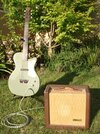
Funny...I've owned that fabric-covered Horizon cable (in the photo above) since the 1980's and still use it...
Just for my own clarification, are you saying the sound isn’t that different just between different power tubes of the same type, such as an EL34?
Or, are you saying completely different tubes, such as an EL34 and a 6L6, won’t sound that much different?
Be careful what you listen for.....you might just hear it.
Vox AC30
Well-Known Member
Using Gain, Overdrive, and Distortion can either add or detract from your overall guitar tone, so it's a good idea to know the differences between them. Technically speaking, there are several definitions to these terms, but we are only going to deal with the audio Aspects, or how it sounds to your ears.
Gain is usually defined as an overall boost in your signal without any added tonal coloration. It is usually expressed in decibels such as "Gimme a 3dB boost on that kick drum." Adding more gain is basically just amplifying the signal so it cuts through the mix or can be heard over a loud drummer.
Overdrive, as it has come to be known as, is a smooth, warm, slightly distorted sound, generally associated with the sound made by cranking up a tube amp. It is fat and dynamic, allowing you to vary your tone just by the way you play. Overdrive pedals can come close to giving you that tube overdrive sound, probably the most popular being the Tube Screamer.
Distortion can be defined as anything from a fuzz tone to a full-on, notched-out midrange, death metal wall of noise. It is a hard-edged sound with as many variations as there are players. Digital distortion has a more metallic, raspy sound which works well for heavy metal, grunge, or reliving your 80's hair band days. Analog tube distortion gives a good, all-around rock tone, such as the sound of a Marshall stack cranked to 10.
The key to all this is to listen and experiment and let your ears be the final judge. Knowing the differences and how to use them will go a long way to helping you define your own signature tone. And if you don't hear it you'll have one less musical monkey on your back which for ost people is a good thing!
Gain is usually defined as an overall boost in your signal without any added tonal coloration. It is usually expressed in decibels such as "Gimme a 3dB boost on that kick drum." Adding more gain is basically just amplifying the signal so it cuts through the mix or can be heard over a loud drummer.
Overdrive, as it has come to be known as, is a smooth, warm, slightly distorted sound, generally associated with the sound made by cranking up a tube amp. It is fat and dynamic, allowing you to vary your tone just by the way you play. Overdrive pedals can come close to giving you that tube overdrive sound, probably the most popular being the Tube Screamer.
Distortion can be defined as anything from a fuzz tone to a full-on, notched-out midrange, death metal wall of noise. It is a hard-edged sound with as many variations as there are players. Digital distortion has a more metallic, raspy sound which works well for heavy metal, grunge, or reliving your 80's hair band days. Analog tube distortion gives a good, all-around rock tone, such as the sound of a Marshall stack cranked to 10.
The key to all this is to listen and experiment and let your ears be the final judge. Knowing the differences and how to use them will go a long way to helping you define your own signature tone. And if you don't hear it you'll have one less musical monkey on your back which for ost people is a good thing!
Be careful what you listen for.....you might just hear it.
Ha!
I get your point, but the question was just theoretical.
syscokid
Ambassador of War & Peace
This is a very nice explanation, thanks.Using Gain, Overdrive, and Distortion can either add or detract from your overall guitar tone, so it's a good idea to know the differences between them. Technically speaking, there are several definitions to these terms, but we are only going to deal with the audio Aspects, or how it sounds to your ears.
Gain is usually defined as an overall boost in your signal without any added tonal coloration. It is usually expressed in decibels such as "Gimme a 3dB boost on that kick drum." Adding more gain is basically just amplifying the signal so it cuts through the mix or can be heard over a loud drummer.
Overdrive, as it has come to be known as, is a smooth, warm, slightly distorted sound, generally associated with the sound made by cranking up a tube amp. It is fat and dynamic, allowing you to vary your tone just by the way you play. Overdrive pedals can come close to giving you that tube overdrive sound, probably the most popular being the Tube Screamer.
Distortion can be defined as anything from a fuzz tone to a full-on, notched-out midrange, death metal wall of noise. It is a hard-edged sound with as many variations as there are players. Digital distortion has a more metallic, raspy sound which works well for heavy metal, grunge, or reliving your 80's hair band days. Analog tube distortion gives a good, all-around rock tone, such as the sound of a Marshall stack cranked to 10.
The key to all this is to listen and experiment and let your ears be the final judge. Knowing the differences and how to use them will go a long way to helping you define your own signature tone. And if you don't hear it you'll have one less musical monkey on your back which for ost people is a good thing!
Vox AC30
Well-Known Member
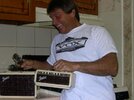
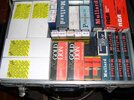
Well Plex, funny you should mention my " Cookie Jar" and tubes! I actually have a Fender "Cookie Master" cookie jar! And right here is a photo of what I actually do put in the "jar " , I mean ceramic cabinet. So for years I've never looked into it and sure enough the same pairs of Mullard EL37's and GEC KT66's were still in it! I kinda laughed for a while thinking to myself hummmph, I must of forgot I had some in there too. Thanks for reminding me about that.
Just goes to show ya how way over the top and gone I actually am with this stuff, that's why I like to hang with you guys here!
OP
Mr Grumpy
Ambassador of Comings and Goings
Now, to add to what VOX30 says, and let me start by saying I know nothing (call me John Snow...), but those descriptions, especially 'gain' should be contextualized, shouldn't they? Gain is not an uncoloured boost unless your amp allows it to be. If your amp goes into OD or goes into distortion due to adding gain or boost, the amp may even colour the sound too at different signal strengths - not all amps are transparent and linear, are they? Just a thought. I should try to avoid thinking...
Right, I'm gonna add to that: OD and distortion are not discrete, they are linear (well, maybe not even linear, but certainly on a scale), nobody can say where one ends and another starts. We may generally be in agreement most of the time, but perhaps my mid-OD is somebody else's low-distortion. I'm suggesting that they cannot be discretely or exactly defined, they are subjective. I mean, clean with a suggestion of hair is clean, we just defined it as, but we also suggested there's some OD on it which is on the scale to distortion. OK, I will shut up now, sorry for the interruption.
Right, I'm gonna add to that: OD and distortion are not discrete, they are linear (well, maybe not even linear, but certainly on a scale), nobody can say where one ends and another starts. We may generally be in agreement most of the time, but perhaps my mid-OD is somebody else's low-distortion. I'm suggesting that they cannot be discretely or exactly defined, they are subjective. I mean, clean with a suggestion of hair is clean, we just defined it as, but we also suggested there's some OD on it which is on the scale to distortion. OK, I will shut up now, sorry for the interruption.
Last edited:

67plexi
Ambassador of Amps
The simple answer is yes I built a 100 watt ODS style amp and used NOS pre 1974 6L6GC made in USA
A friend used that amp on 3 world tours then I get it back tried new production JJ'S and JJ/Telefunken it's not happy
Then scored a NOS quad 6L6GC back to life 2D to 3D sound
A friend used that amp on 3 world tours then I get it back tried new production JJ'S and JJ/Telefunken it's not happy
Then scored a NOS quad 6L6GC back to life 2D to 3D sound