Do Power Tubes Have a Particular Sound???

I'll second Mr 67plexi's recommendation. NOS Mullard.
A bit of general info about EL84's, power tubes amplify current. The EL84 is somewhat unique in that it amplifies voltage as well as current. Cheers

You two are getting me thinking on the NOS Mullard... If EL84s wear out quickly (and I plan to have this map for a good while), and NOS Mullards last considerably longer then I can trick my brain into justifying the expense. Here's a video:


Listening to that and reading the replies was quite strange... Most folks said they didn't hear a difference or it was very slight. I heard quite a lot of difference in the lows, mids and highs; quite interesting note width in the mids with the Mullards which wasn't there at all with the new tubes. The highs, both sounded nice, a bit different. The lows were quite different, and the speed of response also seemed quicker with the Mullards which made the player enjoy the experience more by the look of the clips and by reading the comments.

But, the folks who said they heard no difference weren't wrong or lying, we just hear differently...
 
Last edited:
So wish somebody did live near me,,, would put the effort into a decent gear channel..real simple stuff..

but without help..never would do it when there is music to make..new music vs analyzing the already done...

my buddy approached me about doing live concerts from here...do have the set up to possibly make one heck of a place to film from in the bandroom ..who knows...
You need to move out this way.
You two are getting me thinking on the NOS Mullard... If EL84s wear out quickly (and I plan to have this map for a good while), and NOS Mullards last considerably longer then I can trick my brain into justifying the expense. Here's a video:


Listening to that and reading the replies was quite strange... Most folks said they didn't hear a difference or it was very slight. I heard quite a lot of difference in the lows, mids and highs; quite interesting note width in the mids with the Mullards which wasn't there at all with the new tubes. The highs, both sounded nice, a bit different. The lows were quite different, and the speed of response also seemed quicker with the Mullards which made the player enjoy the experience more by the look of the clips and by reading the comments.

But, the folks who said they heard no difference weren't wrong or lying, we just hear differently...
I think the lower the wattage, the more we crank it up.
Bringing the power tubes more into play.
I kinda have a tin ear, after standing next to the drummer on one side, Marshall on the other. Your hearing may be in better shape.
Have never tried the Millard's, but am being sold due to this thread.
 
I'm extremely good at wasting money, and folks are saying EL84s wear out quite quickly, so I just ordered a couple to see how we get on... Spoke to the amp manufacturer and they said direct swap...
Truthfully, I might be the only one talking about how quickly they wear out.
I think it has more to do with amp design than tubes.

But I'm hip to those Mullards, and would love to try a set out.

You'll be able to roll a bunch of tubes now that you don't need to worry about biasing.

Let the games begin.
 
I always seem to have an EL84 amp.
It's not by preference though, I just go thru a bunch of amps.
I've heard huge differences in the amps, but cant attribute any tonal characteristics to the tube itself.
Ruby's, JJ's, TAD's and Mesa rebranded tubes all made the amps sound like themselves to me.

What's kinda confusing though is the different power ratings of EL84 tubes.
Had a Carvin BelAire - Quad of EL84's = 50 watts
But in an AC30 that same quad produces 30 watts.

Had a Dr. Z Carmen Ghia - Pair of EL84's = 18 watts
Also had a Mesa F30 at the same time - Pair of EL84's = 30 watts.
My current Mesa, a Rectoverb 25, also a pair of EL84's but rated at 25 watts.

The differing power ratings must be amp design related like steveb63 mentioned in the above post.
Single ended vs push pull.
 
I don't know about my amp, doesn't say in the manual, so if anybody on here knows then please tell me! I don't know if this helps:

Cornell7.jpg
This amp is operating in Class A. That EL84 is running balls-out all the time. The EL84 is rated for 12watts of dissipation, but when operating in Class A it has an output rating of 5 to 6 watts. Not sure how the Cornell's attenuation circuit affects the operation of the EL84. This would be a good question to submit to Dennis Cornell. I was looking for a large power rated resistor from the EL84's cathode to ground, but I can't make out the pic very well. More than likely the amp is cathode biased, too... so, no adjusting of the bias is needed.
 
The Russian EL84M is a good choice for longevity it's a 5,000 hour service life tube.

 
just did 2 days on next song..trying to pair guitar & amp...Peavey classic gets it again...more clean on this one,,but right at edge of it..the hair on it..was back n forth with a Super & 6v6 Marshall & Supro..them el84's just gave up the right clean.. like how they respond to pick attack even in clean passages..have PV on 7 on clean side of amp,,that makes one heck of a full tone with the Jensen 15

have had no issues here whatsoever with tubes burning up quick.
 
I dont know how availability is out your way @Mr Grumpy , but the Russian 6p14p-EV equivalent get good reviews and are pretty cheap.
The -EV variant is supposed to withstand higher voltages better, last longer, or just considered more robust than the plain 6p14p.
I have been running a pair in my 18w TMB build that runs cathode bias push/pull at around 100% plate dissipation.
I dont have my notes handy but I think this is around 354 volts at the plates.

I freaked a little when I first measured it but found this is pretty common.
They have been in there over a year and the amp gets LOUD regular play, actually the most of what I have.
They sound about the same as the JJ and Sylvanias I also have, to me anyway.
They are "used but test good" tubes; I know I took a chance but for $18.00 USD shipped for a matched pair I am not complaining.
 
Last edited:
The Russian EL84M is a good choice for longevity it's a 5,000 hour service life tube.

I took @67plexi ’s advice on these a while back...I have a few running, happily, in my EL84 amps now.
Good stuff.
 
More than likely the amp is cathode biased, too... so, no adjusting of the bias is needed.

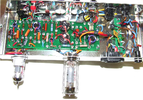
Looking at the gut-shot that Mr Grumpy had earlier posted I "thought" I could make out the resistor/capacitor combination that cathode biases the EL84, but couldn't be 100% sure about, so looked online & found this15846153031714890639047968180184.png
which has the eyelet/turret interconnecting wiring above board. Looking to the lower left of the two black electrolytic capacitors in the center area of the board we see
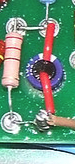
15846150893982969931890447835310.png
this resistor/capacitor combination & brown lead connecting them to the power tube socket. This is the cathode bias arrangement. If I'd posted this earlier it would have saved Mr Grumpy needing to contact the manufacturer to ascertain whether cathode or fixed bias (apologies Mr Grumpy, it was late at night & I went to bed after finding). Cheers
 
Last edited:
The Peavey Ultra series of amps was generally designed to use either 6L6 or EL34 tubes, although specific models shipped with one or the other. For example, the TripleXXX shipped with 6L6 tubes but when it was reissued as the 3120 they fitted EL34s.

JSX amps all shipped with EL34s but many (like mine) have been fitted with 6L6s. Obviously the JJ EL34s were tired when I got it and the Tung Sol 6L6GC-STR replacements have had a proper bias but in terms of characteristics the amp has a lot less mid-range honk now and better cleans.
 
JSX amps all shipped with EL34s but many (like mine) have been fitted with 6L6s. Obviously the JJ EL34s were tired when I got it and the Tung Sol 6L6GC-STR replacements have had a proper bias but in terms of characteristics the amp has a lot less mid-range honk now and better cleans.
This makes sense and true to the known characteristic differences of those tubes.

Looking at the gut-shot that Mr Grumpy had earlier posted I "thought" I could make out the resistor/capacitor combination that cathode biases the EL84, but couldn't be 100% sure about, so looked online & found thisView attachment 40393
which has the eyelet/turret interconnecting wiring above board. Looking to the lower left of the two black electrolytic capacitors in the center area of the board we see
View attachment 40394
this resistor/capacitor combination & brown lead connecting them to the power tube socket. This is the cathode bias arrangement. If I'd posted this earlier it would have saved Mr Grumpy needing to contact the manufacturer to ascertain whether cathode or fixed bias (apologies Mr Grumpy, it was late at night & I went to bed after finding). Cheers
Man... You got a sharp an educated eye for this stuff. You deserve some of this: :cheers:. Also, some of this: :beers:. And you also get the bonus gift: :flash:
 
I suppose guys like Johan can split hairs and detect a sonic difference between a given set of tubez, but I don't wanna put that much thought into it. I can run any amp they put in front of me and get any sound the producer wants. It's just a matter of making adjustments.

There was a time when i would drive myself nuts trying to capture a certain tone on a recording, or pan delays left and right, or stack guitar tracks, only to realize that live, you cannot hear ANY of it.

After a while, i started to realize i was spending too much time analyzing (and writing about) my tone and i just pulled myself away from all of that.

The less time i spent on TTR, the more time i had for practice and improving my technique. I sounded better at rehearsal, better live and noticed huge improvements in speed and articulation.

Getting down to just a simple DSL40C based rig and just one Schecter and one Jackson, totally eliminated the need to work on and dick around with my rig in general. 100% of my time is spent producing music now.

I discovered that my satisfaction with my playing ability improved and my income improved too, all because i was spending more time playing than analyzing and documenting.

Now, i consciously avoid most discussions about gear and just keep my head down and just play... :-)
 
Last edited:
I suppose guys like Johan can split hairs and detect a sonic difference between a given set of tubez, but I don't wanna put that much thought into it. I can run any amp they put in front of me and get any sound the producer wants. It's just a matter of making adjustments.

There was a time when i would drive myself nuts trying to capture a certain tone on a recording, or pan delays left and right, or stack guitar tracks, only to realize that live, you cannot hear ANY of it.

After a while, i started to realize i was spending too much time analyzing (and writing about) my tone and i just pulled myself away from all of that.

The less time i spent on TTR, the more time i had for practice and improving my technique. I sounded better at rehearsal, better live and noticed huge improvements in speed and articulation.

Getting down to just a simple DSL40C based rig and just one Schecter and one Jackson, totally eliminated the need to work on and dick around with my rig in general. 100% of my time is spent producing music.

I discovered that my satisfaction with my playing ability improved and my income improved too, all because i was spending more time playing than analyzing and documenting.

Now, i consciously avoid most discussions about gear and just keep my head down and just play.
Paralysis by analysis.

We use that term occasionally, in my profession.
 
...my new amp, small, with an EL84 is encouraging me to ask this question.

On one side, folks say that it's a product of total amp design and the power tube is somewhat meaningless.

On the other side, I've heard that EL84s are good for small wattage amps to make them chimey with quite an aggressive breakup.

My personal feeling is yes and yes, no and no, and maybe and maybe. It's a product of the amp design and can (or cannot) choose to use 'inherent' power tube characteristics. My Randall RD1 was amazing and it used an 12au7 as a power tube - very non-conventional, extremely early breakup, no clean and amazing OD sounds (not even talking about the driven sounds...). This 5w Cornell, when pushed in gain and volume is most similar to a VOX AC, so quite conventional - not distortion but bitey, slightly snarly OD.

Do power tubes have a particular sound in your amp? What's your preference?

The power tube does have it's own particular sound -- when it's pushed into distortion.
Before it reaches distortion the sound of a particular power tube is not as unique.
The snarling characteristics / voicing are really in the preamp, not so much the power tubes.
 
I suppose guys like Johan can split hairs and detect a sonic difference between a given set of tubez, but I don't wanna put that much thought into it. I can run any amp they put in front of me and get any sound the producer wants. It's just a matter of making adjustments.

There was a time when i would drive myself nuts trying to capture a certain tone on a recording, or pan delays left and right, or stack guitar tracks, only to realize that live, you cannot hear ANY of it.

After a while, i started to realize i was spending too much time analyzing (and writing about) my tone and i just pulled myself away from all of that.

The less time i spent on TTR, the more time i had for practice and improving my technique. I sounded better at rehearsal, better live and noticed huge improvements in speed and articulation.

Getting down to just a simple DSL40C based rig and just one Schecter and one Jackson, totally eliminated the need to work on and dick around with my rig in general. 100% of my time is spent producing music.

I discovered that my satisfaction with my playing ability improved and my income improved too, all because i was spending more time playing than analyzing and documenting.

Now, i consciously avoid most discussions about gear and just keep my head down and just play.


I think with any modern amp, I would want good quality tubes that will last a while. More important than the power tube, I'd be looking for a good pre/amp or phase inverter tube to keep a smooth sine wave going into the power stage of the amp. Thinking back on your thread chasing the various versions of a 12ax7 in the Marshall is a wealth of info for someone wanting to go that same route. Personally, I would not put a quad of NOS English Mullards that cost a minimum of $100.- per tube in a JCM900. However, I would put them in my '72 Hiwatt DR103 or '73 JMP. All my vintage amps have period correct NOS tubes, as that was how they were designed. I still mess with the V3 on the Marshalls when I have time, as I want a really consistent voltage and sine pattern coming out of that tube.

As for Mr. Grumpy's amp, those Russian EL84s at $18.00 a piece look marvelous. They'll probably last longer than anything new, and won't break the bank. No need to drop over $100.00 on a Mullard or Telefunken for that amp. That will leave plenty of budget leftover to mess with the 12ax7, which is another rabbit hole to go down.
 
Last edited:
I have one of those original Vox 1959/1960 AC30/4's and it is a lovely sounding Amp. It's the only amp that will keep up with the 55' Fender bassman. But it's got the ef86 preamp tube and no negative loop. So do the Vox AC10's and AC15's. One night I was jamming with another guitar player who was using a Marshall stack while the bass player used a Randal stack. After a couple of tunes they both asked me to turn down since the AC30/4 was overwhelming the stage. I looked down and said I was only on 3 and using 2 Vox Blue speakers! They said whatever it's still blowing us away. Old Mullards for me any day. Vox only made that amp for less than a year while I couldn't believe that I even found one in England. The guy who sold it to me always laments that if he knew what he had he never would never of sold it in the first place. But to the original question in most of my old amps I can hear and especially " feel ", through my hands different brands of tubes. Not that I could guess the brands by ear but I can discern a difference. When I have a tube listening party I use a welders glove to swap out different tubes w/o turning anything off
 
Back
Top