OP

Clockworkmike
Ambassador of STACKS in WV SHACKS

Gotcha! Thank you!I see these 4 caps on the SLX schematic.
But DSL uses the same bipolar caps 22uF 50V.

Gotcha! Thank you!I see these 4 caps on the SLX schematic.
But DSL uses the same bipolar caps 22uF 50V.

Let's do thisGotcha! Thank you!
Ok I think I see the problem and misunderstanding: the amp that went Kaput on me currently is the JCM2000 DSL50 but in my original post, I started off talking about the JCM900 SLX dying a while back and then this joining it. So yeah that's my fault, kinda made it sound like I was talking about the SLX and im sorry for that.Let's do this
Look at the board and find the 2X 22uF 50V bipolar caps.
Are these caps labeled C11 and C29?
Now look again and find 2X 10uF 100V filter caps. This will be near the bias adjust pot.
Are these caps labeled C11 and C16?
The reason I'm asking is
When Marshall built JCM 900, there was 2 different schematics.
The schematics are the same, except for the part numbers.
I want to make sure that you have the right schematic with the right part numbers.
If you have the schematic we want to make sure the schematic you have matches the part numbers on your circuit board.
If you are looking at the wrong schematic, the part numbers won't match the board.
That will cause confusion.
Let's make sure that we are all on the same page.
Let's make sure that you have the right schematic with the numbers that match your board.
This way we avoid possible confusion.
For DSL 50 you still want to know how much the pin 5 voltage changes when you turn standby to operate.Ok I think I see the problem and misunderstanding: the amp that went Kaput on me currently is the JCM2000 DSL50 but in my original post, I started off talking about the JCM900 SLX dying a while back and then this joining it. So yeah that's my fault, kinda made it sound like I was talking about the SLX and im sorry for that.
THAT amp IS dead and definitely has some issues : namely it blew a mains fuse, torched an EL34 when playing it, charred a socket and continues to blow fuses with no tubes in the amp
But the DSL50 just lost it's volume one day and died. The HT fuse blew, power tubes and preamp tubes were dimly lit. Stopped there and ordered fuses. From there? I would test the DC Voltages at the Octal socket and noticed the bias pots would operate the opposing tube. But I remembered on the Jcm2000 that they bias things a lil differently, namely at that 3 pin port between the two bias pots. So I had an old pair of Svetlanas that were still good, put them in and changed the HT fuse.
Turned the amp on and turned the meter to mVDC, which the bias pots would then read on the correct sides ( left pot would read the left tube and right pot would read the right tube) from chassis ground to each corresponding pin at the bias test point. I dialed it down to 41mV on the left and to 41mV on the right. The tubes now had a slight blue glow to them between the plates and bias was steady I then plugged a guitar in and it worked lol
So I'm guessing it really just was a bad tube that blew the fuse?
Ok, no problem! I tested this just now with the HT fuse swapped and the bias adjust. And what I did was I took a reading with the standby on and had -30.7 VDC from chassis to pin 5 of V6-V7. After allowing it about 5 mins to warm up, I turned the standby off and I had a reading of -31.1 VDC on pin 5 of V7 and V6, so a change of -0.4VDCFor DSL 50 you still want to know how much the pin 5 voltage changes when you turn standby to operate.
This gives you an idea if the board is going bad.
That is, the same tube will blow again down the road because the bias drifts / won't stay where you adjusted it to.
OK that's not too bad. What you want to watch out for is if it changes more than 1 volt.Ok, no problem! I tested this just now with the HT fuse swapped and the bias adjust. And what I did was I took a reading with the standby on and had -30.7 VDC from chassis to pin 5 of V6-V7. After allowing it about 5 mins to warm up, I turned the standby off and I had a reading of -31.1 VDC on pin 5 of V7 and V6, so a change of -0.4VDC
Man,I can't thank you enough for all of this! Yeah, I need to get that SLX back on its feet because it's been far too long. I need to get some wire to fix the socket, but I can certainly try. FPE 200C 22awg a good choice or 20awg?OK that's not too bad. What you want to watch out for is if it changes more than 1 volt.
OK so now the above can be used to test the SLX..
but if you have a fried tube socket that is caused by the wrong impedance speaker.
The wrong impedance might have happened before you owned the amplifier.
So get that socket changed out and then you can do your bias voltage testing again as above.
Maybe you can change the socket yourself?
If you want to send it here I'll change the socket for you...
or send it to Sysco, he needs lots of fun fun activities.
22 or 20 will work just fine. Most amplifiers are built with 22 for the audio circuit, and 20 (50 watt amps) for the power. You see 18 being used for power in 100W amps.Man,I can't thank you enough for all of this! Yeah, I need to get that SLX back on its feet because it's been far too long. I need to get some wire to fix the socket, but I can certainly try. FPE 200C 22awg a good choice or 20awg?
Check this: this morningMan,I can't thank you enough for all of this! Yeah, I need to get that SLX back on its feet because it's been far too long. I need to get some wire to fix the socket, but I can certainly try. FPE 200C 22awg a good choice or 20awg?
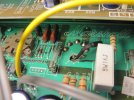
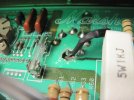
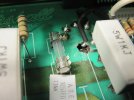
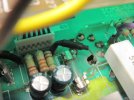
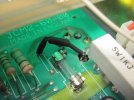

Do we know what caused the failure post-mod? I've not heard of this happening before. Curious.Check this: this morning
A (year) 2001 DSL 100 when tested as above:
the -42 volts DC drops to -31 Volts DC, when the standby is switched to operate.
That board has the bias drift defect severely. (insulation failure)
And in addition
this board was already modified to stop the insulation failure...and the modification didn't last.
The bias still fails, despite the board modification.
View attachment 99462
View attachment 99463View attachment 99464
View attachment 99465
View attachment 99466
Time to install a new circuit board. Lucky we have 2 new ones.
Replace the bias pots, replace the output tubes, re-cap the low voltage supplies and reverb drive board.
That will probably get it going for another 10 years (but UN-known how long it will last).
I don't know yet, but considering we have new boards I'm gonna throw one in.Do we know what caused the failure post-mod? I've not heard of this happening before. Curious.

If not, send it to Sysco, he'll fix anything

That is crazy! So I'm guessing here, that these boards are just genuinely badly fabricated overall? Like the quality of materials?Check this: this morning
A (year) 2001 DSL 100 when tested as above:
the -42 volts DC drops to -31 Volts DC, when the standby is switched to operate.
That board has the bias drift defect severely. (insulation failure)
And in addition
this board was already modified to stop the insulation failure...and the modification didn't last.
The bias still fails, despite the board modification.
View attachment 99462
View attachment 99463View attachment 99464
View attachment 99465
View attachment 99466
Time to install a new circuit board. Lucky we have 2 new ones.
Replace the bias pots, replace the output tubes, re-cap the low voltage supplies and reverb drive board.
That will probably get it going for another 10 years (but UN-known how long it will last).


Seems so. Most likely cause of HT fuse going.Ok I think I see the problem and misunderstanding: the amp that went Kaput on me currently is the JCM2000 DSL50 but in my original post, I started off talking about the JCM900 SLX dying a while back and then this joining it. So yeah that's my fault, kinda made it sound like I was talking about the SLX and im sorry for that.
THAT amp IS dead and definitely has some issues : namely it blew a mains fuse, torched an EL34 when playing it, charred a socket and continues to blow fuses with no tubes in the amp
But the DSL50 just lost it's volume one day and died. The HT fuse blew, power tubes and preamp tubes were dimly lit. Stopped there and ordered fuses. From there? I would test the DC Voltages at the Octal socket and noticed the bias pots would operate the opposing tube. But I remembered on the Jcm2000 that they bias things a lil differently, namely at that 3 pin port between the two bias pots. So I had an old pair of Svetlanas that were still good, put them in and changed the HT fuse.
Turned the amp on and turned the meter to mVDC, which the bias pots would then read on the correct sides ( left pot would read the left tube and right pot would read the right tube) from chassis ground to each corresponding pin at the bias test point. I dialed it down to 41mV on the left and to 41mV on the right. The tubes now had a slight blue glow to them between the plates and bias was steady I then plugged a guitar in and it worked lol
So I'm guessing it really just was a bad tube that blew the fuse?


The problem is the insulation material. Over time it becomes conductive. The good long term repair is to replace the board.That is crazy! So I'm guessing here, that these boards are just genuinely badly fabricated overall? Like the quality of materials?
It looks like slowly over time, the fiberglass turns into a resistor.That is crazy! So I'm guessing here, that these boards are just genuinely badly fabricated overall? Like the quality of materials?
And I noticed, this is the JCM2-60-00 board, so one of the originals? I know it went to JCM2-60-02 by around 2004. Any increase in quality or was it more of the same?
Hey Sysco, are you thinking about driving down to Robert's memorial on the 25th?


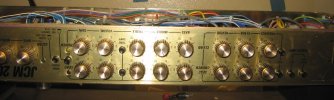

AMS, it’s not in La La land. It’s in Visalia, north of Bakersfield.Hey Sysco, are you thinking about driving down to Robert's memorial on the 25th?
On one hand it would be a nice gesture, on the other hand the traffic will be pure hell.
And thinking about this, does parking cost $15 an hour?
I donno, but the last time I went down to LA LA land, the parking fees were pretty treacherous.
Anyway I'm thinking on this.