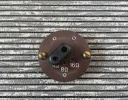
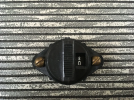
Won't be able to get to it today, but most likely tomorrow I can! ( wife's birthday today so I'm tied up a bit with things). I have a bias tester that plugs into my DMM, which I used before. I will definitely get back with you on this and thank you for the help!
You won't use a bias probe to test this.
Take out the power tubes.
Set meter for DC volts.
Attach the black probe to the chassis.
Attach the red probe to pin 5 of the output tube socket.
(there are pin numbers stamped on the socket)
Turn the power on but leave standby in warm-up position
Do not turn the standby to operate position.
There should be negative DC voltage on pin 5 of the output tube socket.
Now, turn the bias control all the way to the left and write the voltage down.
Turn the bias control slowly, to the right.
Does the voltage adjust up / down smoothly?
or is there any dead spots in the adjustment range? Any erratic spots in the adjustment range of the pot?
Make sure it adjusts up / down with no bad spots in the adjustment range as you turn the pot all the way left and right.
Note:
If there "is" bad spots in the adjustment range,
stop here.
Do not install the tubes or play the amp until the bias pot is replaced.
A bad bias pot is major trouble, don't risk using it, replace it with a new one.
"If" the bias pot is OK:
turn it all the way to the right, and write the DC voltage reading down.
Now what was your far left voltage reading? (report)
What was your far right voltage reading? (report)
Now repeat this for all the output tube sockets and report the DC voltage readings.
We are making sure that all the output tube sockets are getting proper voltage to pin 5. (very important)
Leak down test:
Set the voltage on pin 5 to -42 volts, DC.
"were" you able to adjust the bias pin 5 voltage to -42 volts DC?
If not, STOP HERE. The bias circuit needs more testing and replacement parts.
If yes, proceed.
Now attach your red probe to pin 5 again, turn the standby to "operate."
How much did the pin 5 DC voltage change, when you turned the standby to "operate?" (make a note of this voltage)
Now turn the standby to warm-up position again.
Now repeat this test for all the output tube sockets one at a time. Note how much the pin 5 voltage changed, for each socket, when you turned the standby to "operate."
Now report your readings for each socket.
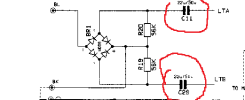
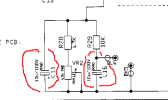
This test: checks to see if the coupling capacitors between the phase inverter and the power tubes pin 5 are working properly.
If the voltage stays the same on pin 5, when you turn the standby to operate, that's good !
If the pin 5 voltage changes a whole bunch when you turn the standby to operate, that's very bad.
It means that the coupling capacitor is shorting out, and B+ is leaking into the bias circuit !
OR, it means that your circuit board insulation is failing (just as the DSL board insulation fails...)
In any case, test all the output sockets and write your results down, and report the results.
If there is any defect detected, do not put the tubes in.
Because your new tubes can be destroyed.
FIRST: test and verify proper bias operation.
NEXT: fix any problem that was detected.
LAST: after everything is verified, then put the tubes in, and bias the amp as usual.
DO NOT "just put the tubes in, and see what happens."
Do not acquire the habits, of hacks.
Don't risk damaging anything, leave tubes out, until you verify the bias operation FIRST.