OP


World Peace...
I was hoping for a ragged hole in the time/space continum...
Last edited:

World Peace...

This Origin 50 originally had both cathodes of V1 with an 820 ohm resistor and a 2.2uF bypass cap.I had to go back & find the pre & post mod pre-amp schematics to be sure, but in following the Jose V1a/V1b theme, the amp is actually developing "less" gain from the first two triodes than it would have if he (Jason Tong) had left the cathode R/C combinations as they were.
V1a previously had 1k5/1uf, he's biased the tube cooler & with less gain in the low end by using 2k7/0.68uf (though IIRC @syscokid used 2k7/1uf).
V2b previously was biased quite warm, with an 820 ohm cathode resistor.
I just tried different resistor values at this suggestion, and nothing seemed to make any difference for the better. So I guess there will not be any World Peace... bummer...To make the boost function more effective, increase the value of that 47k that is in series with the 0.68uf capacitor (try say, 3 ~ 5 times its current value, 150k ~ 250k).


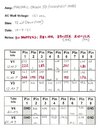
Hi syscokid, do you mind if i ask a couple of questions about the voltage lowering & the R9/R10 resistors ?, i've done the same HF mods on my ORI50 & after reading your (& Roberts) posts i'd like to check my voltages & bias.I just lowered the voltages a tiny bit to V1 & V2 with bigger valued resistors. This is it, and I shall not molest this poor amp anymore. The numbers in red represent the new voltages after increasing R9 & R10:
View attachment 73644
I just tried different resistor values at this suggestion, and nothing seemed to make any difference for the better. So I guess there will not be any World Peace... bummer...
 .
. .
. Cheers, Graham (aka old rocker
Ha ha... You British truly are too proper and polite! Ask away my friend...Hi syscokid, do you mind if i ask a couple of questions about the voltage lowering & the R9/R10 resistors ?, i've done the same HF mods on my ORI50 & after reading your (& Roberts) posts i'd like to check my voltages & bias.
I did the Mods myself, i'm ok with working on PCB's & changing components etc following instruction, as many moons ago i built Hi Fi amplifiers for a small UK manufacturing company(i was a co-owner) , but i'm not an Amp tech & have not fully understood where you measured the voltages & i wouldn't be able to work out replacement resistor values.
So my question is would you be comfortable giving me some guidance or would you rather not do this via the internet, i can take it to an Amp tech an ex working colleague, but after doing all the Mods myself i'd like to complete it myself
I fully understand if you may not comfortable with this & i may be able to figure it out myself by searching out all your notes
Ha ha... You British truly are too proper and polite! Ask away my friend...
 , ok thanks, so if i'm reading your chart correct you have replaced R9/R10 with 10K resistors to lower the voltage as shown by the Red numbers ?, if so can i ask:.
Here's a pic of Rob's Origin 50 before any mods, highlighting R6, R8, R9, & R10:
Do R9/R10 control the voltages for all 5 Valves & all pins ?, so changing the resistors affects all 9 pins on the 5 valves?.
How is the value of the resistor calculated to get the required Voltage ?
Is there a chart/table showing what the voltages should be ? or is it experience based ?, in which case i have a bit of a problem
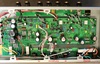
Here's a pic of Rob's Origin 50 before any mods, highlighting R6, R8, R9, & R10:
View attachment 73670
Power supply is on the right. Thinking from right to left:
R6 will only affect V3, V2, & V1. I never messed with R6. I never measured the voltages going into R6.
R8 & R9 will only affect V2 & V1. R8 was increased to 10k, and R9 was increased to 15k, to bring down the excessive voltages hitting V2 (Which also affects voltages at V1).
R10 will only affect V1. R10 was increased to 12k.
Yes, voltage drop can be calculated but you would need to know the amount of current going through the resistors. Perhaps others here can explain the calculating formulas.
AFAIK, there is no voltage chart of this amp that's available for an amp hack like me. But most tubes available today have a datasheet that will show maximum operating values and specs.
so would it be reasonable to assume that if i replace R8/9/10 with your posted values on my ORI50 pcb, i would see the same voltages as Roberts board ?(mine is also a V1 board)., then all i need to do is look up how to adjust the Bias .
Yeso would it be reasonable to assume that if i replace R8/9/10 with your posted values on my ORI50 pcb, i would see the same voltages as Roberts board ?(mine is also a V1 board).
If this is the case could you tell me the spec of the resistors i would need

Eazy Peezy... See the square pad in CN32?then all i need to do is look up how to adjust the Bias



You first need to know the current drawn by the tubes being supplied HT via the resistor(s). Suppose we use Sysco's pic etc above, R10 feeding V1 as our example.How is the value of the resistor calculated to get the required Voltage ?
You first need to know the current drawn by the tubes being supplied HT via the resistor(s). Suppose we use Sysco's pic etc above, R10 feeding V1 as our example.
Start by measuring & noting (writing down) the voltage on the cathode of each triode of V1. Now divide the voltage on each cathode by the value of the corresponding cathode resistor "in ohms".
Suppose V1a's cathode resistor value is 2k7 & the cathode is at 1.6V.
1.6/2700 = 0.000592A.
Do the same for V1b, then add each triode's current draw together for V1's total (rough) current draw. (I say "rough" because to get an accurate figure we'd need each resistor's "exact" value).
For convenience sake, let's suppose both triodes are drawing the same current of 0.000592A. Times two = 0.001185A (or 1.185mA) total current for V1.
You know how much HT voltage you need to be dropped by the resistor, so the formula to use is from ohm's law;
R = V/I
where
R = resistance value required
V = voltage you want to drop
I = current drawn by V1
Example; you want to drop 10V from V1'sHT node, so
10/0.001185 = 8,438 ohms resistance needed.
Sorry for the long-winded rant, you're most likely even more confused now. Cheers
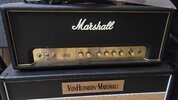
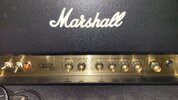
Picked up my Greg-Modded Origin 50 today. It was a 330 mile round trip and definitely worth it. My oldest Son and my Dad accompanied me on the trip.
Let me say that the "Greg-Mod" goes beyond the Headfirst Mod and corrects a lot of issues.
Playing through Greg's 2x12 loaded with Scumback M75-LD's it sounded amazing.
The tone and response is otherworldly. Where in stock form, I had to max out all my controls, after the Greg-Mod, everything is about in the middle and far more responsive than stock.
The amp has much more clarity and dynamics and its much tightervthan it was even with a TS-9.
For example, cranking the bass knob gives totally usable low end without ever intruding into the other frequency ranges. No muddiness even with bass full-up.
The amp's volume production is way beyond stock and it actually has LESS noise than it did in stock form with the "boost" feature engaged.
I am beyond stoked and impressed.
I'll try to get some video up on Saturday...
View attachment 73696
View attachment 73697
.Hi ivanH, ugh! thanks a lotYou first need to know the current drawn by the tubes being supplied HT via the resistor(s). Suppose we use Sysco's pic etc above, R10 feeding V1 as our example.
Start by measuring & noting (writing down) the voltage on the cathode of each triode of V1. Now divide the voltage on each cathode by the value of the corresponding cathode resistor "in ohms".
Suppose V1a's cathode resistor value is 2k7 & the cathode is at 1.6V.
1.6/2700 = 0.000592A.
Do the same for V1b, then add each triode's current draw together for V1's total (rough) current draw. (I say "rough" because to get an accurate figure we'd need each resistor's "exact" value).
For convenience sake, let's suppose both triodes are drawing the same current of 0.000592A. Times two = 0.001185A (or 1.185mA) total current for V1.
You know how much HT voltage you need to be dropped by the resistor, so the formula to use is from ohm's law;
R = V/I
where
R = resistance value required
V = voltage you want to drop
I = current drawn by V1
Example; you want to drop 10V from V1'sHT node, so
10/0.001185 = 8,438 ohms resistance needed.
Sorry for the long-winded rant, you're most likely even more confused now. Cheers
 , yes now confusion & out of my depth reigns .
Once again, this is great thanksYes
View attachment 73688
And make sure that the resistors are "metal oxide" and have a 2-watt rating!
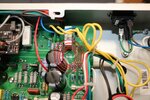
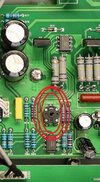
Eazy Peezy... See the square pad in CN32?
View attachment 73689
Amp warmed up for at least 10 minutes. Set the meter to read DC. With one lead of the meter, probe it at that square pad of CN32. The meter's other lead should be grounded anywhere on the chassis, OR... grounded at the circle pad of CN32. Marshall recommends 70mV (35mV per EL34 tube), and this equates to a 60% or "medium" bias.
Yes, this is the trimmer pot for the bias circuit:
View attachment 73691
, yet another question, how do you draw the red markers & printing on your pics ?, just curious.
, i'm almost frightened to ask , but what's the "Gene Mod" !.
That's just Robert showing his appreciation for the help in getting this amp to fly with some added mods based on common sense by humorously calling the extra mods the "Greg Mod"... or the "Iverg Mod"... or even the "Ivanberg Mod"! BTW, I'm Greg.Hi Robert, I'm almost afraid to ask what's the "Greg Mod"
With my PC, I print out the blank voltage chart. Then I hand draw the added info with a pencil or a red marker onto the chart. Then I scan the chart and save the new pic as a jpeg or pdf copy back to the PC. I could also add all the text, the lines, the circles, and colors, using my PC's Paint program.Once again, this is great thanks