OP


So, did this thing ever fly?
YES!!!!!!!!!!!!!!!!!!!!!!!!!!!!!!!!!!

So, did this thing ever fly?

And d d d d d d...? what' sit like?YES!!!!!!!!!!!!!!!!!!!!!!!!!!!!!!!!!!
And d d d d d d...? what' sit like?

Yes, it's fully operational. Ready to go home. It is now a very high gain amp... a very loud high gain amp! A very small amount of added hiss. I've only played about 10 minutes while testing the new loop board with my Fender reverb pedal (Marine Layer), but it did sound really good. The Jose clippers are clipping like cranky crickets!So, did this thing ever fly?
The amp's 3-position power scaling switch feature is practically useless now. I'm guessing the power switch should be left on HIGH all the time. The amp's Boost feature doesn't seem to make any difference to the gain or tone anymore.
I understand what you’re saying, but I’m talking about an amp that actually is clean. The “rolling back” the volume doesn’t really make for a nice, airy clean. It’s cleanER, but still not a nice, clear clean.
That’s why I’ve resigned myself to developing a multi-amp setup as the final iteration of my rig.
I like Marshall dirt and Fender clean. Plus, I’ve realized that I don’t care for an EL34/EL84 clean as much as a 6L6/6V6 type of clean.
In short, the approach Eric Johnson takes strikes me as the way to go.
Correct tools for the job. If you need a heavier crescent wrench to drive the nail in, you should have bought a hammer instead.
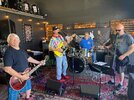

Good observations!!!
This is exactly why I'm going with a twin-amp setup. You can't beat my Marshall MG50 Solid State for its crystal clear clean tones. Maybe a Princeton is cleaner, but I have this 50 watt MG50 on hand, so it's a good choice for zero dollars spent.
The more I think about it, the more the clean/dirty amp setup makes more and more sense. No need to alter amp gain or volume or fiddle with rolling the knobs back between songs, just simply switch on 'A' or 'B' and you're ready instantly.
I'm wondering why I didn't do this sooner.
I’ve been a fan of dual amp setups for awhile.
I’m working on my own dual amp setup,; actually, I started it quite awhile ago, but it got sidelined while I bought a house and sold another.
I need to revisit that project. As I recall, I was just about done with the mechanics. I think I still need to get a couple of speakers.
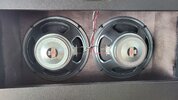
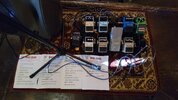
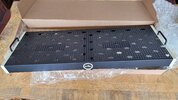
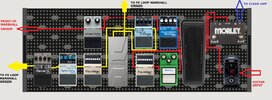
I’ve been a fan of dual amp setups for awhile.
I’m working on my own dual amp setup,; actually, I started it quite awhile ago, but it got sidelined while I bought a house and sold another.
I need to revisit that project. As I recall, I was just about done with the mechanics. I think I still need to get a couple of speakers.
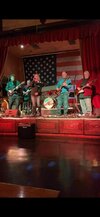
I'm wondering why I didn't do this sooner.
Lighten up on yourself.
No one is born knowing everything and everyone goes through periods of growth and development.
Why didn’t you do this earlier?
Because you weren’t ready to.
Yes, it's fully operational. Ready to go home. It is now a very high gain amp... a very loud high gain amp! A very small amount of added hiss. I've only played about 10 minutes while testing the new loop board with my Fender reverb pedal (Marine Layer), but it did sound really good. The Jose clippers are clipping like cranky crickets!
The amp's 3-position power scaling switch feature is practically useless now. I'm guessing the power switch should be left on HIGH all the time. The amp's Boost feature doesn't seem to make any difference to the gain or tone anymore.
Lighten up on yourself.
No one is born knowing everything and everyone goes through periods of growth and development.
Why didn’t you do this earlier?
Because you weren’t ready to.
So, just to be clear, does this mod actually change the gain structure of the amp, or is the apparent gain increase really a result of the added diode clipping?
So, let me try to explain as I understand the HF mod.
By reassigning tube V2 from FX loop duty, it creates a second gain stage. This is similar to the Tim Caswell #39 mod. Not only does it create a TON or USEABLE gain, it imparts a very dynamic, touch-sensitive character that the Origin does nor have in stock form.
The Jose Arredondo Zener Diode Clipping Modification (to my mind) works much like an attenuator, giving you a flat-topped sine wave at very low volumes, but the actual structure of the gain produced is much more dynamic and articulate than the amp could ever produce on its own.
For comparison, if I hit the studio's Mike Morin Modded (extra gain stage added) JCM800 2204 with a TS-9, it still does not produce as much gain as the HF modded Origin 50H produces.
The higher voltages give a lot of clean headroom and the Origin is much louder than it is in stock configuration...
Okay. So, it is doing both. The reassignment of the tube is what results in the extra gain, but the zener diodes clip the signal. Incidentally, this is not attenuation. Attenuation would be a reduction in amplitude of the signal, while preserving the waveform. Clipping works differently. The diodes have a maximum voltage limit. When they receive a signal that exceeds that limit, only the portion at or below that threshold passes; the portion beyond that limit is “clipped”, resulting in a squared-off waveform. This squared-off waveform is heard as distortion.
Glad to hear it worked out for you.
This squared-off waveform is heard as distortion.