Things have been evolving with regard to my equipment.
Recently, I switched away from my pair of 57 pound DSL40C's because loading them (sideways and flat) into the trunk of my car (sometimes 4 times a day between studio job and rehearsals) was really causing me physical discomfort.
Taking a hard look at my equipment, I decided to not only lighten things up, but also simplify things too.
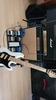
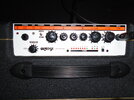
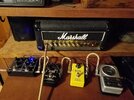
I bought a new Marshall Origin 50 Head, fitted it with Genelex B759 Gold Lions, but left it otherwise stock.
I had a gent build me a lightweight 2x12 cabinet, from finger-joint marine grade mahogany, then fitted it with lightweight Jensen Neodymium speakers. The cabinet is only 2" longer than a DSL40C and weighs only 34 pounds.
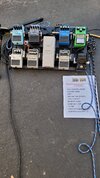
My pedalboard never changed very much. However, I did recently decide to add a reverb pedal in place of my chorus.
Guitars are another story.
I love the feel and tone of a Les Paul, but I have grown weary of their tuning instability during outdoor events, especially in direct sunlight. For a long time, I justified this "love/hate" relationship with my Les Paul's (both genuine and replicas) until I started looking around me.
All the bands I was listening to locally - that had Gibson's - were always either out of tune or out on intonation. I am telling you it was so far out you could hear it. I would watch their guitar players on the tuner between every song, sometimes delaying the start of the next song to try and tune.
I just got tired of being that guy.
I decided to just quit trying to justify the tuning problems. Some guys will cry "setup," but the reality is, I see this problem on guitars that I know (from my interactions) we're setup by personally by Dan Erlewine and some other top notch, So-Cal luthiers.
After a long chat with Gibson's custom shop, I finally got the answer that I had suspected all along. While I will honor my source's request to not have his name appear on websites, I was relieved to get a solid answer.
The issue with tuning stability on Gibson's is so widespread and well documented on the Internet that one only has to perform a basic search, to get thousands of hits on the subject.
There are endless articles where guys top wrap the tailpiece and/or wind the string posts from bottom to top, and devices like the String Butler have been created, all to try and address the issues.
According to my source, that's not the problem.
"Sure. If the string binds in the nut, you can have a tuning issue, but that's really only a very small percentage of these problems. The real issue is the construction methodology. Mahogany is not at all very stable from a thermal standpoint and the tenon is far too short for adequate high temperature and high humidity stability. But, our customers demand we build guitars the "old way" and nearly every modern innovation and improvement are shunned. It's kinda like people who put up with oil leaks to enjoy a Harley. Its just how it is..."
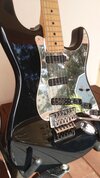
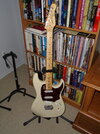
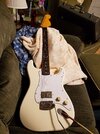
I switched away from all the Les Paul's and went back to my Schecter Hellraiser C1FR and Jackson San Dimas FR. The increase in string tension was pretty dramatic, and that took quite a bit of getting used too, but the tradeoff in tuning stability was well worth it.
My Floyd equipped guitars will stay in tune for not only a 4 hour show (some of it in direct sunlight) with furious whammyization, but for weeks, sometimes months (I am not kidding or exaggerating)
without requiring adjustments.
Ask
@Metal89, who can get up to 6 months of playing and tremolo use before returning is needed.
Saturday, we contracted for a 4 hour (micro brewery) show, which we stretched to 6 because of the chants of "encore" from the crowd. Out of my bad habits, I kept switching on my tuner, but everything was always in spec.
Not only did I enjoy myself more, I played more aggressively and really did a bunch of string-flapping harmonic dives during this performance.
I also try to never perform with brand new strings. In general, I try to have at least 2-3 rehearsals on them before we play out somewhere.
I'm also using the Jackson San Dimas FR more than the Schecter. I find that I am able to leave my amp running wide open and actually "tone things down" by switching to the middle/neck single coils. The lower output gives me a "tamer" tone for some songs and even though they are hum canceling, the neck/middle still give the Stratocaster "quack" that is appropriate on some country songs, like "Fast As You," and "Boot Scootin Boogie," despite my personal dislike for the "quack."
So, that's the thought process behind my recent changes...