18 Watt MojoTone Kit Build With Conversion To JCM800 Circuitry:

So based on the above Ted Weber Kit review, which speaks of a "thinner board" and turrets that are not "Well tinned," what suggestions do you guys have for me???
 
And here's the Mojotone offering...

 
I been dealing with C.J Sutton at Weber for a while now, buying attenuators and beam blockers, etc., so I sent him an email about the transformers used in their 18watt kits...
 
Response received from Weber:

Hi Rob.

here is a link to all our cabinet covering options, and there are handle pics down at the bottom.


In our amp kits, the speaker, cabinet, chassis, fiberboard, and brass plate are all made in Indiana. all other components are made overseas and carry no brand name most of the time. (the tubes are Shuguang Premium tubes, and sometimes they have markings and other times not.)

C.J. Sutton - T.A. Weber Inc.

You gotta respect honesty and transparency. Also, in order to make the kits cheaper, obvious concessions must be made.

I suppose one could easily upgrade the internals to higher quality components???
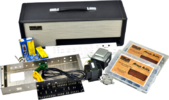
 
Last edited:
I also noted this amp kit during my search:


Everything you need to build a point‐to‐point, hand-wired TMB (Treble Middle Bass) version of the Marshall 18 watter. This is seriously one of the most essential and versatile amps you’ll ever own. And it’s not that hard to build either! Two channels of tasty class A, EL84 goodness. The first channel is just volume and tone – great for shimmering, vox-like clean tones with that top‐end chime that you can only get with EL84s. Crank the volume up and back off on the tone control and you’ve got tones that are reminiscent of a Tweed Deluxe. The second channel features the TMB controls and a master volume, which allow you to punch up the gain, sculpt the tone, and keep the volume right where you want it. This channel is pure Marshall tone, just not as loud as its bigger brothers. Add an A/B box, and you’ve got the perfect channel switching amp for live gigs.

The BYOC TMB18 kit comes with everything you need right down to the hook up wire. The tubes are all JJ EL84 x 2, ECC83 x 3, and EZ81 rectifier. The transformers are Classic Tone™ from Magnetic Components. These aren't rebranded "custom reproductions" of unknown origin. These are paper layer wound to vintage specs, using vintage construction methods, and made in Chicago, USA by a company that has been winding iron since 1943.

We offer a head cabinet that's comparable to the Marshall "small box", made from 13 ply birch, and available in 6 different color options: black with gold piping, cream with black piping, red with silver piping, orange with white piping, purple with gold piping, and seafoam green with white piping.

If you want a 2x10 or 2x12 combo, select "no cabinet" here and then select your combo cab from our amp cabinets page.

Our cabinets are made to order. Please allow 2 weeks lead time when ordering the kit with cabinet.
 
The small parts kit from Mojotone is reasonably priced at $164.95

 
What i like about the Weber kit is how its made like the old 18watt Marshall's with a fixed power cord and a few other details that have since gone "modern style" on other kits.

Could use some guidance here, Gents...
 
Response received from Weber:

Hi Rob.

here is a link to all our cabinet covering options, and there are handle pics down at the bottom.


In our amp kits, the speaker, cabinet, chassis, fiberboard, and brass plate are all made in Indiana. all other components are made overseas and carry no brand name most of the time. (the tubes are Shuguang Premium tubes, and sometimes they have markings and other times not.)

C.J. Sutton - T.A. Weber Inc.

You gotta respect honesty and transparency. Also, in order to make the kits cheaper, obvious concessions must be made.

I suppose one could easily upgrade the internals to higher quality components???
Why use a Steel Chassis instead of Aluminum?

Steel Chassis = Great Idea.
I would not use an aluminum chassis.
Off to a great start.

The first thing I would do is: make sure the chassis you are buying is galvanized steel.
Aluminum definitely has safety issues.
When steel/copper/tin etc is used to connect to aluminum, the metals will oxidize very rapidly.
These connections are made with screws and washers.
No matter how tight the screw is, a layer of oxide forms between the 2 dissimilar metals.
Over time, this oxide layer forms a perfect insulator.

Any electrical connection to the aluminum can fail because of this insulation affect of oxide formation.
Including: the ground connections can fail.
Which means: the safety ground connection to the amp can fail, when it is attached by a screw to aluminum.

Alternative: The electrical terminals can be welded to the chassis aluminum.
This prevents oxide from forming between the 2 dissimilar metals; making the safety ground connection much more reliable.

Which is why (starting 1971) specific rules were created to prohibit electrical grounding using dissimilar metals.


1599137085299.png
 
What i like about the Weber kit is how its made like the old 18watt Marshall's with a fixed power cord and a few other details that have since gone "modern style" on other kits.

Could use some guidance here, Gents...

The Mojotone kit shows a steel chassis.
If you buy a different kit, what is the chassis made of?
I strongly recommend that you avoid aluminum, or take special precautions when attaching electrical connections to aluminum.

Aluminum can still be used, provided those precautions are followed.
Unfortunately, many home made amplifiers do not mention or follow those precautions.

There is no worse choice, than to ground a chassis with screws, using dissimilar metals.
Dissimilar metals meaning: copper, steel, tin, etc...connected to aluminum.
However a trip to the TIG / MIG can permanently bond grounding terminals to the aluminum which would solve the issues.

PS
you cannot solder to aluminum. But you can weld to aluminum.
 
Why use a Steel Chassis instead of Aluminum?

Steel Chassis = Great Idea.
I would not use an aluminum chassis.
Off to a great start.

The first thing I would do is: make sure the chassis you are buying is galvanized steel.
Aluminum definitely has safety issues.
When steel/copper/tin etc is used to connect to aluminum, the metals will oxidize very rapidly.
These connections are made with screws and washers.
No matter how tight the screw is, a layer of oxide forms between the 2 dissimilar metals.
Over time, this oxide layer forms a perfect insulator.

Any electrical connection to the aluminum can fail because of this insulation affect of oxide formation.
Including: the ground connections can fail.
Which means: the safety ground connection to the amp can fail, when it is attached by a screw to aluminum.

Alternative: The electrical terminals can be welded to the chassis aluminum.
This prevents oxide from forming between the 2 dissimilar metals; making the safety ground connection much more reliable.

Which is why (starting 1971) specific rules were created to prohibit electrical grounding using dissimilar metals.


View attachment 48212

I just shot off a couple of emails about chassis construction...will update shortly...
 
From C.J. Sutton at T.A. Weber this morning:

Rob,

The chassis in the kit is aluminum.

(with regards to upgrading all the components in the kit) My opinion is that you can definitely do that if you choose, but personally I am not sure it is worth the extra expense. The result is a little better perhaps, but I tend to think that people who spend an extra $400 on transformers have to convince themselves that it was a good expenditure, so recommending them online and telling everyone else they can hear a difference is a way to provide their own peace of mind about the decision. I personally have built amp kits with the stock transformers, and then went to the “upgraded” transformers to see what difference it made. To my ears, there wasn’t enough of an improvement to justify the expense, and in this case a lot of extra effort.

There you go, there’s my pair of pennies - C.J.
 
Why use a Steel Chassis instead of Aluminum?

Steel Chassis = Great Idea.
I would not use an aluminum chassis.
Off to a great start.

The first thing I would do is: make sure the chassis you are buying is galvanized steel.
Aluminum definitely has safety issues.
When steel/copper/tin etc is used to connect to aluminum, the metals will oxidize very rapidly.
These connections are made with screws and washers.
No matter how tight the screw is, a layer of oxide forms between the 2 dissimilar metals.
Over time, this oxide layer forms a perfect insulator.

Any electrical connection to the aluminum can fail because of this insulation affect of oxide formation.
Including: the ground connections can fail.
Which means: the safety ground connection to the amp can fail, when it is attached by a screw to aluminum.

Alternative: The electrical terminals can be welded to the chassis aluminum.
This prevents oxide from forming between the 2 dissimilar metals; making the safety ground connection much more reliable.

Which is why (starting 1971) specific rules were created to prohibit electrical grounding using dissimilar metals.

Why not use an aluminum screw and washer for the grounding, along with dielectric grease????
 
Why not use an aluminum screw and washer for the grounding, along with dielectric grease????
The aluminum to aluminum is OK, but the solder terminal for ground is not aluminum.
You still have the same problem. The grease is not made for dissimilar metals. Only aluminum to aluminum.

If you do use aluminum, TIG welding the Copper/steel/tin ground terminals to the chassis before building the amp I would recommend.
That's why I only use steel. I can solder screw terminals to a steel chassis no problems. Then I use the screw also.
The solder makes a permanent electrical bond, and the screw makes a mechanical bond.

The grease is made from aluminum powder. It is exclusively made for aluminum to aluminum connections only.
 
Last edited:
I can express that...I recently put an aluminum pick guard on a guy's Stratocaster. I pot a square section of conductive-adhesive .025" copper tape on the back of the pickguard and soldered a ground terminal to that, but that's always voltage application, much different from an amplifier....

Maybe I could find a steel 18 watt chassis???
 
I can express that...I recently put an aluminum pick guard on a guy's Stratocaster. I pot a square section of conductive-adhesive .025" copper tape on the back of the pickguard and soldered a ground terminal to that, but that's always voltage application, much different from an amplifier....

Maybe I could find a steel 18 watt chassis???
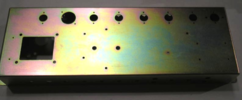
The mojotone chassis "is" steel. From what I see in the pictures, it's not aluminum.

You can use just the chassis...

No I'm wrong. The Mojotone chassis is aluminum. My Bad :fan:
 
Last edited:
I can express that...I recently put an aluminum pick guard on a guy's Stratocaster. I pot a square section of conductive-adhesive .025" copper tape on the back of the pickguard and soldered a ground terminal to that, but that's always voltage application, much different from an amplifier....

Maybe I could find a steel 18 watt chassis???
And that's the best advice I can start with, use galvanized steel.
Bingo dude.
A steel 18 watt chassis.


1599146214755.png

1599146332739.png
 
Why not use an aluminum screw and washer for the grounding, along with dielectric grease????
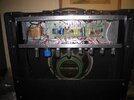
A good cleaning followed by the application of dielectric grease is what I use for any grounding points on a aluminum or steel chassis.

Weber's more economical kit prices are definitely related to overseas-made trannies. I don't believe I've ever came across a negative review from someone who actually has built one of the Weber kits, in regards to the cheaper trannies. But personally, I'm more comfortable with USA iron... or even Canadian iron from Hammond for that matter! It's worth the extra cost, IMO.

A couple questions for you:
Your number one priority is to experience amp building, right?
&
I haven't, but have you played an 18 watt Marshall before? EL84 power tubes is a very different flavor.
 
Back
Top