Project Carvin V-16: Morphing from PCB to Point To Point Turret Board

I enjoyed the Uncle Doug videos. Simplicity at it's finest a child could understand. I'm with Ivan his choice of parts not the finest


Have a great day.

Have you watched any of the D-Labs videos? He is pretty good also. The earlier ones irked me a bit with his glass of wine all the time.
Just watched one where he UN-MODDED an '71 Deluxe Reverb.
 
Thank you ChasFred I just watched it. Why D-Lab's did not check the blue capacitors for leakage they have around 99% fail rate.
1981-1982 were the last of the good Fender Deluxe amps made they can be modified to AB763 specifications easy.
I had one such amp last summer 1981 Deluxe Reverb. It's not often I want to buy a customers amp but it was killer set off the Ruby
alarm My black GSP Ruby howls to any amp that has it going on to the note no full spectrum analyzer needed, it's all fun.
 

Attachments

Thank you ChasFred I just watched it. Why D-Lab's did not check the blue capacitors for leakage they have around 99% fail rate.
1981-1982 were the last of the good Fender Deluxe amps made they can be modified to AB763 specifications easy.
I had one such amp last summer 1981 Deluxe Reverb. It's not often I want to buy a customers amp but it was killer set off the Ruby
alarm My black GSP Ruby howls to any amp that has it going on to the note no full spectrum analyzer needed, it's all fun.
Sometimes he takes what I think are the silliest short cuts, like the blue caps. If you have gone that far why not finish it all the way.
He still is good to watch when there is nothing else going on. He has done several odd ball conversions that are fun to watch also.
 
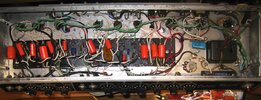
In order to keep the new layout and wiring a lot more efficient, I decided to move the amp's volume control to where the amp's reverb control is. All the other controls except for the Soak control will get shifted one spot closer to the input jack...
IMG_1825.JPG


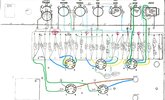
Anyways... I think I got the sketch of the layout for the preamp done. Does it jive with the schematics?????????

This took me many hours to put together on paper:
Sketch 3 Preamp.jpg


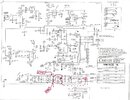
This is not the original Carvin Vintage 16 schematic. This was redrawn by Richard Hassebrock with his suggested mods back in 2004. The red notations is my own doing. On this schematic, Richard Hassebrock purposely omitted the reverb circuit since nothing was changed or modded in that circuit. My vintage 16 is set up with the Hasse V16 mods, and this is what I'm trying to replicate onto a turret board:
Hasse V16 mods (1).jpg


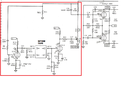
This is just the reverb circuit copied from the original schematic:
V16 Reverb schematic.png


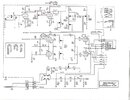
The complete original Carvin Vintage 16 schematic:
Carvin vintage 16 Schematic.jpg
 
What I don't get is 1uf C-2 & C-6
The 1uf C-2 looks to be a "partial bypass" but instead of a resistor it's a "zero ohms link", so we have a V1a cathode bypass value of 1.22uf.
Plugging the numbers into the calculator I linked earlier (much easier than doing all that arithmetic) shows a gain figure at 82Hz of 58.1 (31.62dB), & at 10kHz of 57.13 (35.14dB), with the frequency roll off point in the 1kHz area (or a little lower, say 800Hz).
So this is rolling off only marginally higher than a typical Marshall 2k7/0.68uf 1st stage & has fractionally less overall gain (due to the 500k Rg), but has better & tighter lows.
Plugging in the V1b numbers shows that the frequency roll off point is again in the same area, (very marginally lower), with a bit less gain at 82Hz, 35.12 (30.91dB) with a slight increase in overall gain, 59.25 (35.45dB).
Cheers
 
Last edited:
What I don't get is 1uf C-2 & C-6
Glad you mentioned this section. I want to streamline this part of the circuit, but wasn't sure wtf is going on there. I can always easily change later. Thanks!

The 1uf C-2 looks to be a "partial bypass" but instead of a resistor it's a "zero ohms link", so we have a V1a cathode bypass value of 1.22uf.
Plugging the numbers into the calculator I linked earlier (much easier than doing all that arithmetic) shows a gain figure at 82Hz of 58.1 (31.62dB), & at 10kHz of 57.13 (35.14dB), with the frequency roll off point in the 1kHz area (or a little lower, say 800Hz).
So this is rolling off only marginally higher than a typical Marshall 2k7/0.68uf 1st stage & has fractionally less overall gain (due to the 500k Rg), but has better & tighter lows.
Plugging in the V1b numbers shows that the frequency roll off point is again in the same area, (very marginally lower), with a bit less gain at 82Hz, 35.12 (30.91dB) with a slight increase in overall gain, 59.25 (35.45dB).
Cheers
Oh :poo:!! Old eSGEe is going to vaporize if he tries to read all of that... :cheers:


but instead of a resistor it's a "zero ohms link"
Is this any different than a solid jumper wire?
 
Is this any different than a solid jumper wire?
The circuit sees it as a solid wire. The only reason I know of to use a zero ohms link is when a circuit board trace or solid wire is prone to instability. Maybe they were experimenting with a partial (or switchable) bypass, who knows. Cheers
 
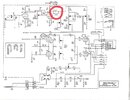
Another question(s)... C34 & C7? If you add them up, you get .057. They are both rated at 400v. Is there some special mojo to have 2 caps in parallel at this point? Or can I just use a single .057/400v cap instead? Mouser does sell a .056/400v cap... close enough for me!

Hasse V16 mods (1).jpg
 
The only reason I know of to use a zero ohms link is when a circuit board trace or solid wire is prone to instability.
"Instability"... interesting... :hmmm:. Not sure if this is related, but did you notice the V16 original schem has the V1 plate resistors at 200K and 220K? The Hasse mods drops both V1 plate resistors to 100K. He said the bigger resistors made the amp too "gainy"!
 
Another question(s)... C34 & C7? If you add them up, you get .057. They are both rated at 400v. Is there some special mojo to have 2 caps in parallel at this point? Or can I just use a single .057/400v cap instead? Mouser does sell a .056/400v cap... close enough for me!

View attachment 32269
Yes, you could sub in a 0.056uf & would most likely not hear a difference. If you did notice any difference it would be very marginally less low end. Cheers
 
"Instability"... interesting... :hmmm:. Not sure if this is related, but did you notice the V16 original schem has the V1 plate resistors at 200K and 220K? The Hasse mods drops both V1 plate resistors to 100K. He said the bigger resistors made the amp too "gainy"!
In conjunction with the (bypassed) 910 ohm cathode resistor, yes, I could see that. Between a 220k anode & 910 ohm cathode resistor the tube is biased reasonably hot. The tubes output voltage swing develops across the anode load (resistor), larger value = larger potential difference & thus swing. Possible instability, maybe. Cheers
 
Back
Top