Where the FVK is Middle C on the Guitar???

Sp8ctre

Ambassador of Steel
Country flag
...you want to chase your tail on the internet??? Go search for a firm answer to this!

What I want to to know is if I see this on standard notation where the hell do I play it???????

Some say guitarist play it on the 5th string 3rd fret. Some say it's on the 1st string 8th fret
and still others say 2nd string 1st fret...anyone who reads music and can tell me as a guitarist?
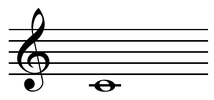
Middle_C.png
 
I believe middle C happens to coincidentally also be the C in between your two extremes!
I visualize it as the G string on the 5th fret but that of course is the same note as your B string (2nd string) 1st fret.

Here is the note on the piano. Make sure your guitar is tuned to A-440 & finger that baby where it feels good & sound right...

https://upload.wikimedia.org/wikipedia/commons/e/e2/Middle_C.mid

Now, where is your finger??
Very good. Mystery over.. time to move on to next puzzling dilemma.
 
Read both pages here. I sort of get it, but not enough to summarize

I read that and a lot more, but I think everyone is confused or in disagreement.

My current class has all the music i standard notation. No TAB! So I have to know where to start the song an the fretboard.
The teacher plays Sax and most of the stundents play piano...I'm going to ask my teacher and see what he says.
 
I believe middle C happens to coincidentally also be the C in between your two extremes!
I visualize it as the G string on the 5th fret but that of course is the same note as your B string (2nd string) 1st fret.

Here is the note on the piano. Make sure your guitar is tuned to A-440 & finger that baby where it feels good & sound right...

https://upload.wikimedia.org/wikipedia/commons/e/e2/Middle_C.mid

Now, where is your finger??
Very good. Mystery over.. time to move on to next puzzling dilemma.

Well...based on trying to play and hear...which I suck at and on some notes from my teacher...I've concluded that Middle C (for me)
based on the picture in my 1st post is on the "A" string 3rd Fret...

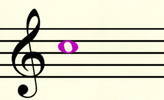
This "C" is on the "G" string 5th Fret (for me)

C5 treble.png
 
Well...based on trying to play and hear...which I suck at and on some notes from my teacher...I've concluded that Middle C (for me)
based on the picture in my 1st post is on the "A" string 3rd Fret...

This "C" is on the "G" string 5th Fret (for me)

View attachment 8882

That is correct.

In standard tuning, middle C on a guitar is played on the third fret of the A string, IF using music written for guitar. The equivalent of that is the eighth fret of the low E string. But, the timbre will be a little different if you play it there.

The confusion arises in that the guitar is a transposing instrument, so guitar music is written an octave above where it sounds. So, if you were to try to match the pitch as played on a piano, middle C would be at the first fret of the B string (and it’s enharmonic equivalents on the fretboard, such as the G string, 5th fret).

If you were using music written in concert C (such as, written for piano - not guitar), middle C as played on the guitar (A string, 3rd fret) would actually be in the bass clef. By treating the guitar as a transposed instrument, we avoid having to use two clefs.

If a piano player asks you to play middle C, play it where it is supposed to be for the guitar and say, “This is my middle C.” Then play an octave higher and say, “This is your middle C.” That will make you seem really smart!
 
Last edited:
Well...based on trying to play and hear...which I suck at and on some notes from my teacher...I've concluded that Middle C (for me)
based on the picture in my 1st post is on the "A" string 3rd Fret...

This "C" is on the "G" string 5th Fret (for me)

View attachment 8882

Middle 'C' refers to the middle C note on a typical standard modern piano which has 88 keys.

The link I gave you plays the actual note (261.63hz) for middle C on the piano. If you actually play that note & here it is again...
https://upload.wikimedia.org/wikipedia/commons/e/e2/Middle_C.mid
you will find that it is the same note (in hz) as the B string 1st fret C (aka G string 5th fret).

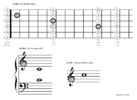
If you are troubled by guitar sheet music notation not actually aligning with middle C on the piano it is because it is an octave off. When actual piano notation note value for note value is applied to guitar, it simply becomes an unnecessary hassle that demands utilizing both clefs to convey real note values. Simply put, factually using piano notation for guitar would require the playing of an open E chord use 2 clefs (both the bass & treble clefs). It's just not efficient so, guitar notation is typically adjusted to save room & speed things up.

Here's a decent illustration displaying everything I'm trying to say...

upload_2017-10-10_3-43-12.png

As you can see, the next problem with this 'shortcut' approach of moving actual middle C an octave for guitar notation is upper fretwork note notation! We end up getting a whole lot of added staff lines after crossing the first G note on our high E string! So... its a compromise that has its benefit & shortcomings.
This is the big reason someone was compelled to come up with a more usable alternative.. enter Guitar Tab! Boy, things just got real easy for us modern guitar players huh??

Some interesting FYI... Lots of instruments make different use of the musical G clef & F clef used in traditional piano Treble & Bass notation. For instance, some instruments look at a written C note but actually play something completely different! A saxophone sees a C note in notation & it actually plays a B flat! Ever wonder why so many horn heavy songs are in B flat or E flat??

The point is, notation is a malleable tool to get a musical job done.

The real question is do you want to be literal or not. Literal middle C refers to the middle C note on a piano averaging 261hz & that note literally translates to the 1st fretted note on the B string & or the 5th fretted note on the G string. Anything else is semantics.
 
That is correct.

In standard tuning, middle C on a guitar is played on the third fret of the A string, IF using music written for guitar. The equivalent of that is the eighth fret of the low E string. But, the timbre will be a little different if you play it there.

The confusion arises in that the guitar is a transposing instrument, so guitar music is written an octave above where it sounds. So, if you were to try to match the pitch as played on a piano, middle C would be at the first fret of the B string (and it’s enharmonic equivalents on the fretboard, such as the G string, 5th fret).

If you were using music written in concert C (such as, written for piano - not guitar), middle C as played on the guitar (A string, 3rd fret) would actually be in the bass clef. By treating the guitar as a transposed instrument, we avoid having to use two clefs.

If a piano player asks you to play middle C, play it where it is supposed to be for the guitar and say, “This is my middle C.” Then play an octave higher and say, “This is your middle C.” That will make you seem really smart!

Gee Smitty, if you had posted that just a little bit sooner ya would have saved me a whole lot of trouble bro! lol

The truth is that it has been a long time since I've bothered with dealing with written music & although I thought I knew what I was talking about & wanted to say I did do some fresh research just to affirm I had it right in my dusty ol brain.

While learning to read music is very helpful it is also worth noting the importance that we work at developing our ears, learn a bit of theory & practice practice practice with all your heart & soul.

I say,.. Put in the the time in & loving the music & instrument(s) you are learning to play pays off big time in the grand scheme of things. Playing with feeling, timing & soul is just as important as being able to read music & in the end.. maybe even truthfully more so.

aka: fvk middle C yo!
LOL
 
Gee Smitty, if you had posted that just a little bit sooner ya would have saved me a whole lot of trouble bro! lol

Ha!

That’s funny.

The middle C thing can be confusing. I remember learning to play guitar, after having first learned music on another instrument and wondering what was up.

You are correct. Middle C would objectively be played on the B string, first fret.

But, when a note is written as middle C (the first ledger line below the treble clef) in guitar sheet music, it is played on the A string, third fret.

Also, your words about listening are spot-on.

I’ve seen sheet music supposedly written for guitar that was an octave off, meaning, it was really written for piano.

I’ve also had to play an octave above written music to hit the correct pitch! It all comes down to whoever was transcribing.

It’s also worth noting that if a piano is playing in a song that didn’t originally have one, the guitar player may want to intentionally play an octave higher or lower just to avoid occupying the same sonic space.
 
Last edited:
It’s also worth noting that if a piano is playing in a song that didn’t originally have one, the guitar player may want to intentionally play an octave higher or lower just to avoid occupying the same sonic space.

And this problem reminds me of a 'Lead' Bass player I dig a bunch of resort gigs with 15 or so years ago. He had a 5 string bass (with the high C string) & he wasn't afraid to use them! lol To bad he didn't spend time listening & wanting to sound like better Bass Players that know where their sweet spot is in the mix. Unfortunately, I just had to do my best to simply tune him out & ignore him because his approach to playing bass left me with nothing to work off of or compliment.

So yes, having a feel for what sounds good or appropriate goes a long way in the gigging biz & can go a long way towards getting the word out & landing you some jobs.

That bizzy bee bassist only got that gig due to loyalty & friendship, not for his never ending bizzy bee upper register leadwork style of playing! Hell, he left a big enough hole in the music that a second bassist could have easily stepped in to accompany us without ant conflict or stepping on any toes.

I think I've done said enough to paint this ugly picture for you guys.

And Smitty,.. what the heck are you still doing up at 4:30 in the morning? wazzup with dat stuff Bud? lol
 
...you want to chase your tail on the internet??? Go search for a firm answer to this!

What I want to to know is if I see this on standard notation where the hell do I play it???????

Some say guitarist play it on the 5th string 3rd fret. Some say it's on the 1st string 8th fret
and still others say 2nd string 1st fret...anyone who reads music and can tell me as a guitarist?
View attachment 8880

Just for clarity, the notes at the 5th string/3rd fret and the 6th string/8th fret are the same note (I assume you meant to say 6th string, instead of 1st string). They are the same fundamental pitch, but they have a different timbre. The decision to use one or the other is determined by the timbre you are trying to achieve. The sheet music, itself, normally won't indicate which should be used. You really have to listen for that. Or, fingering considerations may make it easier to use one or the other.

Incidentally, this is true all over the fretboard. Most notes can be found in more than one place on the fretboard, but the timbre will be different from one to the other.

Getting back to Middle C...

As for the objective, established pitch of "middle C", itself, as Relic and I mentioned, the note at the 2nd string/1st fret is the pitch that corresponds to middle C, as played on the piano - 261.63hz. In PIANO music, this would be the first ledger line beneath the treble clef.

But, the note written as middle C in GUITAR sheet music is actually an octave below middle C on a piano. However, in GUITAR sheet music, this note is also written as the first ledger line beneath the treble clef!

So, you have two different notes on the guitar that may be referred to as "middle C." How do you know which to play?

This is how I approach it:

If you are playing sheet music that was written for guitar (such as guitar music you download from Musicnotes.com or music you find in the printed guitar anthologies you can buy in a music store) whenever you encounter the note written as middle C (the first ledger line beneath the treble clef), use the 3rd fret on the 5th string (or the 8th fret on the 6th string, if it sounds better). You can assume that the music was written taking the pitch characteristics of the guitar into account. But, listen carefully as you play, just in case there has been a transcription error.

On the other hand, if you are playing from music written for another concert pitch instrument, such as flute or piano, you may want to begin by playing an octave higher on the fretboard than you would otherwise play if you were using music written for guitar. But, again, listen to be sure it sounds good in the context of everything else.

The bottom line to remember is that the guitar transposes on the octave. So, within the context of guitar and music written for guitar, a note written as middle C will be played on the 5th string/3rd fret (or 6th string/8th fret). Just be aware that this is an octave below the defined, standard, concert middle C, as played on a piano, which is 261.63 Hz, and corresponds to the note at the 2nd string/1st fret (and it's equivalents). So, from time to time you may have to adjust and play higher depending on the situation.
 
Last edited:
  • Like
Reactions: RVA
This is the big reason someone was compelled to come up with a more usable alternative.. enter Guitar Tab! Boy, things just got real easy for us modern guitar players huh??

Even with Tab, you have to be flexible. For example, I play the intro and rhythm part for Paranoid in a different position than Tony Iommi does. He uses mostly the 6th and 5th strings for the basis of the rhythm. For my rig and setup, it sounds better to use the 5th and 4th strings as my basis. It actually sounds more like the recorded version, too. Maybe if I had his rig, I'd alter how I play it and do it just like him. I dunno.

It's like you said, notation is a malleable tool to get a job done.

But, you gotta use your ears as the final judge and be flexible in how you do it.
 
Last edited:
Thanks for all th in depth explanations! I think I have a handle on it for my purposes.

I am trying very hard to develop my ear, but it's easier said than done...I may be tone deaf!

My big problem for this current class is my teacher is a Saxaphone player. He will play a solo
post it on line and then I have to transpose it to the guitar! Not easy at all when you can't
identify the notes just by listening.

So this and the fact that all the sheet music given is for piano has caused me to go on my
little journey.

I will say that of all the classes I've taken I think this one is going to help me become a better
player more than any others thus far...

The journey is long and hard, but very rewarding and satisfying in the end!!!
 
My big problem for this current class is my teacher is a Saxaphone player. He will play a solo
post it on line and then I have to transpose it to the guitar! Not easy at all when you can't
identify the notes just by listening.

Has he told you if it is an alto, tenor, or soprano saxophone?

Soprano and tenor saxophones are both Bb instruments. An alto sax is an Eb instrument. By comparison, in standard tuning, a guitar is a C instrument, just like a piano. It's just an octave lower.

What this means is that if an alto sax, for example, plays a note that is written as a "C" in music written for an alto sax, the actual note played will sound the same as an Eb on the piano.

If you know what type of sax he's using, it will help with the transposition.

Or, is he asking you to listen and reproduce the notes on the guitar, as you hear them?
 
Last edited:
He is playing an alto sax. It is my understanding I'm to listen and match what he is playing.

The problem is I have no ear for this yet. So I have been using Transcribe software to try and get an idea where
to start with the guitar. I am starting to get the hang of listening to the sax and then playing a note on the
guitar and getting the sound correct...
 
Back
Top