Understanding room and venue acoustics

simoncroft

Well-Known Member
Country flag
This thread includes a lot of material I've put on-line over the years, with the aim of helping musicians – whether recording at home or performing on stage – get the best from whatever environment they find themselves playing in. In addition to looking at how an acoustic space alters the sound we hear, I'll cover topics such as, speaker placement, mic placement, and the maths behind the fact that two speakers in a cabinet don't have the same directional characteristics as a single driver. Most importantly though, I'm happy to answer any questions along the way, or get definitive answers from manufacturers and designers if I don't know the answers.

The origins of this thread are in an observation by the guitar maker Ron Kirn that moving your guitar amp's position in a room, and the characteristics of the room itself were likely to have a much greater effect on guitar tone than factors we guitarists like to get hung up about, like body wood. Ron said: "The reality of the way sound is 'modified' by the environment inwhich it’s produced never enters the discussion either... how aroom, replete with hard surfaces, is just plain gonna sound differ-ent than one with “soft” whatever covering the walls... In the world of esoteric audio, the acoustic treatment of the room typically far exceeds the cost of any single piece of equipment that will be used to generate the sound that will fill the roomonce completed. Yet, in the world of the guitarist, seems guys just don’t have a clue how important the acoustic signature of the room they are playing in is, or, of the sonic influence of many peripheral considerations, that rarely get considered... "

… And so we begin
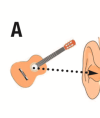
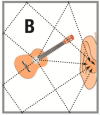
Most of us tend to think of sound arriving at out ears something like Diagram A, a direct transfer of vibrations across the air. In fact, most of what we hear in a room is reflected sound that arrives at our ears only after it has bounced back from one or more solid surfaces. In simplified form, it looks more like Diagram B. (The actual number of reflections will be vastly greater than shown.)

A good experiment to get a feel for the difference that reflectedsound makes is to play an acoustic guitar in the middle of a room. Then sit yourself facing into the corner of the room and keep playing. You’ll find that the closer to the walls you get, the more the tone changes. This effect is known as ‘corner loading’and is thought to be the real reason Robert Johnson recorded while sitting in this position.

I’ll now look at the factors that create the acoustic problems you’ll often encounter in a club or bar, along with what you can do to minimize them.
Screen Shot 2024-11-03 at 19.22.50.pngScreen Shot 2024-11-03 at 19.23.01.png
 
Bar blues and hard walls
Whether you’re cranking the blues at a local bar or bringing the crowd to its feet in an arena, most of us normally play in venues that were never designed for music performance. Unlike dedicated concert halls, these venues exhibit problems that can seriously compromise your sound. That said, once you understand the problems, you can start to overcome them.

Hard, reflective surfaces such as a window,being particularly problematic. There is an additional factor in many venues and that isparallel walls (or worse, parallel walls and parallel floor/ceiling).

An extreme example of a reflective room with parallel sides is a school classroom, which is how I came to discover that when you were really, really bored in a lesson, you could create a mystery humming noise that filled the room. If you were sitting in the right place and hummed the right note, no one could tell whereit was coming from. It was surprisingly loud and seemed to come from all over the room. I had accidentally created a ‘standing wave’.

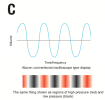
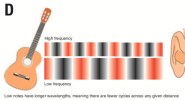
So what is a ‘standing wave’? Well, it’s a bit like the harmonic you get if you sound an open string on the guitar and lightly touch it above the 12th fret. But instead of a string, it’s the air itself that is affected. Diagram C shows the conventional way that an audio frequency is represented. The wavy line confuses some people, so I’ve tried to show in Diagram D what is really happening to the air molecules. When you hit a string on a guitar, it cause the air in the room to form alternating areas of high and low pressure, which is another way of saying the air molecules are closer together in some places and further apart in others.

When you hit the concert pitch of A, which equals 440Hz, this transition – or cycle – between high and low pressure happens 440 times a second.

The other important aspect to consider at this point is ‘wavelength’. For any given linear distance (for instance from a loudspeaker to someone’s ear) each frequency can only go through a certain amount of cycles. As I’ve tried to show in Diagram D, high frequencies go through more cycles than low frequencies over the same distance. Another way of saying the same thing is this: the wavelength of low notes is longer than the wavelength of high notes.

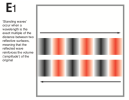
A ‘standing wave’ occurs when the wavelength of a frequency happens to be an exact fit for the distance between two parallel surfaces. Instead of the sound dying away like other frequencies, the reflected energy reinforces the existing pressure wave, making it louder. I’ve shown this in Diagram E1. You may have played an acoustic guitar that had a loud ‘wolf’ note (typically the low G on a jumbo). Well, that’s another example of a standing wave, but inside a guitar body. The standing waves in rooms affect lower frequencies, because the surfaces are further apart. Fortunately, there are ways of taming standing waves.

Screen Shot 2024-11-04 at 00.32.26.pngScreen Shot 2024-11-04 at 00.32.48.pngScreen Shot 2024-11-04 at 00.33.05.png
 
Hangin’ round trouble spots
All theory and no practice makes Simon a dull boy, so let’s move onto some stuff you can check out for yourself next time you’re in an empty venue with a bit of time on your hands. (The ‘hanging around’ time after setting up your gear comes to mind.)

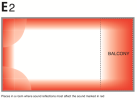
Whether it’s the rest of your band playing, or some music coming through the house system, take a wander round and make a mental note of the places in the room where the sound balance changes most. I’ll bet that your checklist will go something like: a) in corners, b) any under-balcony area and c) close to walls. In these locations, the low end of the mix either turns into a wall of mud, or a few bass frequencies leap out at much greater volume than anywhere else in the room.

A map of the spots to avoid will look something like Diagram E2, where red denotes the problem areas. No prizes for guessing that these are the worst places in the room to put speakers! (The are also the worst places from which to mix sound, but venue owners like to tuck mixing desks as far into a corner as possible, so it’s not unusual to find yourself mixing the band from under the balcony. In the corner. With your back against the wall. Welcome to the sound engineer’s world.

Equally, there’s no magic wand for a nightmare venue with a plate glass window behind the stage (and they do exist). However, if there is enough room on stage, moving the instrument amps forward a couple of feet should make a significant difference.

To understand why, let’s take the example of an open-backed guitar combo, such as a Twin Reverb. The main reason the sound is louder at the front than the back is the shape of the speaker cones. If we were to place two similar mics – one facing the front and the other the back – we would encounter all sorts of tone-degrading phase cancellation if we combined the two signals at a mixing desk.

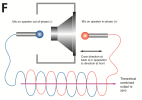
Diagram F shows how the front mic is picking up the speaker cone as it is moving backwards at exactly the same time as the back mic is picking up the cone and it is moving forwards (and vise versa, in alternation, hundreds of times a second). The result is as classic an example of phase cancellation as we can devise in the real world. In theory, the two signals combined would produce silence, as the waveforms imply. In reality, this doesn’t happen because the two signals are not exact mirrors of each other – the mics can never be truly identical; they will never be the exact distance from the speaker; the frequency response of the speaker will be different in front and behind the cone…

Screen Shot 2024-11-04 at 17.13.31.pngScreen Shot 2024-11-04 at 17.14.10.png
 
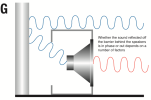
Diagram G shows the full implications of 'the plate glass situation'. Not only is there an out-of-phase signal exiting the back of the speaker cabinet, it almost immediately hits the plate glass and is reflected back into the room. How much will be in phase and how much will be out-of-phase? I can’t tell you that because the answer is a function of the physical distance between the speakers and the glass and the frequencies the speaker is reproducing at the time. What I can predict with confidence is that different notes on the guitar will suffer from different degrees of phase cancellation, with the exception of a few that will be bang-on in phase and sound unexpectedly loud. At this point, it’s a fair guess the guitarist doesn’t care one Cent whether his guitar is made from Samoan Elbow wood or last week’s newspapers. He has bigger problems on his hands.

What can he do if moving his amp forward is not an option? Well, putting something acoustically absorbent between his speakers and the glass would help somewhat. Gig bags and amp covers might help a bit but ideally, the material needs to have greater density. A bar owner’s dead body would be ideal.

Next topic, how EQ can be used in the fight against problem rooms.

Screen Shot 2024-11-04 at 17.19.57.png
 
All things not being equal
So we’ve established that most of us set up and play in conditions that, acoustically speaking, would just about be acceptable for a livestock auction. (“Dollar, 50 dollar, 100 dollar, 150 dollar, that was Johnny B Goode, youvbeenawonderfulaudience. Goodnight.” At least, I think that’s what he said.)

One of the tools in our sonic arsenal is equalisation, or EQ to use the short term. It’s a very useful tool but often misunderstood, so let’s start right back at the beginning. Back in the days when the world was only available in Black & White and radio was staffed by men with clipped moustaches, and even more clipped accents, the technical types noticed that the longer a cable run got, the less high frequency there was at the other end.

“I say Harry,” said one of the bods, “Why don’t we invent equalisation?” “Yes, that should solve this pesky problem,” said the other bod, although his name was actually Rick.

The point of this tale is that EQ was first developed as a corrective tool, not a creative one. And it quickly became a much more versatile system than a simple compensator for signal loss.

Until fairly recently, any decent Sound Reinforcement (PA) rig was bound to have a couple of 31-band graphic equalisers, set to optimise the performance of the Front of House system. (More recently, this role is sometimes taken on by digital processors capable of performing multiple functions, but the good-old analogue EQs are easier to explain.)

You may wonder, why 31 bands? Well, the more bands an equaliser has across the 20Hz-20kHz audio spectrum, the narrower each one can be. Narrow bands are particularly useful for ‘notching out’ problem frequencies, as caused by standing waves in the room. (Not only does this make for a better-sounding system, it helps to reduce feedback problems from the mics, which predominantly occur at just a few frequencies in any room.) Also, 31 bands is an agreed standard, with the centre of each band defined by the ISO (International Standards Organisation).

The reason a stereo rig needs two 31-band EQs is that they are mono; there is no guarantee that that the left and right speakers will need the same settings. (Ideally, any on-stage monitoring needs its own system EQ, which helps to answer the question of why sometimes the sound through the ‘wedge’ monitors seems nothing like the sound you can hear through your own amps.)

Diagram H shows the ISO frequencies along with some indication of the general parts of the sound spectrum they affect. As the name ‘graphic’ implies, the setting of the sliders provides a visual indication of the total frequency contour. This is one of the reasons why an experienced sound engineer can hone in on a problem frequency with great speed.
Screen Shot 2024-11-04 at 17.23.19.png
 
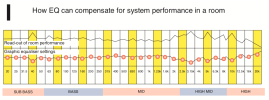
Diagram I shows a simplified version of how an irregular frequency response can be corrected using a graphic equaliser.

It is possible to equalise a rig completely by ear. The normal way of doing this is for the engineer to play a CD he/she is familiar with and adjust the equalisers until it ‘sounds right’. The alternative approach is to use a ‘spectrum analyser’, or a combination analyser/equaliser. The way these work varies, but a typical approach is for ‘white noise’ to be fed though the system. Then a microphone in the room sends the sound back to the equaliser stage, which is adjusted until the level of each frequency range is of equal volume. (Which is basically what the random-sounding white noise signal delivers.)

Modern digital systems make the EQ adjustments automatically, making them very quick to use. Some of these systems continue to monitor the output of the speakers throughout the performance, automatically ‘killing’ feedback by turning down the level of any offending frequency.

Now the average venue probably isn’t going to let performers mess with the FOH system EQ. In fact, even a bar owner with half a brain (that would be most of them) will want the system EQ locked, to prevent visiting sound engineers from imposing ‘their’ sound on the venue. This is understandable, because any FOH engineer with an ego large enough to think they have a ‘signature sound’ is also stupid enough to turn the last two octaves of the rig into an assault weapon.

At this point, you are perfectly entitled to ask: “Simon, if we’re playing in venues where we have no control over the Sound Reinforcement rig, why are you filling our heads with these notions?”

My answers are a) some of you will be taking your own SR/PA systems from venue-to-venue and b) everything I’ve said in this post is about the notion of optimising the performance of amps and speakers in a specific room. That idea extends to all the amps you have on stage.

For instance, a lot of bass amps have a graphic EQ on them (not 31 bands but useful enough). Most bass players spend a lot of time considering how the graphic can help to shape their own sound as a player, but never ask a band member to walk into a room to see if there are any problem frequencies they should pull back a little.

Getting the ‘backline’ amps on stage to interact well with the room also helps to minimise a problem I’ll come back to this in a later post, but mics picking up backline amps when they weren’t supposed to can significantly compromise your sound.

Screen Shot 2024-11-04 at 17.26.59.png
 
A couple of asides before we dig in deeper
Some of you may be wondering if any of this is useful to the home recording community. The answer is yes, but it's necessary to look at the same fundamentals of acousticsnthrough a slightly different lens. In the 1970s, a popular method of achieving a monitoring environment (ie Control Room) was to use graphic equalisers, as explained above, in Diagram I. Back then, there were a number of characters who gave up selling snake oil to concentrate on convincing studio owners that they, and only they, had some secret formula for 'tuning a room'. Others were more mainstream and used proper measurement equipment, inckuding FFT (Fast Fourier Transfer) analyzers to plot a room's performance as the sound decays with time.

There are limitations to the benefits of graphic equalisers in room correction, so more recently monitor speaker designers have turned to approaches such as using DSP (Digital Signal Processing) to improve monitor accuracy in less than ideal acoustic environment. I've heard some impeessive results from this approach.

A lot of people with home studios have turned to nearfield monitors as a way of minimising the affects of room acoustics. However, this can only be partially successful, because even with nearfields, a lot of the sound that reaches the mix position is reflected of the walls etc. This is why acoustic tiles are popular, because they provide a way reducing standing waves in a room at relatively little cost.

Suffice to say, professional studio designers go a whole lot further. For one thing, they 'float' the control room and studio floor on separate concrete slable, typically mounted on a bed of rockwool to provide maximum isolation. A number of approaches are used to control the frequency response of the mix room. These include bass 'traps', and other physical designs that can tune the room itself. Walls a rebuilt non-parrallel to minimise standing waves, and so on. Combined with very high quality monitoring systems, these approaches can provide world-class mixing environments.
 
Those of you who are more interested in getting the best sound for live performance may be wondering why I use the term Sound Reinforcement, SR, in preference to PA, which stands for Public Address. Strictly speaking, Public Address is the correct term for the systems used in places like railway stations, where the only audible announcements are coming from the speakers.

Sound Reinforcement is, technically, the correct term where there is already significant volume coming off the stage and the Front of House rig is there to augment it. However, I will use both to avoid confusion.
 
Last edited:
Where the bodies are buried
Imagine I asked: “Would you like to get your gear in and do the sound check now, or would you like until the portable sound absorbers arrive?” I’m sure most of you would rather wait until these sound absorber gizmos arrived before getting your sound sorted. From an acoustic point of view ‘sound absorbers’ pretty much sums up an audience. Believe it or not, academic research has shown that human bodies scatter sound but act as sound absorbers when wearing clothing. (Don’t ask me about the experimental method…)

In an overly reflective room, the arrival of an audience can significantly improve the sound. If you could persuade everyone to line the walls, they’d act a bit like those acoustic tiles you can buy to improve the performance of a home studio! Unfortunately for you and your band, audiences tend to sit and stand wherever they want. If you are talented enough to fill venues, a lot of the audience may be hearing you through several rows of bodies clustered at the front of the stage. For the rest of the audience, that could mean they are listening to a muddy mess. I’ll explain why.

Those acoustic tiles I mentioned earlier only absorb the mid and high frequencies. Even in large numbers, people have a similar acoustic effect, meaning the further away from the stage an audience member is, the more bass heavy the sound will become. So how do will turn the situation to our advantage, making sure that everyone in the audience hears a good sound balance?

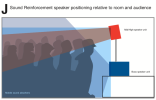
Diagram J shows a cross-section of a venue, with viable positions for the Sound Reinforcement (PA) speakers. Note that the bass units can be positioned on the stage, but the mid and high units should ideally be above the heads of the audience and pointing down to reduce the amount of reflected sound from the ceiling. (I’ll deal with the dispersion characteristics of mid and high frequency units in a later post. For now, it’s probably enough to say they are ‘more directional’ than bass/sub bass speakers, which are effectively omnidirectional.)

Screen Shot 2024-11-04 at 19.05.00.png
 
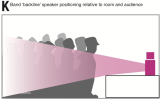
Diagram K shows what tends to happen to a typical guitar cabinet at a well-attended gig. The first couple of rows take it full blast, but the sound is progressively less audible going to the back of the room. Ideally, the guitar amps on stage are low enough that the FOH engineer can add them to the SR/PA mix, so giving everyone in the room a decent sound. But I've known a guitarist from a band that scored No 1 hits act like a child having a toy taken away when asked to back his amp down from 'stadium' to 'the club you're actually in tonight'. I won't name names, but it ain't my fault you're not a pop star any more…

Screen Shot 2024-11-04 at 19.08.02.png
 
This is a great thread. Thank you. My worst experience as a bass player was playing out doors. At one gig the band was on a cement platform with a cement wall directly behind us. It was a horrible experience. My next out door gig I had an HPF, a compressor, and a Radial JDI on my pedal board, The XLR from the JDI went to the board and the through out to my stage amp. The stage amp had the bass cut back and mids turned up. At the sound check the sound guy complimented me and my sound check took less than a minute. The band could hear me clearly and the sound guy was happy. Listening back to some recordings from the audience on their phones the bass was clear and not mushy. Previously the bass was mud on phone recordings. One of the other bands at the same gig had a bass player who did his own thing. Not sure what amp he was using but he had an Ampeg 8x10 cab cranked so loud it I could feel it 50 yards back in the audience. The whole band sounded like mud. You could barely hear the vocals. I talked to the sound guy. He told me he worked with him for ten minutes at the sound check then gave up and just let him do his thing.
 
Quick question Si. Concerning diagram G.

I’m thinking that reducing the sound coming from the back of the cab would be a good thing. Therefore my question concerns sound absorption materials. That is, pillows, blankets, fiberglass insulation sheets or high density foam pads. Something to place behind the amp. As modifying the room is not an option. Here is the specific example.

IMG_1784.jpeg

Essentially, is a lightweight material, or a high density foam best/better?
 
This is a great thread. Thank you. My worst experience as a bass player was playing out doors. At one gig the band was on a cement platform with a cement wall directly behind us. It was a horrible experience. My next out door gig I had an HPF, a compressor, and a Radial JDI on my pedal board, The XLR from the JDI went to the board and the through out to my stage amp. The stage amp had the bass cut back and mids turned up. At the sound check the sound guy complimented me and my sound check took less than a minute. The band could hear me clearly and the sound guy was happy. Listening back to some recordings from the audience on their phones the bass was clear and not mushy. Previously the bass was mud on phone recordings. One of the other bands at the same gig had a bass player who did his own thing. Not sure what amp he was using but he had an Ampeg 8x10 cab cranked so loud it I could feel it 50 yards back in the audience. The whole band sounded like mud. You could barely hear the vocals. I talked to the sound guy. He told me he worked with him for ten minutes at the sound check then gave up and just let him do his thing.
Thank you for sharing your experiences, Kerry. As you've shown, excessive backline volume levels cause a raft of problems the FoH engineer can't fix. As for muddy low end… I once went to see a Queen tribute band (not a mega fan, but it was local and the tickets were cheap enough). It was an open-air bandstand that hormally hosts brass bands on Sundays. As soon as I heard the pre-show background music, I sensed we were in trouble, because the bass was excessive. (Surely, the whole objective when you're playing pre-recorded music is to get the rig as close as you can to a loud hi-fi?)

When the band came on, my worst fears were confirmed. The bottom two octaves were a wall of high pressure mud. It was impossible to distinguish the bass guitar from the kick drum, to the extent that the bass player could have been playing the middle section to Alright Now by Free for the entire evening and I wouldn't have known. By the end of the evening, I was fuming! :cautious:
 
I totally used my room today to my advantage & was letting vocals rip. When i faced the mic the other way( yelling into the open room)so much natural seemed to pop out, vs in the confined space.

Finding out..don't overthink,,play & sing your heart out is what its all about !
 
Quick question Si. Concerning diagram G.

I’m thinking that reducing the sound coming from the back of the cab would be a good thing. Therefore my question concerns sound absorption materials. That is, pillows, blankets, fiberglass insulation sheets or high density foam pads. Something to place behind the amp. As modifying the room is not an option. Here is the specific example.

View attachment 103746

Essentially, is a lightweight material, or a high density foam best/better?

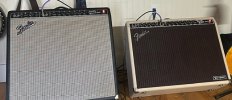
You make a good point, Dave. A lot of players prefer the more open sound of open-backed cabinets, such as the two Fenders you've shown. Ideally though, the cabinet needs to be in 'free space', meaning the back wall, and all other physical obstructions are taken away, leaving the speakers in infinite space. Unfortunately, that can't happen in real life, so the next best thing is plenty of space between the amp and the back wall. Why, because if we take the back wall away from Diagram G, the sound out front will be free from noticeable phase issues.

Your suggestion of damping behind the amp is a good, real-world, solution. Ideally, I think I would try damping the wall, rather than obstructing the back of the cabinet, but again, it depends what's practical. As a starting point, I'd suggest the foam acoustic tiles you can buy for home studios.
 
There is a solution we always did at soundcheck... we used that time & we all marked out spots on floor with tape. We did low level checks on clean passages & then the heaviest passages..always had 2 dif spots marked on stage needed to be at during certain levels
 
I totally used my room today to my advantage & was letting vocals rip. When i faced the mic the other way( yelling into the open room)so much natural seemed to pop out, vs in the confined space.

Finding out..don't overthink,,play & sing your heart out is what its all about !
Well, digital reverb is essentially 'room simulation', so if you have a good-sounding room, it's a shame to waste it. Also, most singers find it a lot easier to pitch in a reflective room than a dead one.

There are a couple of limitations to your approach, though. One is that, if you record your vocals 'wet' with the reverb in place, you're largely stuck with it at mix time. So, if you later decide there's too much reverb, or it doesn't sit as well as you hoped with the overall song, you'll have your work cut out. While you can get rid of reverb from a vocal take using a noise gate, it takes a fair bit of fine tuning.

The other limitation is the sound quality from most mics is a lot poorer 'off-axis' than it is when you sing straight at it. I'll post some diagrams to expain why, but first I want to explain why this also matters in a stage situation.
 
I'd suggest the foam acoustic tiles
Thanks Si.

Practical solutions, yes. As much I make this a jam space, it remains primarily a functional bedroom. A large one, but a bedroom in the house regardless. So padding the walls is out. I’ll have to settle for some cushion behind the amp.
 
If you've followed this thread from the start, you'll know that its origins were in an observation the guitar-maker Ron Kirn made about how much moving an amp in a room could make to the sound. He later went on to say this:

“Here’s just one that is never mentioned… You’re on a stage… of course everyone is cranked to 10… the vocalist’s mike is “open” as is the drummer’s... and you’re playing away, the sound YOU are generating is picked up by those two or more mikes, and processed through the system... and spit out of the audio system… guys, at that point… anything you did to alter your “tone” is as lost... Think about it…”

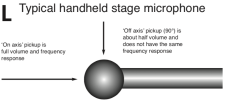
Ron is absolutely right, but before we can discuss why, we need to make sure we’re all on the same page when it comes to the terms ‘on axis’ and ‘off axis’. Diagram L shows a handheld stage vocal mic in its simplest form. As we all know, these microphones have to be directional. Otherwise, they will pick up enough volume from the Sound Reinforcement (PA) speakers to create howling, uncontrollable feedback. So, stage mics only pick up sound at full volume from the front (‘on axis’). By the time we are 90° ‘off axis’, the volume of pick up is down to around 50%.

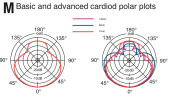
The most common pick-up pattern for a stage mic is called ‘cardioid’, which means heart-shaped. (What I’m about to convey also applies to other directional patterns, such as hypercardioid.) Take a look at the left side of Diagram M and you will see the kind of polar plot you sometimes see in the technical specifications for a cardioid mic.

Although it gives a general idea of what the mic is designed to achieve, there is a significant omission: we’re not told at what frequency this polar plot was created. Is it in the key 4kHz-8kHz vocal range? Across the entire frequency range of the mic? Or is the plot maybe showing something completely different?

When Ron used the phrase “one that is never mentioned” he might have hit on a raw nerve with mic manufacturers. The truth is that the polar response for any directional mic varies considerably with frequency, as the more advanced plot on the right of Diagram M shows. What this means in practice is that the off axis frequency response of any directional mic is severally degraded compared to the on axis response.

Screen Shot 2024-11-05 at 19.15.51.png
Screen Shot 2024-11-05 at 19.16.31.png
 
Back
Top