Understanding room and venue acoustics

just finished this one another Homebrew recording

$35 Blue Mic on vocals, no room treatment, sung in the Living room staring at Underdog hanging from the ceiling while watching election results on TV & my cat running in circles around me.

Guitars mic'd - MXL Cheapy Ribbon & MXL DX2 on 4x12 cab 50 ft away LOUD in a non treated master bedroom facing 3' away from inside wall so i dont have to go to jail

Bass DI into GAP 73 pre

Leads - 1 Mic on 4x12 on the 45 angle

No room treatment..no effects going in except phaser/flanger on my 1 lead, Spent time on capture before i even hit record vs fix it in the box

 
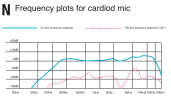
Please take a look at Diagram N. The blue line shows a very acceptable frequency response for a vocal mic. But would you buy a mic that had a frequency response like the one shown by the dotted red line? I’m guessing you wouldn’t, but it’s the same mic, only measured off axis.

Depending where the speakers in your amp are positioned relative to the mics on stage, that crappy-looking dog-leg of a frequency response described by the pink line in Diagram N could be exactly how your guitar sound is bleeding into the Sound Reinforcement system.

Sorry to say it but the news is about to get worse. You might assume that I’ve used a really cheap ‘n’ nasty mic as an example, just to make a point. Not so. The plots I’m showing here are based on a very high quality mic! There is every chance you’ve been working with worse.

The reason why mic manufacturers don’t rush to tell you about these problems is that all directional mics suffer from them, to a greater or lesser extent. While the really cheap mics are so badly engineered (relatively speaking) that the left and right side of the polar plots don’t even match, even the best manufacturers are battling with the laws of physics to deliver a product we can all use on stage. If just one manufacturer spells out the practical limitations of directional mics, most of us might assume that all the other manufacturers must have cracked this problem. Believe me, they haven’t.

Chances are though, if you’re playing loud enough for one stage mic to pick up your sound, you are probably bleeding into several vocal, drum and other instrument mics. Can you imagine how random this combination is going to be? In addition to the multiple, and compromised, frequency responses, you also have to factor in the phase relationships between the mics.
Screen Shot 2024-11-06 at 17.24.32.png
 
The ‘quack’ pickup settings on a Strat are electrically in phase; it’s partly the fact that the two pickups are sensing different parts of the string that alters the tone. Well, if you believe that two pickups a couple of inches apart are creating subtle phase differences, you’ll hopefully realise that several mics spaced across a stage are doing the same thing. It’s also worth considering that the vocal mics will probably have been EQd at the desk and have probably been subjected to all sorts of processing you didn’t choose for you guitar sound.

Does all this ‘kill’ your tone? No, but it can change it significantly – and in a way that is out of your control. Keeping your on-stage volume levels in check will help to keep these problems under control.
 
Cue the horn section
In this post, I’m going to look at the directivity, or dispersion characteristics, of loudspeakers. This has a big impact on the way the speakers interact with the room, the audience and, of course, you on stage. Although I will get to guitar cabinets, it makes more sense to start by looking at Sound Reinforcement systems, as they cover a much wider range of frequencies. Also, the ideal SR system should be capable of performing like a very big Hi-Fi, whereas a guitar amp/cab needs to make a sound the player likes, which is not the same thing at all.

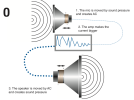
In my last post, I looked at the compromises in off-axis frequency response we have to accept in stage mics if we want them to be directional enough to minimise feedback. A dynamic mic and a loudspeaker are pretty much the same thing in reverse, as Diagram O shows. In the case of a mic, changes in air pressure move the diaphragm, which moves the coil backwards and forwards over the permanent magnet. This creates a small AC current. When amplified, this AC causes the magnetic coil in the loudspeaker to move backwards and forwards across the permanent magnet, thereby causing the cone of the speaker to create pressure changes in the air that we perceive as sound.
Screen Shot 2024-11-06 at 17.29.16.png
 
No prizes for guessing that speaker system designers can control the directivity of speakers, in a similar way that microphone designers can make mic more or less directional. (In fact, some of the polar response plots for speaker systems look very like the more advanced microphone plot shown in Diagram M.) There are a number of practical benefits to being able to do this. These include:

• Maximising the sound level received by the audience
• Ensuring that all audience areas receive similar coverage
• Minimising the sound levels directed at reflective surfaces (ie walls and ceiling)

In short, the more the speakers are directing the sound where it’s wanted and not bouncing it off the walls, the less the sound engineer will need to EQ the rig in an attempt to rescue it from the unwanted effects of room acoustics.

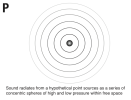
Before we look at how directivity can be controlled, it’s probably helpful to see how sound propagates when there is no control at all. Diagram P shows a theoretical ‘point source’ in free space. This sound source has no dimensions, or mass, and the sound therefore radiates from it as perfectly spherical areas of high and low pressure. (That is to say, as sound waves travel through the air, the molecules bunch up and move apart, thereby transmitting the energy. When you hit a power chord, individual molecules do not rush from the speaker, across the room, to the listener’s ear!)
Screen Shot 2024-11-06 at 17.31.09.png
 
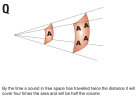
Because the sound is emitted in ‘free space’, there are no barriers such as walls for the sound to reflect from. This is important because it allows us to see how the ‘inverse square law’ works. As Diagram Q shows, the further the sound wave is from the source, the more molecules it has to excite in order to keep going. As a result, the wave is dissipated, or to put it another way, the energy is progressively diluted the further it travels. In fact, the sound has a quarter of its original energy for every doubling of the distance between the sound source and the listener, because the area it covers is four times greater.

But what if we could prevent sound ‘escaping’ to where we didn’t want it, so that all the energy was directed at the audience. That would not only cut down on reflected sound, it would make the output louder in the areas where the sound was directed. The most obvious example of this is the horn-loaded compression driver used for the mid-range of many Sound Reinforcement systems.

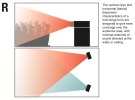
There is an excellent and comprehensive Wikipedia entry on horn loudspeakers Horn loudspeaker - Wikipedia, so I’m not going to go over the same ground here. For those of you who’d rather cut to the chase and skip the detail, Diagram R shows how a horn shaped to give a dispersion of, say 90° x 50°, helps to confine the mid range coverage to the audience.
Screen Shot 2024-11-06 at 17.33.38.png
Screen Shot 2024-11-06 at 17.34.08.png
 
Horn loaded ‘bass bins’ have traditionally been the way to squeeze maximum SPL (Sound Pressure Level) from the low frequency drivers but this approach is not as popular as it once was. In the age of lightweight, high output power amps and very efficient speakers, the sheer physical size of some horn loaded ‘sub-woofers’ counts against them. They are expensive to transport because they take up so much space in a truck and occupy a lot of real estate in venues.

For the purpose of the topic of controlling venue acoustics, whether the low bass cabinets are horn-loaded is also somewhat irrelevant. This is because at longer wavelengths, sound becomes less and less directional but requires greater and greater levels of energy to reproduce. It therefore becomes progressively more difficult to control by purely acoustic means. Conversely, by the time you get past the mid range and into the high frequencies, the short wavelengths are inherently so directional that system configuration is more about pointing the tweeters where you actively want coverage, than it is about preventing sound from dispersing. (Stand outside a club and what can you hear from the sound system? Thud, thud, thud. That’s all those high-energy low frequencies coming straight through the walls. By contrast, the highest frequencies simply bounced off a couple of walls and ran out of energy.)

Horn loading is not the only way of achieving more directional sound. Line array systems can get close to producing a cylindrical wave, in marked contrast to the spherical output of the theoretical ‘point source’ we started with. They do this through the combined output of closely spaced individual drivers, mounted in a series of enclosures to form a vertical array. Believe it or not, some of the theory that goes into line arrays goes all the way back to the PA columns used in the 1960s and 70s. Some of the theory even impacts on the performance of the average 4x12 guitar cab. I'll get to the specific maths behind that further down the line.
 
Most people reading this thread are probably far more interested in the way their guitar set-up interacts with a venue than they are in how line arrays work. After all, line arrays are for sound engineers to worry about, while what’s coming out of that guitar cab is all down you. So, although line array speaker systems will get a passing mention, the focus is solidly on the issues that matter to guitarists.

Also, the more academic material I’ve waded through, the more I’ve had to consider how to make the subject interesting and of practical value to musicians, without descending into what one of my school science teachers used to sneeringly refer to as ‘Reader’s Digest science’. Hopefully, plenty of diagrams will get me out of that hole.

Although I won’t get through all of this in one post, the key points I’d like to address are:
• How does a cone speaker disperse the sound of an electric guitar?
• What difference does having more than one speaker in cabinet make?
• What difference does the shape of the cabinet make?
• Open or closed back – what’s really happening?
• Practically speaking, what does all this mean to me as a musician? What can I do about it?

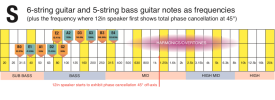
Maybe the best place to start is with the very source of our interest, the guitar. Diagram S shows where the open notes of a guitar in standard tuning sit in the full 20Hz-20kHz spectrum of human hearing. I’ve also added a 5-string bass to make things more interesting. Bear in mind that these frequencies represent the fundamentals – a lot of what makes for musical and individual notes is in the harmonics. That spice-rack of overtones sits higher up the frequency spectrum, and how prominent they are determines whether we perceive an instrument to be ‘dark’ or ‘bright’. We’ll get to that red line on the diagram shortly.

Screen Shot 2024-11-06 at 17.46.40.png
 
How does a cone speaker disperse the sound of an electric guitar?
We’d all like to think the sound comes out of our speaker cabinet as the sort of orderly beam shown back in Diagram R. But as we know from experience, as we move away from standing directly in front of the speaker, the volume drops somewhat and the tone gets a lot ‘darker’, ‘muddier’, or whatever else we might want to call a general loss of high frequencies.

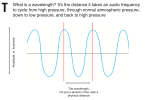
Earlier in this thread, we explored to notion that high frequencies have shorter wavelengths than low frequencies. To put this into context, if we were feeding a sine wave through a sound rig, the wavelength at 20Hz is approximately 50ft (15.25m) whereas the wavelength at 20kHz is just half-an-inch (13mm). Diagram T shows what a wavelength is, and reinforces the idea that every frequency we can hear occupies physical space with regard to its cycles of high and low air pressure.

As we’ll see, there is a direct correlation between the wavelengths a speaker is reproducing, the width of the speaker cone and its frequency response as we move off axis.
Screen Shot 2024-11-06 at 17.53.52.png
 
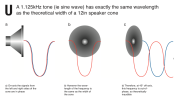
Diagram U gives us three views of a 12in speaker reproducing a sine wave of 1.125kHz. It so happens that the wavelength of that frequency is exactly 12in. Of the left of the diagram (a) , I’ve shown how the on-axis frequency will be: exactly in phase. On the right (b), I’ve shown a very different picture from a 45° angle. Let’s explore what’s happening here.

The same 1.125kHz tone is exiting the speaker cone from two different points – these being on opposite side of the speaker. So when we move 45° off axis, the difference in distance between the two points is sufficient to place the sound waves 180° out-of-phase. In other words, they have cancelled each other out completely!

But if we move to a slightly different position off-axis, the phase cancellation at that frequency will be only partial. Similarly, at frequencies higher than 1.125kHz the ‘listening’ position for total, 180°, phase cancellation will vary. In other words, at any given off-axis listening position, we will still be able to hear the fundamental notes but the spectral content above 1.125kHz will vary greatly.

(To any Strat player, this is not such an alien concept. Some people think the ‘quack’ tone when pickups 1&2 or 2&3 are used together is out-of-phase. Electrically, that’s not true – but because the two pickups are sensing different parts of the string, some harmonics are partially cancelled. We all know pickup combinations 1&2 sound quite different from 2&3, even if the pickups are apparently identical. Well, it’s essentially the same thing with loudspeakers and air.)

Screen Shot 2024-11-06 at 19.01.53.png
 
But if we move to a slightly different position off-axis, the phase cancellation at that frequency will be only partial. Similarly, at frequencies higher than 1.125kHz the ‘listening’ position for total, 180°, phase cancellation will vary. In other words, at any given off-axis listening position, we will still be able to hear the fundamental notes but the spectral content above 1.125kHz will vary greatly.

(As I’ve pointed out before, to any Strat player, this is not such an alien concept. Some people think the ‘quack’ tone when pickups 1&2 or 2&3 are used together is out-of-phase. Electrically, that’s not true – but because the two pickups are sensing different parts of the string, some harmonics are partially cancelled. We all know pickup combinations 1&2 sound quite different from
2&3, even if the pickups are apparently identical. Well, it’s essentially the same thing with loudspeakers and air.)

Some important notes: In the example above, frequencies below 1.125kHz will not exhibit phase-related problems, because the wavelengths are longer than the distance across the cone. For the sake of this example, it’s probably best to consider all frequencies below this point as being propagated in an omni-directional manner.

If the cone width is reduced to, say 10in, the frequency where we first encounter phase problems will go higher. If we increase the cone width to 15in, the problems will start at lower frequencies.

Please understand that this is a very simplified model! Our hypothetical speaker is so far only emitting a few sine waves as test tones. We haven’t even put the speaker in a cabinet. Plus, when we talk about ‘45° off-axis’, we should think of that as being in a complete circle around the speaker (top, bottom, left and right). It’s only when we start introducing physical barriers, such as baffles and walls, that the dispersion pattern will be modified.

At this point, you may wonder if we could improve the dispersion characteristics of our speaker by putting another speaker next to it, or placing it in a wide cabinet. (Initial answer ha-ha-ha-ha!!)
 
What difference does having more than one speaker make?
Earlier, we looked at what happens when a 12in cone driver is reproducing a wavelength equal to the width of the cone. Perhaps this is a good point to explain what your ears and experience have already taught you: at wavelengths shorter than this, the sound becomes even more directional.

I found this explanation on the Leonard Audio Institute web site, which provides informational papers on hi-fi and music reproduction topics Introduction: Greetings and introduction

On the subject of frequencies where the wavelength if smaller than the diameter of the speaker it notes: “This causes node and lobe distortion within the cone (chaotic resonances). Dispersion narrows to a beam and the frequency response becomes chaotic, sounding harsh and screechy.” Does that by any chance sound like any guitar stack you’ve ever stood in front of? Kinda muffled from the side but “harsh and screechy” right on-axis? I’ve certainly played through plenty of those.

If you would like to calculate the frequency at which beaming occurs in speakers of various dimensions, here is the maths. The speed of sound is 1,145 feet per second at sea level. First convert this to speed of sound in inches: 1,145 x 12 = 13,740 inches per second. Then divide this number by the width of the speaker in inches*.
• A 15in* driver will start beaming at 916Hz (13,740/15)
• A 12in* driver will start beaming at 1.145kHz (13,740/12)
• A 10in* driver will start beaming at 1.374kHz. (13,740/10)

* This is made somewhat approximate by the fact that the ‘speaking’ width of the cone is likely to be somewhat smaller than the stated nominal diameter.

Those of you who are really keeping up with this topic, might find yourselves thinking: The implication is that the ideal guitar speaker would be maybe 1in wide. From the perspective of most ideal dispersion characteristics and minimum distortion, that would be correct. However, you probably won’t be amazed when I say the tiny amount of air the speaker could shift would make it useless for performances in spaces bigger than maybe a cubic inch, at which point the speaker would be almost against your ear. Congratulations! You’ve just invented headphones!

Screen Shot 2024-11-07 at 17.23.05.png
 
Out there in real venues, not only is a 12in cone getting close to the smallest diameter we can use with a guitar amp and still shift enough air, for many applications, a single speaker isn’t enough. Unfortunately, adding further speakers into the system adds a whole new raft of complications, even more so when the speakers are mounted side-by-side.

There may be some forum members who get a little defensive at this point, especially if they have an abiding affection for their Fender Twin, Vox AC30, or Marshall Bluesbreaker combo. So, let me make this clear, there is no sense in which I’m saying the designers of those classics ‘got it all wrong’. On the contrary, between them, they have delivered some of the best electric guitar tones ever. But when the designers opted for two speakers instead of one, they did so mainly because players wanted more powerful amps and the existing speakers couldn’t handle that power. So doubling the number of speakers (or using any bigger multiple) was the most logical solution. Similarly, if you want to build the amp into the same cabinet – or place it on top – putting two speakers side-by-side makes a lot more sense than putting them on top of each other.

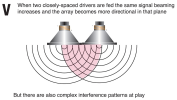
Although intuition might lead us to guess that two speakers would somehow ‘spread the sound out’, the actual effect is the exact opposite. Diagram V gives some idea of what actually happens. If the two speakers are close enough together, and are fed with the same signal, there will be points in the soundfield where the two waveforms are in phase and reinforce each other. There will also be points where the two speakers are out of phase and cancel each other out. As you can imagine, when presented with real-life electric guitar music that is constantly changing, the actual results are far more complex than this ‘in phase/out of phase’ analysis suggests. (Key ‘interference patterns’ into a search engine and you will find diagrams like V all over the place, but describing the effect as it apply to water, light and other wavelengths in addition to sound.)

However, there is one effect that can be stated very simply: the cabinet is more directional with two speakers placed side-by- side. Some players with stacked 4x12s have proven this by disconnecting all the drivers down one side. They have found that doing so makes the sound dispersion broader. This tells us not only that closely spaced drivers start to create a ‘beam’ effect as they couple acoustically but also that the physical width of the cabinet plays less of a role in horizontal dispersion than we may have assumed. (That’s not to say that cabinet size and baffle width are unimportant – I’m only talking about dispersion at the moment.)
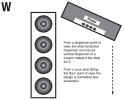
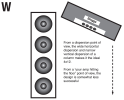
Logically then, if two speakers side-by-side make for tighter horizontal dispersion, shouldn’t two speakers on top of each other make for tighter vertical dispersion? The answer is yes! And if you put four speakers in a vertical array, the vertical dis- persion becomes tighter still, which is exactly what we want to prevent unwanted reflections from floor and ceiling. This draws us to the inescapable conclusion that the ideal 4x12 looks like the one in Diagram W – a column speaker.

Screen Shot 2024-11-07 at 17.28.26.png
 
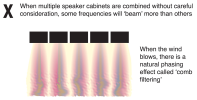
If you ever stood in a muddy field at a festival in the 1960s or 70s and noticed that when the wind blew, the whole band sounded as if it was going through a flanger. This is because the beaming effects delivered different frequencies across the audience area. Any wind would shift these bands to another area, creating what are known as ‘comb filtering’ effects. Diagram X gives an idea of how this translates in practice.
the soundcheck so that the you are happy with the FOH sound, but bearing in mind that this will change as the venue fills up.

Also, the sound you are hearing through the stage monitor may be a poor indicator of the sound FOH. While this is annoying, you may have to accept that this is ‘just the way it is’. If the PA/Sound Reinforcement rig isn’t particularly sophisticated, it’s likely that there is no separate ‘system’ EQ for the monitor system. Which brings us to…

Screen Shot 2024-11-07 at 17.32.27.png
 
Practical strategies for guitarists

OK, enough theory. What can we all – as guitarists who have learned our chops and paid for our gear – do to combat those tone-robbing venue acoustics?

Here is my action list, in approximate order of easy-to-difficult. Some of these solutions only work if there is a full-scale Sound Reinforcement rig. Others are still useful in more intimate gigs, where the speaker in your amp is your only amplification, and any PA is mostly for vocals.

1. Turn down and/or use a smaller amp

As others have suggested earlier in this thread, deafening a small section of the audience at the front from your ‘backline’ amp makes little sense if there is a Sound Reinforcement system that can carry the output of your amp to all of the audience. (This is assuming also there is an on-stage monitor system, so that you can be heard adequately by everyone in the band, regardless of the level from your amp.)

The reasons why some guitarists are reluctant to go down this path vary but they mainly fall into the following categories:
a) I’m a rock star who happens to be playing a small club, therefore I need both stacks set to 11. Solution for problem = grow up emotionally, or get on a stadium tour.
b) My amp doesn’t get the sound I want until it’s running close to flat out. Solutions = buy a smaller amp or a power sink. (I’m sure we all agree there are few sadder sounds than a 100W head with almost no signal going through the power stage or the speakers.)
c) The sound Front of House (FOH) isn’t the sound I’m making on stage. Solutions = test that assumption by getting another band member to go into the venue and see how it sounds and/or get the sound engineer on board with what you actually need. (Good luck with that one if you’re the support act though…)

(In smaller venues, soundmen sometimes lie about whether an amp is miked up at all. When challenged by someone in the audience, they’ll usually say how great the sound balance is the other side of the room.) In general terms: try to get things fixed during the soundcheck so that the you are happy with the FOH sound, but bearing in mind that this will change as the venue fills up.

Also, the sound you are hearing through the stage monitor may be a poor indicator of the sound FOH. While this is annoying, you may have to accept that this is ‘just the way it is’. If the Sound Reinforcement rig isn’t particularly sophisticated, it’s likely that there is no separate ‘system’ EQ for the monitor system. Which brings us to…

d) If I turn down my amp, we can’t hear what I’m playing on stage. Often, the FOH mix guy/gal is also creating the monitor mix(es) going to the stage. Unless you tell them you need more of instrument or vocal X, they’ll assume you’re happy. Solution = communicate with the sound engineer.

An act that has already learned to get a good on-stage balance normally plays better and sounds better than one that relies on the engineer out front to solve all issues. In terms of attitude, this collective approach is the polar opposite to attempting to prove that with your rig, you don’t need a FOH system!

2a. Experiment with speaker positioning…
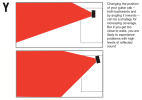
However directional your speaker cabinet is, common sense that the further back it is, the greater area it will cover. (Of course, not all stages are deep enough to give you any choice in this matter.) Similarly, tilting the speaker cabinet in towards the rest of the band may help somewhat in getting even coverage. Diagram Y illustrates these ideas.
Screen Shot 2024-11-07 at 18.02.59.png

… and 2b. Consider sealed versus open-backed cabinets
Whether you prefer a closed or open-backed cabinet (or some combination of both) is a matter of personal taste. Arguing which is ‘better’ is as pointless as pitching the same argument about single-coil pickups versus humbuckers. However, it is worth considering the differences between them.

It is often said that the ideal mounting for a loudspeaker would be on a baffle infinitely wide, with an infinite amount of space behind it. This would prevent any out-of-phase signal from behind the speaker interfering with the direct signal from the front of the speaker, which would create a certain amount of cancellation at some frequencies.

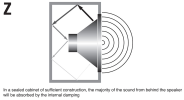
A completely sealed cabinet is an attempt to realise this idea by enclosing the space behind the speaker. Providing the cabinet is built solidly enough and is sufficiently damped internally, little or none of the potentially out-of-phase sound can ever mingle with the direct sound from the front of the cone. This is shown in Diagram Z.
Screen Shot 2024-11-07 at 17.56.18.png
 
Last edited:
There are some practical downsides to this approach. One is that to come anywhere near to the theoretical concept of ‘infinite baffle’, the cabinet has to be heavily constructed, so will therefore not be a trivial lift when getting gear on and off stage. Another downside is that a sealed cabinet can be more directional than an open backed one. In fact, a single speaker in a sealed cabinet will act something like the polar plots for a cardioid mic we looked at back in Diagram M. Note that not only is the output inherently directional, but it becomes more directional as frequency increases, and the speaker starts to ‘beam’. (This occurs even more if two speakers are ‘coupled’ by being mounted close together.)

But there is another issue here and that is for the frequency range of an electric guitar, the baffle never needs to be infinite, or even particularly wide. (I was tempted to write “or even close to infinite.” Duh! What numerical value will ever be close to infinite?)

Conventional thinking has it that phase cancellation problems on open-backed cabinets start at around the frequency where the wavelength coincides with the width of the baffle. As we know the low E on a six-string guitar is 82.41Hz, this would imply a baffle width of around 14ft – way too wide for a touring guitar rig but hardly ‘infinite’!

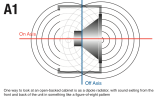
But if you key ‘open baffle speaker’ into a search engine, you’ll get multiple entries from Hi-Fi buffs who have been building backless cabinets with baffles not much wider than the chassis of the woofer. So how does that work out? Probably the most meaningful way to think of a loudspeaker that is not in a sealed cabinet is that it is a ‘dipole’ radiator. This is illustrated in its simplest form in Diagram A1. (Those of you who know your recording mics are probably thinking “That’s like the Figure-of-8 polar pattern.” Exactly right.)

Screen Shot 2024-11-07 at 17.59.06.png
 
Now, we know that when the front of the cone is moving forwards, the rear of the cone must be moving backwards. At least, that’s the way it looks if we walk round the other side. But it’s all the same speaker cone and I would argue that in free space, where there are no walls or ceilings, the front and the rear energy is in phase from many listening positions. If this wasn’t so, drums, tubular bells and many other percussion instruments would also require baffles to function correctly. For that matter, what about the harp? Surely, when one of the strings is deflected towards us, it deflects away from us if we move round to the other side?

I’m not just shooting from the hip here. A leading sound designer for musical productions in London’s theatres has used suspended Tannoy speakers with no cabinets for most of the frequency range. I’ve heard the result, and it gives an airy, natural sound. Apparently the power handling of the speakers is significantly reduced, but that’s not our main concern here.

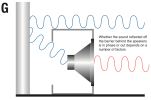
It’s only when we add a reflective surface behind the speaker (ie a wall) that reflected sound returning to the listening position out-of-phase with the sound from the front of the speaker becomes a real issue. I illustrated why in Diagram G near the start of this thread.

Let’s get back to the practical issues of what we, as guitarists, can do to improve our lot when it comes to positioning an open-backed cab. Diagram A1 is very simplistic. As we already know, speakers tend to ‘beam’ at higher frequencies, so the plot shown could not apply over the entire range. Also, even open-backed cabinets have sides and some back paneling, which will skew the result. But, most significantly, real-life speakers are used in real-life venues, and reflected sound will be a significant factor.

Even if Diagram A1 is a flawed model, it is reasonable to infer that the off-axis response will be a very different representation of the sound experienced directly in front of the speaker. No, it won’t be the complete silence implied by the diagram, but the phase cancellations will be real, and to a great extent, unpredictable (unless the relationship between the cab and the acoustic space in which it is situated is analysed in great detail). The SPL (Sound Pressure Level) at the side of the cab will also be a lot less than either directly in front, or directly behind.

This helps to explain why many guitarists are happy with the sound of an open-backed speaker cabinet, but their band members do not always agree. If all the drummer, bass player etc can hear is the sound from the side of the cab, and the reflections from the room, they are likely get a very indistinct experience, compared to the sound from other positions.

Again, changing the position of the guitar cabinet, or placing more trust in the FOH and monitor system, are likely to help. But they are not the only solutions. In my next post, I’ll look at ways to modify the dispersion characteristics of existing speaker set-ups, as well as cabinet designs that aim to eliminate many of the problems found in conventional side-by-side speaker arrangements.

** And I almost forgot: never underestimate the value of getting your speaker cabinet off the floor! Just sticking it on a couple of beer crates will massively reduce reflections from a surface a lot of players tend to forget about – the stage. It will also help to get your speakers closer to the ear height of the audience if they are standing. **

Screen Shot 2024-11-07 at 18.00.53.png
 
When I originally posted this thread 'elsewhere' on-line, I was asked at this point whether I thought that Perspex/Plexiglass baffles would be beneficial in terms of the directional characteristics of guitar speakers when playing in a small club, with none of the backline fed through the PA. The short answer is "no", but here is a more detailed response.

As anyone can testify if they have worked in an old-school recording studios – where baffles are used to reduce the spill from the drums into the guitar mics and vise versa – the reduction in level a baffle can create comes at a price. Without the baffles, the spill is at least fairly natural and ‘open’ sounding. With the baffles, the spill tends to be muffled and quite unpleasant, meaning even more work at the mixing desk to reduce the spill levels. This fits what Ron and Stratman323 have said about using baffles in a live situation.

I totally respect artists who have decided to use Perspex/Plexiglass, or other types of baffle to attenuate the sound output of their rig – doubly so if it is to protect their hearing and other players around them – but it is a solution with a downside. In fact, in terms of guitar tone, I’d argue that it’s made the old ‘off-axis’ problem worse by attenuating the natural output of the speaker even more. Possible alternatives include: using a smaller amp; using a power soak, or taking the speaker cabinet off the stage completely and miking it up from somewhere back-stage.

Can the directional characteristics of a guitar cab be improved?
The answer to this is undoubtedly yes, and one way we touched on is to mount the speakers vertically, rather than horizontally or in a cluster of four. While this improves the dispersion characteristics, the practical problems of sitting an amp on top were demonstrated in Diagram W. As I noted at the time, some players have removed or disconnected the speakers down one side of their 4x12. This gives many of the advantages of a 4x12 column, while keeping the traditional rock stack appearance.

There is a type of device known as a ‘beam blocker’ formodifying the dispersion characteristics of a speaker. One specific design is otherwise known as the ‘Mitchell Doughnut’, as was devised by Jay Mitchell.

Here’s a link that shows how these are made and provides further links: Guitar Amplifier Directivity Modifier

Here is a similar page, with more detailed information:
Princeton Reverb II; loudspeaker treble-beaming problem; foam donut to reduce high-frequency beaming

Mr Mitchell makes a coherent argument for his design approach, as one would hope of someone who owns a loudspeaker manufacturing company. He also argues that other design approaches are flawed. I’m not prepared to express an opinion, for the simple reason I haven’t tried them but the Mitchell Doughnut is cheap and easy for anyone to make in order to try for themselves.

Speaker Directivity - The Gear Page

The alternative approach is available in a commercial product: The Weber Beam Blocker. Weber Beam Blocker -- high frequency diffuser

With models ranging from $15 to $23, a little experimentation with this design is hardly going to break the bank, and it certainly looks easy enough to fit.

It is important to understand that any passive device that makes the on-axis and off-axis responses closer in frequency contour can only do so by reducing some of the high frequency output on-axis. It is likely that most players will seek to compensate to some extent with a little tweaking of the tone controls. On the other hand, amp makers put tone controls on their products precisely so that you can adjust your sound to taste, and you’d probably feel the need to make some adjustments if you switched from one brand of speaker to another.

Are there alternative cabinet designs?
Yes there are. One that comes to mind is this series of XF Guitar Cab designs from Bill Fitzmaurice. They are available in 2x12 and 2x10 configurations, as well as 4x12 and 4x10. These designs retain the look of traditional guitar cabinets but employ a ‘crossfire’ speaker configuration in an attempt to improve the dispersion characteristics and ‘eliminate combing’. The design also allows for closed cabinet design, which can be changed to open back by undoing a latch and removing a panel.

XF Guitar Cabs

None of the above is a substitute for achieving a good sound balance between the instruments on stage, or for careful placement of your speaker cabinets, but you may find some of these approaches helpful.

Screen Shot 2024-11-07 at 17.28.26.png
 
Something else I was asked about was how Line Array systems work. While I was happy to help at the time, I'd rather start a completely new thread on PA/Sound Reinforcement, because I don't want this thread to get so technical, it turns people off.

I've said about all I have to say about acoustics, but I'm always very happy to answer questions.
 
Please take a look at Diagram N. The blue line shows a very acceptable frequency response for a vocal mic. But would you buy a mic that had a frequency response like the one shown by the dotted red line? I’m guessing you wouldn’t, but it’s the same mic, only measured off axis.

Depending where the speakers in your amp are positioned relative to the mics on stage, that crappy-looking dog-leg of a frequency response described by the pink line in Diagram N could be exactly how your guitar sound is bleeding into the Sound Reinforcement system.

Sorry to say it but the news is about to get worse. You might assume that I’ve used a really cheap ‘n’ nasty mic as an example, just to make a point. Not so. The plots I’m showing here are based on a very high quality mic! There is every chance you’ve been working with worse.

The reason why mic manufacturers don’t rush to tell you about these problems is that all directional mics suffer from them, to a greater or lesser extent. While the really cheap mics are so badly engineered (relatively speaking) that the left and right side of the polar plots don’t even match, even the best manufacturers are battling with the laws of physics to deliver a product we can all use on stage. If just one manufacturer spells out the practical limitations of directional mics, most of us might assume that all the other manufacturers must have cracked this problem. Believe me, they haven’t.

Chances are though, if you’re playing loud enough for one stage mic to pick up your sound, you are probably bleeding into several vocal, drum and other instrument mics. Can you imagine how random this combination is going to be? In addition to the multiple, and compromised, frequency responses, you also have to factor in the phase relationships between the mics.
View attachment 103765
We keep our stage levels reasonable to even quite low by most of today's standards. Combined with the noise gate on voc mics, we now have very little bleed.
Before the digital board with the gates, I could mute the singer's mic from recordings and have the snare drum drop considerably!
We now use a Shield of Shame (copyright @SG John for the term) for the drums indoors in smaller venues. That helps a lot too.
 
Back
Top