TTR tube amp gurus: please help!

I believe so; I will re-measure this evening.

If I take 16 volts / 989 ohms, I get .06177 amps.
If 384 VDC is multiplied times .06177 amps, I get 6.212 VA. (or, 6 "watts".)
(you guys call VA by "watts." But, it's not really watts.)
Then it's 3 watts per tube.

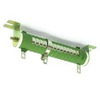
That means you need to change the cathode resistor to 560 ohm or maybe a little larger.
(maybe an adjustable resistor would be my choice)
1629229495403.png

Then I can adjust it to 90% where it should be.

Then when I use different tubes, I can still set it to 90%.

But I would not lower the plate voltage with zener diodes.
I would adjust the cathode resistor instead.
 
True watts is:
Volts X amps = VA

VA X efficiency = true wattage.

The wattage can never be known until there is a number for efficiency.
Since there is no number for efficiency % in this calculation (above) the true wattage cannot be known.
 
(maybe an adjustable resistor would be my choice)
1629229495403.png
IT'S SO HUGE!!!
 
Note he states that crossover distortion only occurs in class AB & class B amplifiers. Cheers

My Oscilloscope disagrees.
He is not considering crossover distortion which occurs after the amp reaches the point of clipping.
He is talking about non-clipped audio signal.
I am interested in what happens when the amp is pushed to the point of screaming, pleading, and begging for holy mercy, clipped of course.
Mate,,,
:BH::BH::BH::BH::BH::BH::BH::BH::BH::BH::BH:Then your 'scope is telling you that the output stage is not operating in class A push pull.
Read the very first chapter of Mr Aiken's explanation of crossover distortion;
It (crossover distortion) happens during the time that one side of the output stage shuts off & the other turns on.
So during the handover of duty to the other half of the push pull team.
This does not happen in class A push pull. Remember, the very definition of class A is that the tubes are ALWAYS CONDUCTING & CAN NEVER BE IN CUTOFF.
No tubes ever shut off or turn on.
No handover of duty, the time during which crossover distortion occurs.
Therefore no crossover distortion.

As to "pushed to the point of screaming, pleading & begging etc",
To operate in class A, the tube(s) have to be biased to the centre of the linear portion of the tube's characteristic curves. As such, if the tube(s) are driven towards saturation (positive excursions of input signal), then the tube(s) are also being equally driven towards cutoff (negative excursions of input signal).
Tubes pushed to cutoff equals tubes not operating in class A.
But explaining this is getting old.

@jtcnj, I took a look inside mine & powered it up to take a few readings.
The power tube I'm using is a NOS/NIB RCA 6680/12AU7A with 1% matched triode's, 10.2mA/10.2mA,
gm 2200/2200.
The cathode resistor is the stock value of 820r (actually measures 822r).
My B+, read at the rectifier immediately off standby 375V, settled to 372V after stabilising for a few minutes.
12AU7 cathode to plates voltage 350V.
Plate current determined by;
Measure & note resistance of each half of OT primary (powered down & drained of course).
After powered up amp has stabilised, measure voltage drop across each half of OT primary.
Divide voltage drop by corresponding OT primary half's resistance.

Plate currents 8mA/7.9mA, so 2.8 watts per triode. A little hot, but there's never been any sign of red-plating so I've left as is. I do have a NOS Mullard 12AU7 but I remember that it biased somewhat hotter than the RCA does. Didn't red-plate at any time during operation though.
Your idea of bypassing the 470k resistors with small(ish) value caps is a good one, but I would suggest only "partially" bypassing these resistors by putting a resistor in series with each bypass capacitor (experiment to find best value).
Using a tube rectifier to drop voltage is also a good idea, but due to the very small current drawn by this amp, even a 5Y3 may not drop enough. If so, maybe look to one of the miniature 6V types, BUT, you would need to use a type that has the cathode seperate from the filament, like maybe the (7 pin miniature) 6X4 type that I have linked the data sheet of below.
The EF80's are also a good idea, people seem to like the results using these. Cheers
 

Attachments

Last edited:
Yesterday, I looked at this again, rather than from memory. I was close.

Measuring across the OT windings vs cathode resistor yields the same current of 16.9ma, as it should.
With no red-plating at 109% plate dissipation, I'm not overly concerned, but will bring it down some.
I will experiment with increasing the cathode resistor value over the coming weekend.

21-08-17 Plate power calcs.jpg
 
I experimented with clip leads to add 200Ω and then a 250Ω 5w resistor in series with the 1kΩ shared cathode resistor.
This brought the dissipation down to around 95% / 2.5w (dont have my notes handy).

I temporarily soldered in the 250Ω for sound check. I played a bit yesterday and today.
Completely different amp.
Sounds MUCH better.
I'm still wringing it out but on the right track.

I plan to experiment with other tuning options such as:
the variac to see if I want to drop the B+, or possibly individual node voltages.
Lift the NFB to see if I want to add switch or pot options.
Either add the Lo input (ruins my faceplate), or possibly replicate the HI and Lo input triode cascade on a switch.
 
I experimented with clip leads to add 200Ω and then a 250Ω 5w resistor in series with the 1kΩ shared cathode resistor.
This brought the dissipation down to around 95% / 2.5w (dont have my notes handy).

I temporarily soldered in the 250Ω for sound check. I played a bit yesterday and today.
Completely different amp.
Sounds MUCH better.
I'm still wringing it out but on the right track.

I plan to experiment with other tuning options such as:
the variac to see if I want to drop the B+, or possibly individual node voltages.
Lift the NFB to see if I want to add switch or pot options.
Either add the Lo input (ruins my faceplate), or possibly replicate the HI and Lo input triode cascade on a switch.

I'm not sure what point above 100% will red plate....but it's going to at some point.
Usually when a tube overheats far above normal, it doesn't sound all that great.

But it's funny that there is no bypass cap across the cathode resistor.
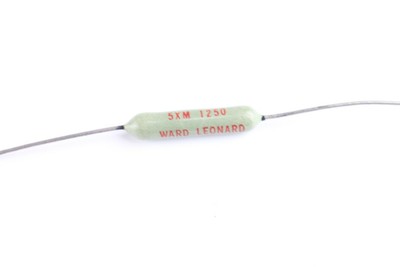
I might try 5uF across the 1250 ohm resistor, and read the current again.
You might get chunkier lows with a bypass cap...
The calculator shows frequency response on a graph, according to which capacitor you insert into the circuit.
(you can experiment with different capacitors...)
 
I experimented with clip leads to add 200Ω and then a 250Ω 5w resistor in series with the 1kΩ shared cathode resistor.
This brought the dissipation down to around 95% / 2.5w (dont have my notes handy).

I temporarily soldered in the 250Ω for sound check. I played a bit yesterday and today.
Completely different amp.
Sounds MUCH better.
I'm still wringing it out but on the right track.

I plan to experiment with other tuning options such as:
the variac to see if I want to drop the B+, or possibly individual node voltages.
Lift the NFB to see if I want to add switch or pot options.
Either add the Lo input (ruins my faceplate), or possibly replicate the HI and Lo input triode cascade on a switch.
Good to hear that you've got it biased more sensibly & performing better.
I'm not sure what point above 100% will red plate....but it's going to at some point.
Usually when a tube overheats far above normal, it doesn't sound all that great.

But it's funny that there is no bypass cap across the cathode resistor.
I might try 5uF across the 1250 ohm resistor, and read the current again.
You might get chunkier lows with a bypass cap...
The calculator shows frequency response on a graph, according to which capacitor you insert into the circuit.
(you can experiment with different capacitors...)
Regarding the linked Amp books cathode bypass capacitor calculator, when used for the correct purpose these Ampbooks calculators are great. However, the formula that this linked calculator uses (taken from The Radiotron Designers Handbook, 4th edition) is for a single triode set up as a resistance capacitance coupled voltage amplifier, not for two triodes operating in class AB push pull.
In this " push pull output stage" application, there "is no" RG (the following stage's grid leak resistor) value to plug into the calculator (the calculator doesn't work without a figure here).
RK has two triode's drawing current through it, so its value "appears" to each triode as twice that of it's nominal value.
The common cathode resistor "sees" the RL of each triode in parallel (there are complexities of RL in this application that I wont go into).
So we can see that RG aside, the numbers will be "off".

That said, I've never seen a cathode biased class AB guitar amplifier that features a properly designed cathode resistor/bypass capacitor arrangement.
From my copy of The Radiotron Designers Handbook edition 4;
In a cathode biased class AB amplifier, "each" valve should have a cathode resistor of equal value. Each of these cathode resistors is then bypassed with a capacitor.
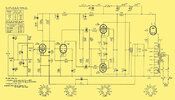
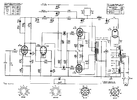
Examples of this type cathode arrangements can be seen in these amplifier circuits from Mullard Circuits For Audio Amplifiers.
The Mullard 5-10 amplifier
16297146956827149421478057591708.jpg
and an ultralinear design16294345218594074104967203818796.png
If we look at various designs (both audio & guitar amps), we commonly see cathode bypass capacitor values of 25uf & 50uf, however the roll off point ( or frequency cut off point) of a given cathode bypass capacitor can be calculated using the formula
FC = 1
---------------
(2pi) R C

Now all this said, I really don't think this amp "needs" cathode bypassing, however I've given you the info to go about it properly should you decide you want to, for whatever purpose. Cheers
Edit:
I should have included the relevant info needed to use the formula that I posted above, so here it is;

FC = cutoff (roll off point) frequency.
R = resistor value in ohms.
C = capacitor values in farads.

To get a capacitor's value in farads, the following applies;
"uf" values, divide by 1,000,000
Example; 0.022uf = 0.000000022F.
"pf" values, divide by 1,000,000,000,000
Example; 470pf = 0.00000000047F.

This same formula can be used to calculate the roll off point of treble peakers etc. Apologies for not including this info when I posted the formula last night, it was late & I was tired. Cheers
 
Last edited:
Good to hear that you've got it biased more sensibly & performing better.

Regarding the linked Amp books cathode bypass capacitor calculator, when used for the correct purpose these Ampbooks calculators are great. However, the formula that this linked calculator uses (taken from The Radiotron Designers Handbook, 4th edition) is for a single triode set up as a resistance capacitance coupled voltage amplifier, not for two triodes operating in class AB push pull.
In this " push pull output stage" application, there "is no" RG (the following stage's grid leak resistor) value to plug into the calculator (the calculator doesn't work without a figure here).
RK has two triode's drawing current through it, so its value "appears" to each triode as twice that of it's nominal value.
The common cathode resistor "sees" the RL of each triode in parallel (there are complexities of RL in this application that I wont go into).
So we can see that RG aside, the numbers will be "off".

That said, I've never seen a cathode biased class AB guitar amplifier that features a properly designed cathode resistor/bypass capacitor arrangement.
From my copy of The Radiotron Designers Handbook edition 4;
In a cathode biased class AB amplifier, "each" valve should have a cathode resistor of equal value. Each of these cathode resistors is then bypassed with a capacitor.
Examples of this type cathode arrangements can be seen in these amplifier circuits from Mullard Circuits For Audio Amplifiers.
The Mullard 5-10 amplifier
View attachment 72408
and an ultralinear designView attachment 72411
If we look at various designs (both audio & guitar amps), we commonly see cathode bypass capacitor values of 25uf & 50uf, however the roll off point ( or frequency cut off point) of a given cathode bypass capacitor can be calculated using the formula
FC = 1
---------------
(2pi) R C

Now all this said, I really don't think this amp "needs" cathode bypassing, however I've given you the info to go about it properly should you decide you want to, for whatever purpose. Cheers
Edit:
I should have included the relevant info needed to use the formula that I posted above, so here it is;

FC = cutoff (roll off point) frequency.
R = resistor value in ohms.
C = capacitor values in farads.

To get a capacitor's value in farads, the following applies;
"uf" values, divide by 1,000,000
Example; 0.022uf = 0.000000022F.
"pf" values, divide by 1,000,000,000,000
Example; 470pf = 0.00000000047F.

This same formula can be used to calculate the roll off point of treble peakers etc. Apologies for not including this info when I posted the formula last night, it was late & I was tired. Cheers
You can use all the formulas you like.
But nobody ever created a formula for what sounds good.
And mathematically, there is no formula for what sounds good.

Guitar amps were built according to what sounds good.
Not by mathematical theories.

And there is still no formula to explain what happens when a tube amp is pushed into overdrive.
There is no linear prediction of the result which is expressed by numbers.
There is no formula for guitar sustain...

What sounds good???
That's not a formula. It's not a calculation.
What sounds good was an experiment, and it wasn't driven by numbers and formulas.
What sounds good: is not written on a chalk board.

The most learned professor in the most respected classroom....
cannot design a good sounding guitar amplifier using numbers.
Never has, never will be.
 
You can use all the formulas you like.
But nobody ever created a formula for what sounds good.
And mathematically, there is no formula for what sounds good.

Guitar amps were built according to what sounds good.
Not by mathematical theories.

And there is still no formula to explain what happens when a tube amp is pushed into overdrive.
There is no linear prediction of the result which is expressed by numbers.
There is no formula for guitar sustain...

What sounds good???
That's not a formula. It's not a calculation.
What sounds good was an experiment, and it wasn't driven by numbers and formulas.
What sounds good: is not written on a chalk board.

The most learned professor in the most respected classroom....
cannot design a good sounding guitar amplifier using numbers.
Never has, never will be.
Mate,,, you linked the Ampbooks cathode bypass capacitor calculator for a resistance capacitance coupled voltage amplifier, which is working off a formula, I just gave the "correct" formula to use for this application.
However, I do beg to differ regarding the use of formulas in designing valve (or SS) guitar amplifiers. Most of the early designs were lifted straight from the pages of publications like the RCA, GEC, Mullard, Philips etc tube applications manuals (all valve manufacturers published these type manuals, they wanted people to use their tubes so showed how best to). All the circuit information within these publications were created using formulas.
Of course amplifier manufacturers use formulas in designing their amplifiers, it's how they get their "intended" frequency response & performance characteristics throughout the signal chain. To suggest that amplifier design teams don't use formulas is LITERALLY LAUGHABLE.
Imagine,,,, ok you design team guys, start bunging some stuff together,,, anything,,,eventually we'll stumble onto something that sounds good. How we've always done it. What, did you think this company was founded on amplifier "design principles" or some damn crap like that.
Mate, it's the hacks that don't use formulas, usually best known for copying someone else's work.
But this is getting rediculous. Cheers
 
Actually, I need to "fess up" here.
When I said that the linked Ampbooks cathode bypass capacitor calculator was using the wrong formula for this application, I actually didn't word the statement correctly & thus gave an incorrect implication, for which I apologize to my TTR buddies & will hereby correct.
The Ampbooks calculator is actually working of the same
F = 1
---------------
(2pi) R C

formular. What differs is the manner in which the formula is "applied". The same formula is also used to calculate the 3db roll-off point of inter-stage coupling capacitors, again, "applied" differently.
Fear not brethren, the voice of your amplifier has not been landed upon by some "suck it & see" type approach, rather, the frequency response of each stage has been "chosen" by the designer(s), where necessary through calculations using proven formulas to get their "desired" result. And a good many other type calculations (using formulas) go into designing an amplifier from a clean sheet.
Hell, any modder worth his salt will similarly "choose" the frequency response etc of his/her modification, using calculations/formulas where necessary. Cheers
 
I am currently experimenting with lifting the bypass cap off the treble peaker(s) and adding the LO input via switch.
So far I lifted the first one at the input to the cold clipper stage V1B, but I had put a 12AY7 in at V1 just to try it.
Never enough time.

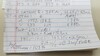
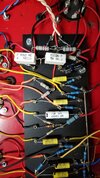
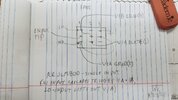
Anyway, here is a pic of the cathode resistors (sloppy: I didnt orient the markings consistently, Grr) and of the proposed switch diagram - any input on the switch would be appreciated, thanks forward.

20210828_170122-2.jpg

20210827_114032-2.jpg
 
I am currently experimenting with lifting the bypass cap off the treble peaker(s) and adding the LO input via switch.
So far I lifted the first one at the input to the cold clipper stage V1B, but I had put a 12AY7 in at V1 just to try it.
Never enough time.

Anyway, here is a pic of the cathode resistors (sloppy: I didnt orient the markings consistently, Grr) and of the proposed switch diagram - any input on the switch would be appreciated, thanks forward.

View attachment 72728

View attachment 72727
Are you connecting the relay directly to the plate of the tube?
I don't understand how you wired it.

However there is a way but you need to separate the DC voltage from the relay poles.

The relay isn't made to switch DC voltages, only AC like audio signal.
The relay has no isolation or shielding between the plate signal and the input signal, therefore you might end up using 2 relays.
But actually it is not customary to switch the signal at the input jacks...mostly because of the noise it will create.

You should make a diagram that shows all your connections.
 
Frustrating: I've never tried to condition my little brain to understand how to setup a switch to open or close additional circuits.

Just for fun:
Thanks for the link.
I would have preferred a neater, single resistor as well, but not for almost $6.

I have some items carted at TubeDepot, they have either 1k or 1.5k; even with the tolerance at 1.5k, I dont want to go much lower. But for $0.45. , I added 1 to cart.
 
So, a question for you knowledgeable folks. When you plug in an amp to 110AC, is it the transformer that converts to the power to DC???
 
So, a question for you knowledgeable folks. When you plug in an amp to 110AC, is it the transformer that converts to the power to DC???
The transformer is all AC.
The rectifier changes the AC voltage into DC and the filter caps store the DC.
Then the amplifier circuit runs on DC.
The filaments are still AC usually, but in high gain circuits, the filament for preamps can be DC to lower the noise.
 
Are you connecting the relay directly to the plate of the tube?
I don't understand how you wired it.

However there is a way but you need to separate the DC voltage from the relay poles.

The relay isn't made to switch DC voltages, only AC like audio signal.
The relay has no isolation or shielding between the plate signal and the input signal, therefore you might end up using 2 relays.
But actually it is not customary to switch the signal at the input jacks...mostly because of the noise it will create.

You should make a diagram that shows all your connections.
I am trying to avoid making another faceplate if the switch is feasible.
Noise is a possible deal killer.

It is a switch, not looking to add a footswitch and relay. I can add the switch to the front of the amp.
If I want to add the 2nd input jack, I will have to move the existing jack to reposition the holes.

I am not on the power side of the coupling caps.
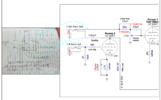
the Hi and Lo at SW1 are arrows to indicate switch position, not connections, with the input from the tip of the jack at the common.


1630423746265.png
 
Back
Top