Traynor YVM-1 Voice Master --> Rock Master

Jay

Well-Known Member
Country flag
I bought a 1968 YVM-1 Voice Master last year on an impromptu road trip to help out a family member. The stock amp had four parallel input stages, each with one gain stage before a front-panel volume control. As the model name implies, it was intended to be used with microphones rather than guitar. I have since turned it into a single-channel guitar amp. If there is sufficient interest, I'll post a chronological build thread.

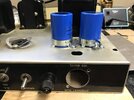
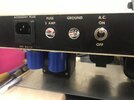
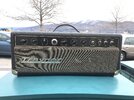
Mostly stock amp, with non-stock knobs.
IMG_3345.jpg
 
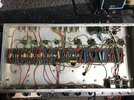
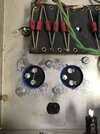
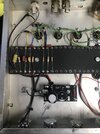
Here's a gut shot of the stock amp.
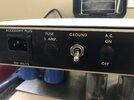
- 2-prong power cable makes its way into chassis and is wired to rear-panel accessory outlet (upper right).
- rear-panel ground switch with blue 'death cap' to chassis.
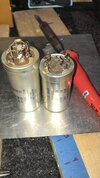
- two main filter caps, each with a quad of tabs that are soldered to the chassis.
- four rear-panel input jacks (upper left) with unshielded grid wires (red) connected to parallel preamp stages on eyelet board.
- multiple ground points soldered to chassis. input and output jacks also mounted directly to chassis for grounding purposes.
- components: mixture of carbon film and carbon comp resistors; old ceramic disc bypass caps, some mustard yellow coupling caps original axial electrolytic caps for negative bias supply etc.
- separate indicator lights for AC power switch and DC power (standby) switch. Cool!


IMG_3398-2.jpg
 
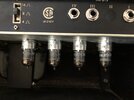
Sweet old-stock tubes. Probably the originals.

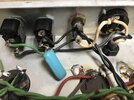
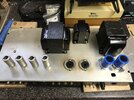
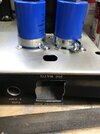
The 4 parallel input jacks were modified. All were isolated from the chassis using nylon shoulder washers on each side. It looks like I need to add the metal flat washer on Jack IV. Jack I is now the only input. Jacks III and IV were used for a tube-driven effects loop send and return. Isolating the jacks from the chassis enabled me to control the grounding scheme for a substantial reduction in hummmm.

Traynor YVM-1 open back 2.jpg
 
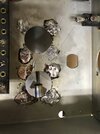
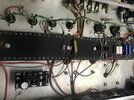
Eyelet board cleared and cleaned. New components/circuits loaded onto the right side of the board, including new caps for negative bias supply, new screen resistors, phase inverter plate resistors and coupling caps.

Bottom left: a PCB holding a dropping resistor and filter cap for the preamp. I use modern radial electrolytic with long life expectancy (10,000+ hours) whenever possible.


IMG_4237.jpg
 
The stock amp had a coupling cap between (each) input jack and grid of first gain stage. I kept that in there. Used shielded wire to board-mounted cap, and added a 33k grid stopper on pin 7 of the tube socket.

My wiring colour code for tube sockets:
- brown for unshielded grid wires
- yellow for cathode
- blue for plate.

Follow the wires to find:
- first gain stage cathode: 2k7 R with bypass cap
- first gain stage anode/plate: 220k plate with bypass cap to remove some high end hiss
- plate coupled to front panel gain pot.
- output of gain pot fed to input of second gain stage (with shielded wire and 91k grid stopper)
- second gain stage cathode: no bypass cap. lower value than Marshall's 10k cold clipper (4k7, I think)
- second gain stage anode: 100k R

anode Rs: 1W
cathode and most other Rs: 1/2 W

IMG_4242.jpg
 
Do you calculate this bypass cap for a cut at a specific frequency? Or do you follow your ears? Or both?

I usually start with calculations and then fine tune from there.
For this amp, I really didn't know what I was going to do until I started dropping in components. Somewhere along the line I decided to make something that would be in the ballpark of a 2204, with a bit less high frequency. The anode bypass cap was added to keep everything stable (and perhaps remove a bit of hiss) without affecting the guitar signal too much. 220k/220pf usually works for me in such cases (3dB rolloff point is ~14kHz).
 
Last edited:
Back
Top