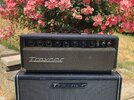
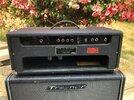
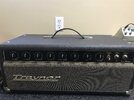
Traynor YVM-1 Voice Master --> Rock Master

I usually start with calculations and then fine tune from there.
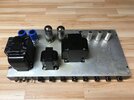
For this amp, I really didn't know what I was going to do until I started dropping in components. Somewhere along the line I decided to make something that would be in the ballpark of a 2204, with a bit less high frequency. The anode bypass cap was added to keep everything stable (and perhaps remove a bit of hiss) without affecting the guitar signal too much. 220k/220pf usually works for me in such cases (3dB rolloff point is ~14kHz).
Nice!
 
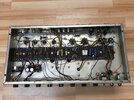
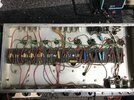
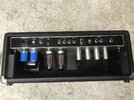
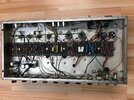
This is probably close to the final (or at least current) circuit. There are some slightly different things going on in the preamp (compared to the earlier photo). The input coupling cap was removed to save space and simplify the input wiring. Some of my usual tricks were added.

Second preamp tube is a standard cathode follower arrangement. Third tube is for the effects loop. Fourth tube is a standard long-tailed phase inverter.

I added another stage of filtering on my filter PCB.

The additional PCB on the bottom right is a ground-loop suppressor circuit.

That's about it :)

IMG_4855.jpg

from this original amp:

IMG_3398-2.jpg
 
Last edited:
Wow that's crazy!
What type of amp is it now? Any particular circuit type it is emulating? Or just redoing the Traynor for 1 input?
Looks fantastic
It's in the ballpark of a 2204 with two preamp gain controls and some other things that I like to do. With a tube-buffered effects loop and an adjustable and foot-switchable boost. More gain than a 2204 on hand due to the dual-gains and other tweaks. I originally configured it to have more gain that it does now, but I dialled it back to match its vintage looks.
 
Last edited:
More about conversion to EL34.
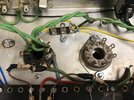
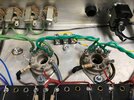
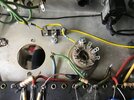
1. The stock octal tube sockets did not have all pins. The stock 7027A tubes do not need pin 1, since it is tied to the screen grid and pin 4. EL34s tie pin 1 to their suppressor grid, which is normally tied to the cathode (pin 1). So I replaced the original octal sockets with new Belton sockets and tied pin 8 to pin 1.
2. EL34s draw considerably more heater current than do 7027As (1.5A vs 0.9A). The heaters were wired with 22AWG wire throughout. I replaced the two pairs of octal heater wires (from pilot light to V6, and from V6 to V5) with 18AWG for more safety margin. The total draw of the 12AX7s is only 1.2A, so these do not need heavier-gauge heater wires.

IMG_5306.jpgIMG_5312.jpgIMG_5313.jpg
 

Attachments

Thanks, Robb :giggle:
It's currently loaded with 6CA7s, because that seems fitting for a vintage Traynor...
Yeah, that's what I have in most of mine but in my older ones, 1965-66 I try to track down the 7027a tubes that are getting harder to find, I'm currently looking for 1 that won't kill me with shipping charges.
 
Not my area of expertise at all & admire this type of work very much, super job !!, Can it be cascaded with an individual knob for each stage? for a very precise level. That sounds very interesting. My thoughts went to if 4 gain stages were in line, deciding what slammed what would be wild with a knob for each stage. Not sure if that makes sense or is possible but the more i learn to play its the precise adjustments that seem to really keep the tone thick when gain stacking
 
Not my area of expertise at all & admire this type of work very much, super job !!, Can it be cascaded with an individual knob for each stage? for a very precise level. That sounds very interesting. My thoughts went to if 4 gain stages were in line, deciding what slammed what would be wild with a knob for each stage. Not sure if that makes sense or is possible but the more i learn to play its the precise adjustments that seem to really keep the tone thick when gain stacking
This one had a gain control for each of the first two gain stages. I think Kevin O'Connor designed an amp or preamp with even more controls over individual gain stages. It gets a bit much after two, in my opinion, since there are soooo many possibilities. This one was flexible enough (although without super-high levels of gain). With gain 2 set at 2 o'clock, it would be similar to a JCM800. Increase or decrease for something different.
 
Back
Top