The Low Output / High Gain Discussion Thread:

Inspector #20

Ambassador of Tone
Fallen Star
Country flag
I thought this would be a fun and useful thread to discuss the "old school" methods of using relatively low output pickups in higher gain applications, (perhaps not chugging metal gain) much like our heroes did in the 60's and 70's before there were many high gain pickup options.

I thought we should first define what a low output humbucker is.
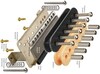
humbucker-internals1.jpg

I located this article and am reposting it here: (Source -

Vintage Gibson Humbuckers Specs:

1956 – 1957 (“PAF”): Long (2.5”) Alnico 2, 3, 4 and 5 magnets used randomly, brushed stainless steel cover, *no* PAF sticker, automatic traverse wound with manual-stop (until bobbin was “full”), #42 plain enamel wire (purple/maroon), individual coil ohm differences, black leads on coils, ohms vary from low 7k to high 9k, black PAF-style bobbins (“square in circle” with holes). PAFs first installed on Gibson lap-steels in ‘56 and then guitars in ‘57.
1957 – 1961 (“PAF”): Long Alnico 2, 3, 4 and 5 used randomly (A2 most common), nickel cover, “Patent Applied For” sticker, automatic traverse-wound with manual-stop, #42 plain enamel wire (purple/maroon), individual coil ohm differences, black leads on both coils, ohms vary greatly – generally between 7k and 10k, black and cream (early-’59 thru mid-‘60), all bobbins black again by late ’60, PAF-style pickup bobbins.

1961 – 1962 (Late “PAF”): Smaller (2.37”) Alnico 5 magnet used for remaining production (all transitioned by July ’61), nickel cover, PAF sticker, automatic traverse-wound with manual-stop, #42 plain enamel wire (purple/maroon), black leads on both coils, individual coil ohm differences, ohms averaged 8.0k by ‘62, PAF-style bobbins.

1962 – 1964 (“Patent number”): Alnico 5, nickel cover, “patent no.” sticker (mid-’62), polyurethane wire (starting ‘63), black/white lead wires, “auto-stop” winding starts circa-’62, PAF-style bobbins, usually 7.6k – 8.0k ohm.

1965 – 1967 (Late “Patent number”): Alnico 5, polyurethane wire, “patent no.” sticker, bobbin wires white, Chrome cover (starts mid-’65), more durable and flatter bobbins with no “square in circle” hole circa-‘65, ohms usually between 7.4k – 8.0k. Gold-plated PAFs used in arch-top electrics as late as 1965 – “Varitone” guitars had gold-plated pickups with one pickup having a reversed magnet. This pickup style was used far less than nickel-plated pickups, thus inventory lasted thru 1965.

1967 – 1980 (“T-top”): “T” on bobbin top, Chrome cover, Alnico 5, polyurethane wire, automated winding begins ‘65 – ‘68, some ’69 – ’73 pickup covers embossed “Gibson”, “patent no.” sticker on baseplate ’67 – ’74, (patent number metal-stamped beginning 1974), ink stamp with date ’77 – ’80, ohms average 7.5k – consistently reading between 7.3k – 8.0k.

So, from this article, it would suggest that "low output" can be defined as pickups being in the 7.0k to 8.0k ranges. While many other factors - besides DCR will determine a pickup's output - I'll suggest we use the DCR values for the purpose of this discussion.
 
Last edited:
This thread has a lot of great information about Jimmy Page's original #1 and #2 Les Paul's and the differences in pickups he used, including some comments by Jimmy's guitar tech around the time Page started using custom wound Seymour Duncans....

 
Randy Rhoads was using low output humbuckers.

Much has been written about Randy's white 1974 Les Paul Custom, not only the fact that he had Karl Sandoval install vintage Fender fretwire in it, but also with respect to the pickups he used.

– Randy Rhoads Alnico 3 Humbucker pickup

If there is a list of legendary guitars, the Randy Rhoads turned cream white Les Paul Custom is in the top 5. This was the 1st guitar he was identified with, donated by the members of Quiet Riots. She followed him throughout his career.

It was a Les Paul Custom from 1974, then fitted with T-Buckers, the new version of Gibson’s PAFs. Most of these T-Buckers were fitted with Alnico 5s and only a few models were fitted with Alnico 3s including Randy’s.

The sound was then mellow and open for the neck pickup while supporting saturation well. The bridge pickup, nervous enough to play all styles (Randy Rhoads was not known for playing Blues), became pleasant with singing highs, unlike the Alnico 5 version.

Our set takes the exact characteristics of the reissue that Gibson’s Custom shop produced in 2010: the Les Paul Custom 74 Randy Rhoads.

The neck pickup is 7.4 kohms and the bridge 7.6 kohms. They both benefit from a slightly asymmetrical coil, which widens the frequency range picked up by the pickup. This handwound model is made, like all our pickups, with the best components available on the market.

Neck, bridge or 2 pickups set
Alnico 3 magnet
42 AWG Plain Enamel

The “Plain Enamel” is the coating of the copper wire used by Gibson from the 40’s to the 60's and inyo the esy 70's. e
The impact of the coating on the sound is marginal, or even nonexistent.

Butyrate plastic coil for 49.2mm spacing (Vintage Gibson) or ABS for 50mm – 52mm spacing, modern version

Resistance : Neck ~7.4 kohms | Bridge ~7.6 kohms

Set NOT wax-potted for the butyrate coil version and wax-potted for the ABS coil version

Spacing of screws and slugs from E to E : 49.2mm (butyrate) or 50mm and 52mm (ABS)

Supplied with 2 mounting screws and 2 springs per pickups 35/38cm wire length per pickups

Available bobbins color: black, cream, white zebra and reverse zebra
Raw Nickel/Silver, Nickel platted, Cosmo Black or Gold cover in options.

Source: Super 74 - Randy Rhoads Alnico 3 Humbucker pickup - Cecca Guitars
 
This thread has a lot of great information about Jimmy Page's original #1 and #2 Les Paul's and the differences in pickups he used, including some comments by Jimmy's guitar tech around the time Page started using custom wound Seymour Duncans....


From Rob's URL post.

A T Top is a very different character to a PAF. Typically mid 7K-ish, unpotted, short AV magnet. With the switch in the middle position, as Jimmy did for the majority of his live playing, there's that almost 'out of phase' like tone combined with the neck PAF. Any 2 pickups on together have overlapping magnetic fields that cause frequency cancellation, his example is quite unique and instantly identifiable.

It's often overlooked that JP's classic era live tone was not so different when he used the EDS1275. Honky, quacky, nasal. It had period T Tops (also since replaced by SD). I have a mid 70's EDS1275 and it's tone is spot on. I'm a JP fan but use pure nickel 10 strings with a rounder tone compared to his super light EB Slinky's, light pick and bony finger touch. I played Jimmy Sakurai's R8 with EB Slinky 8's and lightest Herco pick - a much thinner, reedier tone to my heavier Herco and DR Blues 10's.

The notion that any winder can make a JP pickup leaves much to interpretation. I've had a 'JP' set that had a super hot 9K-ish bridge pickup. That's nothing like a T Top so I'm unsure what the inspiration was based on. There's plenty of used T Tops for sale and prices are continually going up. As with anything it pays to know what you're looking at. Or check with Rewind Pickups for eg. James make's fantastic JP pickups. Very popular with players, including me, plus he's a regular here.

Of course the pickups are only part of the equation. They work with a guitars' natural tone and resonance. I've a couple of Historics that naturally have JP-esque tonal qualities and others that simply don't.

Daz
 
Rob, Any info similar to these on Tarback/Superhumbucker pups?

The 'Tarback,' also called a 'Super Humbucker,' was a Bill Lawrence design for Gibson. Historically, they appear to have been produced from late 1971 until late 1984, although there is wide speculation on these dates.

Gibson tar back specifications:

Inductance 4.7 Henries
Resonant Peak 5.8 Khz
DC resistance 7.8 K ohms (at 1000 cps)
Impedance High
Two Active upper coils
One Ceramic Magnet (indox 7)
Adjustable pole pieces
Removable pickup cover
2 point height adjustment

Quite an interesting choice of magnets!@@@!

original.jpg

gibson-Tarbacks-Super-humbucker-1974-Chrome-big.jpg

 
Thank you Rob, Tarbacks were the OEM in my '76 SG Std that was removed in favor of the EMG's I was mentioning in that other thread. The previous owner kept all the OEM pots, switch, jack of the original setup in the case, along with the EMG boxes and info from the
The EMG setup was the normal 85/87 in the bridge ( i always forget which goes where) but had the single coil in humbucker sized pup, EMG H in the neck plus all the pots, switch jack for that setup.

It sounds incredible to me with the Tarbacks. AND I can put the EMG's in just about any guitar.
 
Last edited:
The 'Tarback,' also called a 'Super Humbucker,' was a Bill Lawrence design for Gibson. Historically, they appear to have been produced from late 1971 until late 1984, although there is wide speculation on these dates.

Gibson tar back specifications:

Inductance 4.7 Henries
Resonant Peak 5.8 Khz
DC resistance 7.8 K ohms (at 1000 cps)
Impedance High
Two Active upper coils
One Ceramic Magnet (indox 7)
Adjustable pole pieces
Removable pickup cover
2 point height adjustment

Quite an interesting choice of magnets!@@@!

View attachment 76053

View attachment 76054


I would say the regular old Gibson HB pickup.
High output (to me) just overloads and sounds pretty muddy...harder to get a clean sound.

Bill Lawrence: I think he's retarded.
Never been impressed with anything he did.
Especially "solderless" guitar cables. Probably some of the most unreliable cables ever made.
UN-plated 1/4" brass plugs really stupid....
Solderless speaker cables - even dumber.
 
I would say the regular old Gibson HB pickup.
High output (to me) just overloads and sounds pretty muddy...harder to get a clean sound.

Bill Lawrence: I think he's retarded.
Never been impressed with anything he did.
Especially "solderless" guitar cables. Probably some of the most unreliable cables ever made.
UN-plated 1/4" brass plugs really stupid....
Solderless speaker cables - even dumber.

I have no dog in this fight except being the owner of 2 Bill Lawrence pup variants in 2 of my SG's. My first one and my last.
My first has the Circuit board type and the 2nd has my previously mentioned Tarbacks. In between those 2 SG's, I got the Classic with P90's and the Faded Special with 490's

I had no other knowledge of BL stuff like Ampmad speaks of, until now.
 
Good example 1957 Gibson gold top and 2015 Custom shop why Gibson can't build a clean sounding pickup today is a mystery to me.
In the video FF to 15min.


Steve, I don't understand German, why CAN'T Gib build a clean sounding pickup? Is it JUST the pup we are hearing here? The wood, pots, wiring, adjustments of the pups, the hardware compositions or what?
 
Steve, I don't understand German, why CAN'T Gib build a clean sounding pickup? Is it JUST the pup we are hearing here? The wood, pots, wiring, adjustments of the pups, the hardware compositions or what?

I don't know if it had nibs or not the point was a real 1957 PAF compared to 2015 production Custom Shop what was the sound difference
Udo discussed the difference in clarity between the '57 and and '15 pickups. I didn't watch all of it, just the first few minutes, then skipped to 15:00.
 
As far as I see it, hot pickups are sorta like running a higher level into the amp, like running an OD with level high. A few of my guitars had very mundane, mediocre output and I do not care for them. Pushes the front of amp harder, even a high gain amp. It seems to work for me.

I have always favored the higher output pickups too....but then I bought this Gold Top with an 8.4k Burstbucker 3 Alnico II.

Now, we are all different and I'm not selling anything here, but something that happened tonight really and truly amazed me.

I plugged into the console and pulled a profile in VST Amp Rack. I selected 100 wat Plexi, EQ's about 1pm, 4x12 cabinet, chorus, a Seinhauser 421 and a SM57 off axis with a noise gate and light reverb.

I could not believe the tone I was hearing. It was an absolute ringer for Randy Rhoads' Tone on Crazy Train...I mean exactly (love or hate that tone as you may) as you hear on the recording.

That sound may not be for everyone, but brother does it ever sit famously in a mix...
 
Last edited:
Hmmm... Isn't it very much depending on the amp? Lower output pickups will require you to increase the gain on th amp more to reach the same high gain sound. I find that the characteristics of a lot of amps change with the gain setting which should make a difference together with the pickups. Thus, some amps should sound better wil lower output pickups and vice versa.

I prefer low output pickups myself, both single coils and humbuckers. I recently changed pickups in my SG, now there's a SD Seth Lover in the neck- and a Lundgren Heaven 57 in the bridge position
 
Back
Top