The DoubleNeck Thread:

Inspector #20

Ambassador of Tone
Fallen Star
Country flag
Just looking for the best DoubleNeck photos and stories. Here's the first one:

Ron Weinstein.JPG

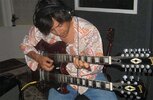
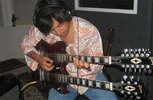
In the camp of the not-quite-world-famous doubleneck players, there’s Ron Weinstein, a talented guitarist/singer/songwriter from Long Branch, New Jersey—a loyal user of the Gibson EDS-1275 and a prime example of how most of us are influenced by our guitar idols. When questioned about why he began using one, Ron replied, “The awesome Jimmy Page inspired me, of course! I went to see Led Zeppelin at Madison Square Garden, and immediately bought a Gibson 6-12 doubleneck that still sounds and looks cool. The obvious advantage is the ability to play rhythm on the 12-string neck and lead on the 6-string neck without changing guitars. The doubleneck was instrumental (pun intended) in helping me write and produce one of my originals, ‘Trippin’ All Over The World,’ that wound up sounding like a Tom Petty song, partially because of the 1275.

Can you make out his TRC detail???
 
Don felder 3 Hole.jpg
Don Felder
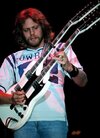
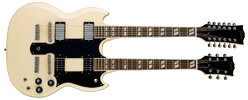
Another well-known proponent of the EDS- 1275 is Don Felder, formerly of The Eagles and now a bandleader and solo artist in his own right. Felder used the guitar live on “Hotel California.” His Gibson is finished in white and has custom wiring with double input jacks that allowed him to run the 12-string neck through a Leslie speaker while running the 6-string neck into his amps and pedalboard. Felder also used a capo on the 12-string neck.

Do uses 3 hole TRC's on his guitars and Gibson produces the "Hotel California" model with 3 hole TRC's.

Don Felder EDS-1275 Model Gibson.jpg
 
Last edited:
Emmett.jpg

Rik Emmett in 1982 with his Ibanez Artist doubleneck.
Rounding out the “Canadian Team” is Rik Emmett, formerly of the band Triumph, and now a very successful solo artist. Emmet also favored the Gibson EDS-1275 and other doublenecks during his days with the band. Rik was kind enough to email some comments regarding his use of doubleneck guitars: “I have owned eight doublenecks in my day, all 6 and 12 configurations. The first was a cherry red bolt-on Ibanez Gibson copy, which was covered in silver reflective mac-tac and was first used in a band called Act III. I also used it in the very early days of Triumph, but soon acquired a white Gibson, and used it from 1976 to about ’78 or ’79. Then, I got an Ibanez Artist in wine red, and used that until about 1984. Dean made me a doublneck around 1983, but I was not happy with it, so I traded it in on some other gear. Yamaha made me a white custom SBG doubleneck, which I used from 1984 until about 1989. That white Yamaha was on the cover of guitar magazines, and was truly a magnificent bit of custom guitar building.

“In 1989, I ordered and purchased a Steinberger doubleneck, hoping the body would be a lot lighter and that the lack of headstocks less head-heavy to wear. It was a lot more balanced, and was unbelievably good for tuning stability, but it was also very heavy. I stopped using doublenecks in 1991 or so, as I started having trouble with my neck and back. But in 2008, when Triumph had its reunion, I had also just struck a new endorsement with Gibson, and they sent me a gorgeous white doubleneck, the lightest one they could find in the Custom Shop. It still weighs a lot, and I only use it for a song here and there onstage, but it is by far the best sounding doubleneck I have ever owned. The 6-string neck has that absolutely killer Angus Young SG sound to it, and the 12-string neck rings like a bell.”
 
Some Historical Information on the Gibson Doubleneck:

Double-neck Gibsons are wild and wonderful by nature. A top attraction in any guitar freak show, they cry out for a second look. The guitar (originally named “The Double Twelve”) made its way onto the market in 1958 alongside fellow before-their-time Gibson revolutionaries The Explorer and The Flying V. The Double Twelve stands out as the first double-neck guitar ever produced on a commercial basis by a major manufacturer.

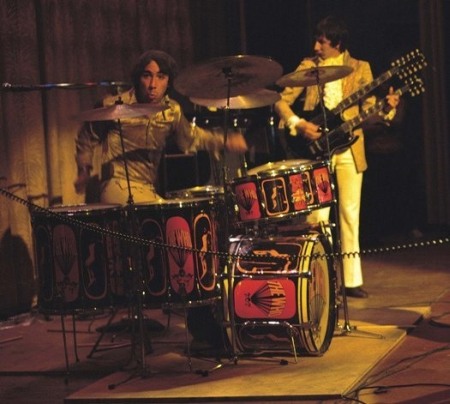
Having been made famous in the hands of Led Zeppelin’s Jimmy Page (who used one live to traverse the guitar parts in “Stairway to Heaven”), The Mahavishnu Orchestra’s John McLaughlin (who many credit with popularizing the instrument), and The Eagles’ Don Felder (who launched into “Hotel California” in concert with one of these babies in hand), the double-neck Gibson smacks of the best in ’70s rock and roll. (Prior to the ’70s, the EDS-1275 — as The Double 12 would later be renamed — first picked up cache when it was played by Pete Townshend during a number of Who gigs, two of Earl Hooker’s album covers, and strummed by Elvis Presley in the movie Spinout.) The instrument is both retro and modern and at a strange crossroads between magnificently dynamic and just plain outlandish. In more recent decades, plenty more boldfaced names have embraced it for its on-stage versatility and stage presence — including Rush’s Alex Lifeson, KISS’s Ace Frehley, Yes’ Steve Howe, Elton John’s Davey Johnstone, Slash and Zakk Wylde. In 2008, a Gigwise.com reader poll determined that the EDS-1275 is The Coolest Guitar in Rock. We like to think so.

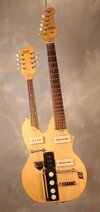
In those very first years, Gibson double-necks were produced in limited quantities as custom orders only and available in two versions: as The Double Twelve, a 6-string guitar paired with a 12-string guitar (pretty similar to the EDS-1275 offered by Gibson today) and as The Double Mandolin, a 6-string guitar paired with a mandolin (which was actually a short guitar neck tuned an octave higher than usual to reproduce the mandolin sound). These first double-necks were priced at $475 and $435 respectively. Those made from 1958 to 1962 featured a hollowbody design with arched spruce tops, maple back and sides, one-piece mahogany necks and rosewood fingerboards. The original silhouette was defined by a sharp Florentine double cutaway and came in brown sunburst, solid white, or solid black. Get your hands on one of those original models and you’ve got one of the most coveted of all vintage guitars, prized for both quality and scarcity. In a Guitar Player article from 1982, guitar guru George Gruhn said he believes that “no other Gibson electric surpassed [the Double Twelve] in quality” and he revealed that from the double-neck’s introduction in 1958 until the end of 1961, Gibson sold only 46 Double Twelves and 44 Double Mandolins. Last year one of these Double Twelves was appraised with a value between $25,000 and $35,000 on an Antiques Roadshow episode. (One such lucky owner of a Double Twelve? Carlos Santana, who can claim one in his collection.)

In 1962, Gibson changed things up by introducing a 6-string guitar and bass guitar hybrid called The Double Bass — with the earliest of these models including a stock built-in fuzztone until it was dropped in 1965. This instrument essentially married an SG Standard to an EB-3. This was the year, too, that the Double Twelve was reintroduced as the SG-inspired EDS-1275. A solid mahogany body, three-piece maple neck, and 20-fret rosewood fingerboard anchored the newer version. This was the guitar that found itself in the hands of Jimmy Page, who used it to more easily reproduce the complex studio arrangement of “Stairway to Heaven,” “The Rain Song,” and “The Song Remains The Same” in a live setting.

In a 1975 interview, Page marveled over the guitar’s value but in a most unusual context.

“The other night we played in the Philadelphia Spectrum, which really is a black hole as a concert hall,” said Page to Crawdaddy Magazine in ’75. “The security there is the most ugly of anywhere in the States. I saw this incident happen and I was almost physically sick. In fact, if I hadn't been playing the guitar I was playing it would’ve been over somebody’s head. It was a double-neck, which is irreplaceable, really, unless you wait another nine months for them to make another one at Gibson.”
 
Semie Mosely may have done more for establishing doubleneck electric guitars than any other individual. As an apprentice with Paul Bigsby when he was barely out of his teens, Moseley got the opportunity to work on the guitars of many famous players. Picking up the luthier’s trade rapidly, Moseley learned how to craft every single part of the guitar himself, including pickups, vibrato tailpieces, knobs and other plastic parts. They were also durable, with many examples still in existence. He also learned to be unafraid of invention, innovation and making guitars way, way out of the norm. Going into business for himself in about 1954, he began building solidbody guitars for players in and around Southern California. In 1954, Moseley made doublenecks for Joe Maphis and Larry Collins of the Collins Kids. He became known as the go-to guy for multi-necked instruments and eventually made more pieces for Maphis and Collins, as well as for stringburner Phil Baugh and others.

Throughout the ’50s, one-off and homemade doublenecks made appearances across the scene. Herbie Treece and Sherwin Linton are two that come readily to mind. Both pickers in the country circles, each played homemade doublenecks. Treece’s guitar was a stylish axe with dual six-string necks of differing scale, and Linton’s homemade doubleneck had a revolving cast of six-, eight-, and twelve-string necks with features such as B-benders and headstock-mounted vibratos. Linton used his doubleneck on the aptly named album, “Hello, I’m Not Johnny Cash.”

The Big Boys Step In
In 1958, Gibson introduced two doubleneck electric instruments, the EDS-1275 Double 12 and the EMS-1235 Double Mandolin. The first Gibson electric doubleneck, however, was built a year or two earlier as a custom order. Seeing the possibilities in the model, Gibson built a number of samples, some of which they exhibited at the 1957 NAMM show. Enough positive reaction was garnered that the company put the models in the next catalog, but very few of the instruments were actually produced. Initially, both of these instruments were thinline hollowbodies, 1-7/8" deep. The EDS (Electric Double Spanish) had two 24.75" scale necks, the upper a twelve-string, the lower six-string. The EMS (Electric Mandolin Spanish) had a 13-7/8" scale six-string neck in the upper position and a 24.75" scale six-string neck in the lower position. Both models had a two-piece solid spruce top with maple sides and a one-piece maple back. Colors available were white, black and sunburst. The dual-cutaway shape of the thin-lines was a precursor to the SG-style solidbody which both instruments transitioned to in 1962.

In their 1959 catalog, the Carvin Guitar company introduced two doubleneck models. The #4-BS Professional Doubleneck featured dual 25-1/8" necks; one a six-string guitar, the other what would amount to be a (very) short-scale bass. The #1-MS was a guitar and mandolin combination with one 25-1/8" scale guitar neck. The body was maple and similar in shape to their other guitars. The electronics on the Carvins were a bit unique. Each unit had two P-90-style pickups on the guitar and a single pickup for the bass and mandolin, respectively. Whereas many other doubleneck models would have had a switch to select which neck you were playing, the Carvin used the pickup selector to do this job. Position 1 of the pickup selector would be the bridge pickup of the guitar. Position 2 would be the guitar’s neck pickup and position 3 would be the single pickup of either the bass or mandolin. Carvin continued to offer the #4-BS and #1-MS throughout 1964 when they redesigned the pair.

Carvin #1-MS.jpg


Carvin offered the doubleneck option throughout the ‘60s, and continued to help players satisfy their doubleneck cravings consistently throughout the years, making them one of the longest-lasting and most prolific producers of doubleneck guitars and basses.

For the 1961 model year, Gretsch introduced one of the more unique multi-neck offerings ever to come from a major manufacturer. The Bikini was actually three units, a guitar (6023), a bass (6024), and a doubleneck bass and guitar (6025). The concept was that you could use one body and slide in either a bass or a guitar neck. To make things slightly more complex, the body also folded down the middle on a piano hinge, becoming known as a “butterfly.” A player also had the option of combining separate butterfly back components to make a doubleneck. The guitar was 25-1/2" scale and the bass was 29-1/4" scale. Electronics, pickups, tone and volume controls were self-contained in each respective neck shaft. The guitar was a good idea in theory but not in practice, and was difficult both to produce and to operate.

Throughout the rest of the 1960s and 1970s, Gibson was the only major manufacturer to consistently offer an electric doubleneck. Mosrite kept the Joe Maphis doubleneck in its catalog up until the latter part of the decade, and Rickenbacker occasionally produced guitar and bass doubleneck combos. Other manufacturers produced doublenecks only as a custom order. By and large, the doubleneck moved into novelty status with only Jimmy Page of Led Zeppelin using one to any effect. Rick Nielsen famously paired with Hamer on a number of extreme multi-neckers, and in the 1980s some metal bands made use of the shock factor of the instrument to add to their visual appeal. In the late 1990s and early parts of the 2000s, retro appeal brought back some doublenecks into the realm of “guitar geek” status.

Some of the most enlightening moments in guitar learning have come for me at the Museum of Making Music. Located at NAMM headquarters in Carlsbad, CA, the Museum not only preserves the history of the music instrument industry but teaches the history of music instruments to the public. I was lucky enough to work at the museum doing a number of things, none more gratifying than giving tours to youngsters. Once while giving a tour to a group of Brownies—girls between the ages of seven and nine—I walked up to a case holding an incredibly rare Bigsby doubleneck built for J.B. Thomas. It’s a beautiful piece with a maple top and one regular-scale guitar neck and one mandolin neck. I asked the Brownies the question, “Now why would a guitar have two necks?” The girls were silent until one of them, in a whisper quiet voice, said, “So you can rock and roll?”

A great answer, and probably not too far from the truth.
 
Pagey.jpg

Jimmy Page
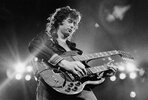
For many of us, the sight of Jimmy Page playing his cherry red Gibson EDS-1275 is one of the classic iconic images of rock guitar. Page began playing one after recording “Stairway To Heaven,” and used it extensively both live and on Led Zeppelin’s recordings, including “Rain Song,” “Celebration Day,” and “The Song Remains The Same.” Page commented on his use of the 1275 in a 2006 London interview conducted by guitarist Slash (currently available on YouTube and presented here in edited and clarified form): “I knew Gibson had made a doubleneck, and I was sort of aware of its presence. After having recorded the fourth album, which had ‘Stairway,’ which was definitely going to have to be played live, and was recorded with 12-string acoustic and electric, I needed something that would affect the pacing of that, you know, while still using the electric 12-string and electric 6-string neck. So that was it. The doubleneck was the one instrument that was going to fulfill it. The Gibson doubleneck became sort of iconic, you know? I had to use the doubleneck to play ‘Stairway’ live, and then it started to take shape.… The doubleneck was tailor-made for that.”

When asked if he had seen another guitarist using a doubleneck, Page remarked, “It probably was an American country guitarist, but it wasn’t Joe Maphis. He played a doubleneck, but it wasn’t a Gibson. It would have been accessed from that arena if you like. It was almost a calling, and there was no other way to do it. By that point in time, most people know I used a Les Paul in the early days, so I continued on the theme of using a Gibson, and it didn’t let me down.” Page recently donated a later model EDS-1275 for charity, but it was not the famous one he used with Led Zeppelin. That guitar remains firmly in his possession.
 
Rush.jpg

Alex Lifeson and Geddy Lee
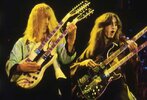
Alex Lifeson and Geddy Lee of Rush have both used doubleneck instruments onstage and in the studio. Lifeson’s original EDS-1275 was broken by a falling speaker horn at a gig at Nassau Coliseum in the late 1970s, but was repaired and repainted afterward. Lifeson gave the guitar to Eric Johnson as a gift, but it was stolen within weeks. Lifeson has since replaced the 1275 with another that he has used only in rehearsals as of this writing.
 
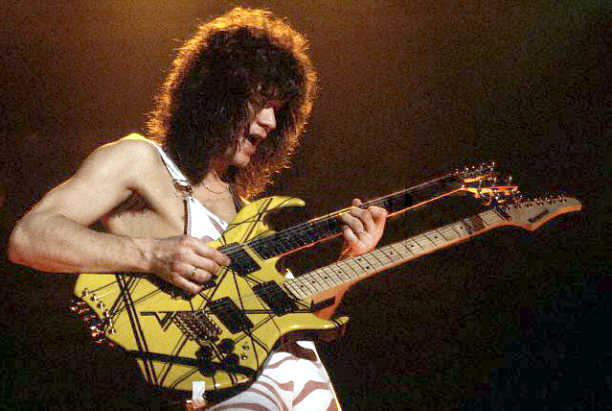
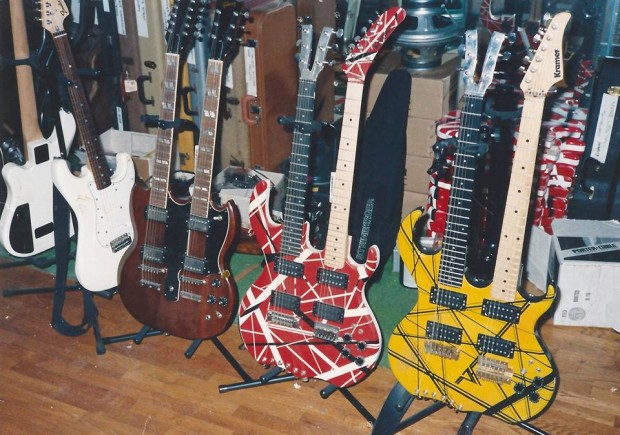
Eddie had a few:

edyeldouble.jpg


Eddie_Van_Halen_5150_Studios_guitars_3-620x435.jpg
 
Gibson SG EDS-1275 double-neck guitar
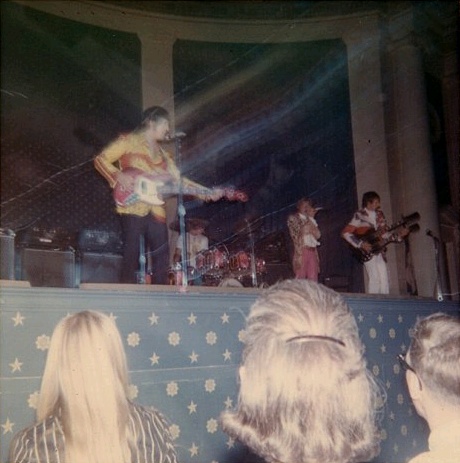
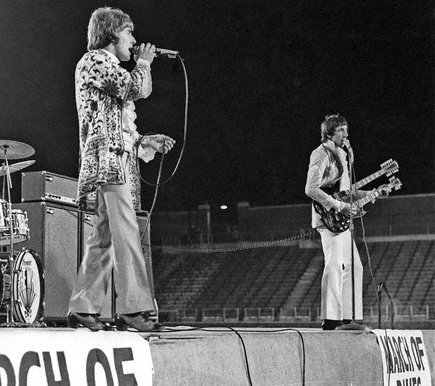
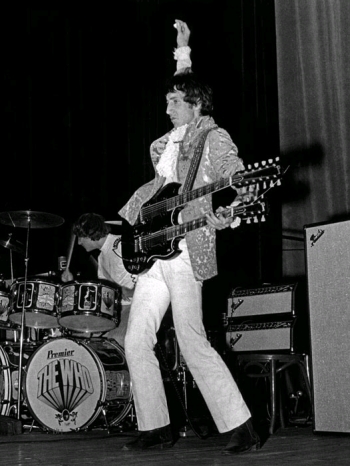
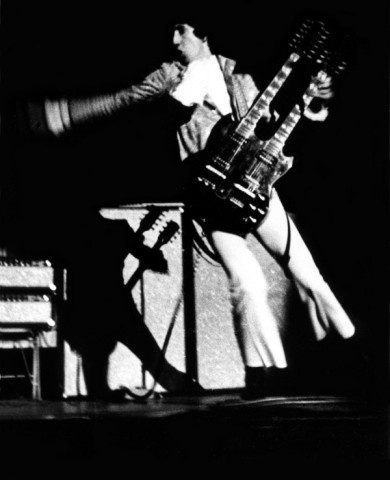
Pete Townshend used a Gibson SG EDS-1275 black custom 6/12 double-neck guitar from approximately August to November 1967. He typically used this guitar for the opening numbers, such as Substitute.

The first known date is 13 Aug. 1967, Constitution Hall, Washington, D.C. However, it may have been used as early as 5 Aug. 1967, in Chicago. The last known date is 4 November 1967 at Walthamstow, UK.

Los Angeles Times — 11 September 1967, regarding 8 September 1967 show at the Anaheim Convention Center, Anaheim, California:
Townshend added flexibility to their instrumentation by playing a double-necked 6 and 12 string guitar, but he switched to a more conventional guitar before their destructive finale.

General specification (1962 and later models):
  • SG-style body.
  • 12-string guitar neck in upper position.
  • Six-string guitar neck in lower position.
  • Both have 20 frets, a 24¾″scale, with neck/body joint at the 15th fret. Double parallelogram inlays.
  • Kluson tulip-style tuners.
  • Tune-o-matic bridge.
  • Four — two for each neck — double-black Patent Applied For (PAF) humbucking pickups (with covers removed).
  • Two three-position toggle switches:
    • One for pickup selection for the necks (located on lower horn).
    • One as a neck selector (upper, lower, or both), located between bridges.
Broken and repaired – A theory
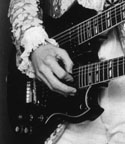
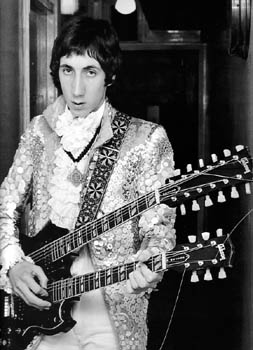
Click to view larger version (578kb).Closeup of Gibson SG EDS-1275 double-neck body repair joint from backstage at the Saville Theatre, London, 22 Oct.1967.

You’ll notice in the photos below that some show a traditional — parallel — setup of the two necks, and some show the two necks at an odd angle. Our theory is that this guitar was broken lengthwise down the middle of the body and repaired with an off-center body joint, causing a slight angle — a slight “V” shape — to the necks.

The following presents a possible theory about the history of this guitar.

The first known use of this guitar is 23 Aug. 1967 at Atwood Stadium in Flint, Michigan. The Who had just come off a two-day break a week earlier in Nashville, so it’s possible he picked it up during that time (along with new Sunn amplifiers).

One early photo below with it unbroken has a Fender Showman amp, which were likely only used in North America (though the photo is sometimes attributed to Sheffield City Hall in October; however, this gig was one week after the Saville Theatre …).

The backstage photo is 22 Oct. 1967 at the Saville Theatre in London. In this photo, the guitar’s body is clearly repaired (see closeup) between the six- and 12-string sections running the length of the body. (In addition, the pickup-selector toggle switch on the treble horn appears to be missing following the repair.)

He used the guitar as late as 4 Nov. 1967, at Walthamstow. Consider the theory that he used it for opening numbers, which is likely the case since the backstage photos have him with it, he doesn’t have it for the first date of the next U.S. tour (17 Nov., Shawnee Mission, Kansas).

Geoff Davidson reports about seeing a portion of this guitar at the Kinema Ballroom, Dunfermline, Scotland, on 8 October, 1967. Geoff Davidson:

I can verify adamantly that when The Who played Dunfermline Kinema on Sunday 8th October ’67 he was playing the remaining bottom half of the double neck SG. It was splintered straight across the factory-glued join and Pete’s right-hand fingers were bleeding from the constant catching on the splinters. His frilly yellow satin shirt front was splattered with blood. I’ll never forget it. Then a few weeks later they were on Top of the Pops (to premiere “I Can See For Miles”) with the guitar rebuilt with the necks V’d rather than parallel. I said to my mate — that’s half of the guitar I saw him play!

So, a possible theory is that he purchased it in early August, possibly in New York during the 6–8 Aug. 1967 break, or possibly even earlier. He then used it for the remainder of August and broke it either in one of the two September 1967 U.S. shows (Anaheim or Honolulu) or in the early October Scotland shows (Ballerina Ballroom, Nairn, Scotland – 6 Oct.; Beach Ballroom, Aberdeen, Scotland – 7 Oct.), and after the Dunfermline Kinema date (8 Oct.), had it repaired during the two-week break until the 21 Oct. New Century Hall, Manchester, and the 22 Oct.1967 Saville show, as pictured, and stopped using it sometime between 4–10 Nov. 1967, the last of the UK shows before the next American tour, commencing 17 Nov., 1967.

19670813_washington_01.jpg

13 Aug. 1967, Constitution Hall, Washington, D.C., with first known use of Gibson SG EDS-1275 double-neck.Photo courtesy thewho.org.

19670823_flintmichigan_gibsondneck.jpg

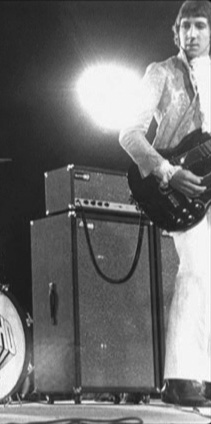
Flint, Michigan, 23 Aug. 1967, with first known use of Gibson SG EDS-1275 double-neck. Two amp stacks at left are one Sunn 100S with two 2x15s, and stack at right is one Super Beatle.Photo: Michael Ochs Archives

67_sunn-top.jpg

Flint, Michigan, 23 Aug. 1967, first known use of Gibson SG EDS-1275 6/12 double-neck, paired with two Sunn 100S amplifiers and 2x15 cabinets.Photo: Michael Ochs Archives

pt_19670831_dneck.jpg

Cleveland, 31 Aug. 1967, with Gibson SG EDS-1275 6/12 double-neck, with Marshall Supa Fuzz pedal and two Fender Showman amps with 2x15 cabinets.Photo: G. Shuba

pt_doubleneck.jpg

Ca. 1967, unknown USA date with Gibson double-neck and Fender Showman amps with 2x15 cabinets.

gibson_eds1275dneck.jpg

22 Oct. 1967, backstage at the Saville Theatre, London, with Gibson double-neck.Photo: Chris Morphet

sc68.jpg

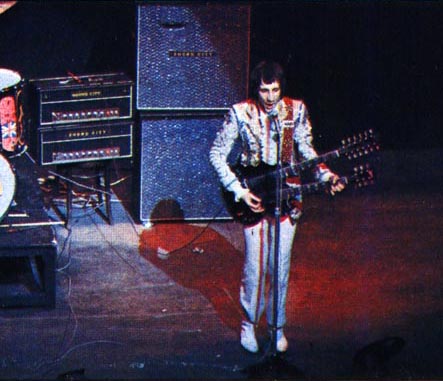
At the Saville Theatre, London, 22 Oct. 1967, with Gibson SG EDS-1275 double-neck. Amps are Sound City.Photo: Chris Morphet

67_spr_gibson1275_pol.jpg

Ca. August 1967, early use of Gibson SG EDS-1275 double-neck, with what appear to be two Super Beatles.

Resources and Information
Acknowledgments
Thanks to Chris Privett for assistance with this page.

Guitar info
For more information on Gibson EDS-1275 guitars, see:

Manufacturer
This page last updated 19 May, 2012

A note on the content here:
This information, along with all other content included in Whotabs, is intended for private study, scholarship or research. Associated images are included for reference only and are the property of the original owner. Non-Whotabs links are provided for informational purposes only and are not controlled or monitored by Whotabs. For more, see Terms of Use.
 
Can you make out his TRC detail???

Ron Weinstein.JPG


I became friends recently with Ron Weinstein. He has had his double neck over 20 years and it is a hand built replica. It features 22 frets, Block Inlay and Les Paul style stopbar tailpieces. The truss rod covers read "Custom L-5"

Note where Ron put his upper straplock.

Now, we all know about Slash's Kris Derrig replica, well I've been talking to a number of studio musician's recently who told me the Gibson replicas have gone back all the way to the 1950's...
 
Last edited:
View attachment 13052


I became friends recently with Ron Weinstein. He has had his double neck over 20 years and it is a hand built replica. It features 22 frets, Block Inlay and Les Paul style stopbar tailpieces. The truss rod covers read "Custom L-5"

Note where Ron put his upper straplock.

Now, we all know about Slash's Kris Derrig replica, well I've been talking to a number of studio musician's recently who told me the Gibson replicas have gone back all the way to the 1950's...

I only see 20 frets on that guitar instead of 22...did you do a miscount Robby Von Herndon?:hmmm:


;>)/
 
Back
Top