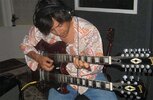
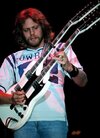
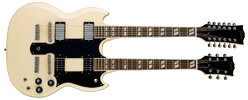
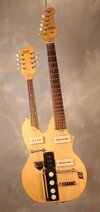
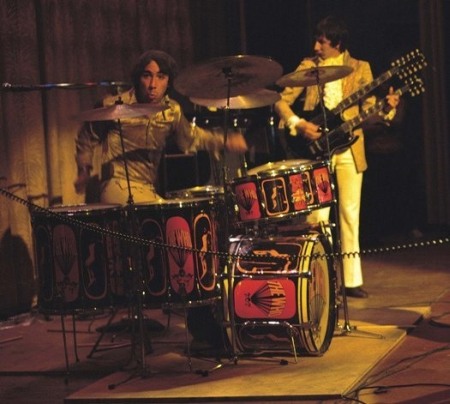
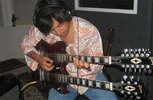
Gibson SG EDS-1275 double-neck guitar
Pete Townshend used a Gibson SG EDS-1275 black custom 6/12 double-neck guitar from approximately August to November 1967. He typically used this guitar for the opening numbers, such as
Substitute.
The first known date is 13 Aug. 1967, Constitution Hall, Washington, D.C. However, it may have been used as early as 5 Aug. 1967, in Chicago. The last known date is 4 November 1967 at Walthamstow, UK.
Los Angeles Times — 11 September 1967, regarding 8 September 1967 show at the Anaheim Convention Center, Anaheim, California:
Townshend added flexibility to their instrumentation by playing a double-necked 6 and 12 string guitar, but he switched to a more conventional guitar before their destructive finale.
General specification (1962 and later models):
- SG-style body.
- 12-string guitar neck in upper position.
- Six-string guitar neck in lower position.
- Both have 20 frets, a 24¾″scale, with neck/body joint at the 15th fret. Double parallelogram inlays.
- Kluson tulip-style tuners.
- Tune-o-matic bridge.
- Four — two for each neck — double-black Patent Applied For (PAF) humbucking pickups (with covers removed).
- Two three-position toggle switches:
- One for pickup selection for the necks (located on lower horn).
- One as a neck selector (upper, lower, or both), located between bridges.
Broken and repaired – A theory
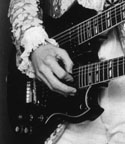
Click to view larger version (578kb).Closeup of Gibson SG EDS-1275 double-neck body repair joint from backstage at the Saville Theatre, London, 22 Oct.1967.
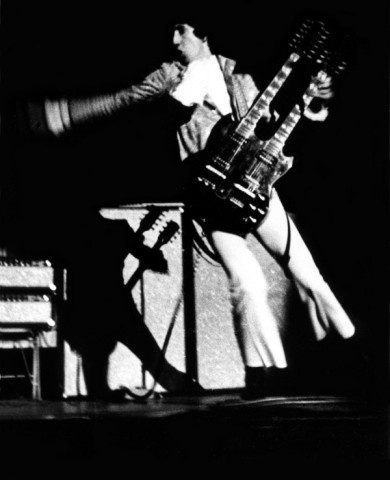
You’ll notice in the photos below that some show a traditional — parallel — setup of the two necks, and some show the two necks at an odd angle. Our theory is that this guitar was broken lengthwise down the middle of the body and repaired with an off-center body joint, causing a slight angle — a slight “V” shape — to the necks.
The following presents a
possible theory about the history of this guitar.
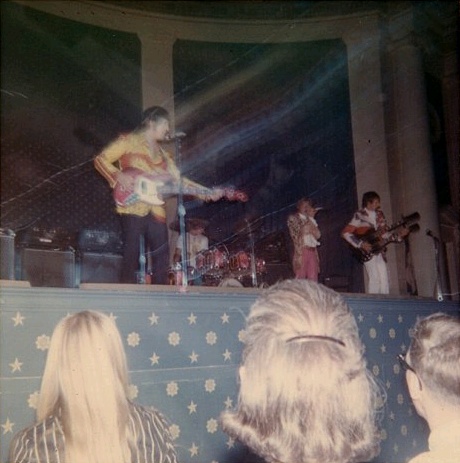
The first known use of this guitar is 23 Aug. 1967 at Atwood Stadium in Flint, Michigan. The Who had just come off a two-day break a week earlier in Nashville, so it’s
possible he picked it up during that time (along with
new Sunn amplifiers).
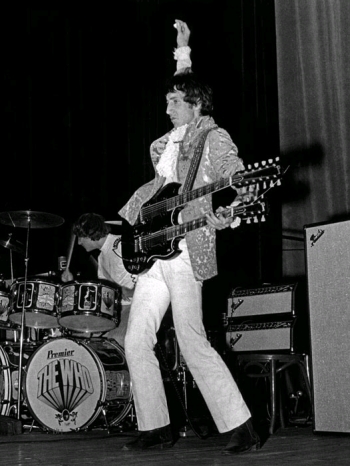
One early photo below with it unbroken has a
Fender Showman amp, which were likely only used in North America (though the photo is sometimes attributed to Sheffield City Hall in October; however, this gig was one week
after the Saville Theatre …).
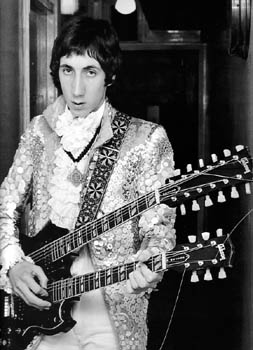
The
backstage photo is 22 Oct. 1967 at the Saville Theatre in London. In this photo, the guitar’s body is clearly repaired (see
closeup) between the six- and 12-string sections running the length of the body. (In addition, the pickup-selector toggle switch on the treble horn appears to be missing following the repair.)
He used the guitar as late as 4 Nov. 1967, at Walthamstow. Consider the theory that he used it for opening numbers, which is likely the case since the backstage photos have him with it, he doesn’t have it for the first date of the next U.S. tour (
17 Nov., Shawnee Mission, Kansas).
Geoff Davidson reports about seeing a
portion of this guitar at the Kinema Ballroom, Dunfermline, Scotland, on 8 October, 1967. Geoff Davidson:
I can verify adamantly that when The Who played Dunfermline Kinema on Sunday 8th October ’67 he was playing the remaining bottom half of the double neck SG. It was splintered straight across the factory-glued join and Pete’s right-hand fingers were bleeding from the constant catching on the splinters. His frilly yellow satin shirt front was splattered with blood. I’ll never forget it. Then a few weeks later they were on Top of the Pops (to premiere “
I Can See For Miles”) with the guitar rebuilt with the necks V’d rather than parallel. I said to my mate — that’s half of the guitar I saw him play!
So, a
possible theory is that he purchased it in early August, possibly in New York during the 6–8 Aug. 1967 break, or possibly even earlier. He then used it for the remainder of August and broke it either in one of the two September 1967 U.S. shows (Anaheim or Honolulu) or in the early October Scotland shows (Ballerina Ballroom, Nairn, Scotland – 6 Oct.; Beach Ballroom, Aberdeen, Scotland – 7 Oct.), and after the Dunfermline Kinema date (8 Oct.), had it repaired during the two-week break until the 21 Oct. New Century Hall, Manchester, and the 22 Oct.1967 Saville show, as pictured, and stopped using it sometime between 4–10 Nov. 1967, the last of the UK shows before the next American tour, commencing 17 Nov., 1967.
13 Aug. 1967, Constitution Hall, Washington, D.C., with first known use of Gibson SG EDS-1275 double-neck.Photo courtesy
thewho.org.
Flint, Michigan, 23 Aug. 1967, with first known use of Gibson SG EDS-1275 double-neck. Two amp stacks at left are one
Sunn 100S with two 2x15s, and stack at right is one
Super Beatle.Photo: Michael Ochs Archives
Flint, Michigan, 23 Aug. 1967, first known use of Gibson SG EDS-1275 6/12 double-neck, paired with two
Sunn 100S amplifiers and 2x15 cabinets.Photo: Michael Ochs Archives
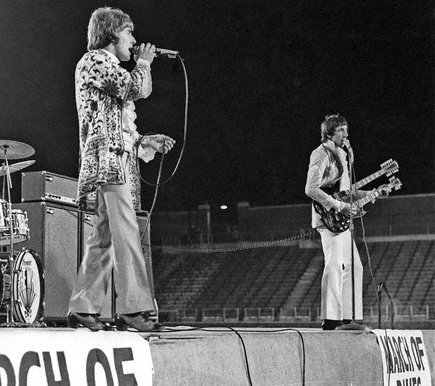
Cleveland, 31 Aug. 1967, with Gibson SG EDS-1275 6/12 double-neck, with
Marshall Supa Fuzz pedal and two
Fender Showman amps with 2x15 cabinets.Photo: G. Shuba
Ca. 1967, unknown USA date with Gibson double-neck and
Fender Showman amps with 2x15 cabinets.
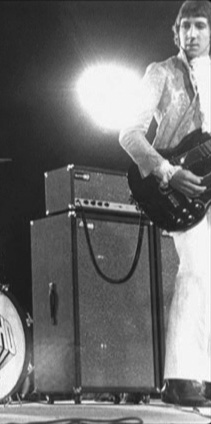
22 Oct. 1967, backstage at the Saville Theatre, London, with Gibson double-neck.Photo: Chris Morphet
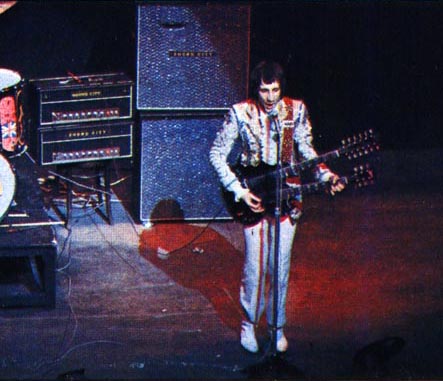
At the Saville Theatre, London, 22 Oct. 1967, with Gibson SG EDS-1275 double-neck. Amps are
Sound City.Photo: Chris Morphet
Ca. August 1967, early use of Gibson SG EDS-1275 double-neck, with what appear to be two
Super Beatles.
Resources and Information
Acknowledgments
Thanks to
Chris Privett for assistance with this page.
Guitar info
For more information on Gibson EDS-1275 guitars, see:
Manufacturer
This page last updated 19 May, 2012
A note on the content here:
This information, along with all other content included in
Whotabs, is intended for private study, scholarship or research. Associated images are included for reference only and are the property of the original owner. Non-Whotabs links are provided for informational purposes only and are not controlled or monitored by Whotabs. For more, see
Terms of Use.