The Cost of Building Your Own...

All right, I read through all of these posts.

There are some incredibly talented and creative individuals on this forum.
I really enjoyed most of what I read, and am fascinated by all of this.

Pity the fool that thinks he can design a generic guitar that will satisfy
everyone. If anybody ever did this, it was Leo Fender. But he actually went
to shows in person and talked a lot with players. He gave experimental models
to players and listened to what they said in review. And then he put their ideas
into his designs. This too was a brilliant concept: Design guitars based on what
players actually want.


Maybe Les Paul gets a nod, if he really designed the guitar we know by his
name plate. McCarty doesn't back this up. But Les Pauls satisfy most everyone,
like Strats do.

Maybe one of the best ideas ol' Leo had was to make the parts interchangeable.
That is actually priceless, because it makes possible most of this thread.
View attachment 34353
Me, I built my dream bass. I used Warmoth neck and body, because I didn't have the
tools or the skill or the confidence to try any precision wood working. Warmoth makes
excellent components, I'll testify. I bought one of their least expensive necks, and was
delighted with the workmanship and the way it fit right into the body.
View attachment 34354
Those are not frets, they are maple inlays. Here you see rosewood (fretboard) and
walnut (P/G) and Swamp Ash (body) and Maple (neck). Some might say that's too
many different kinds of wood, but I don't care. This is mine.
View attachment 34355
I've loved the tones of the Fretless Jazz Bass since I first heard them... maybe Jaco Pastorius with Joni Mitchell and Weather Report. So of course my dream bass would be
a fretless J-Bass. I already owned one of the best: my '66 J-Bass. The only tone I could
not get from my vintage Fender was the Fretless M-wah sound. I kept hoping somebody would design and market a pedal that would enable the fretted bass player to get that sound
on his regular bass. But nobody ever did... so I had to build me a fretless, and learn how to play it. And there's no loss in that adventure. ...unless I spent a lot of money on a bass that
was no good.
View attachment 34356
But I didn't... Ain't nothin' like the real thing, bay bee...

I named this bass Luretta, after a song by Townes Van Zandt.
And I chose the same neck as the fretted ones I was used to playing, to make the
transition a little easier. So my fingers found there way around without too much
cramping or stretching, and I only needed to be more precise in my finger placement.
Playing a fretted bass allows the player to be a little sloppy, which was another of old
Leo's brilliant ideas. His original "Precision Bass" was one of the best musical ideas of
the 20th century... as well as being the best musical instrument name of those times.
...Lay your finger down between the frets, and your note is Precise...
View attachment 34359
Players of the doghouse bass could appreciate this concept.
And since the Fender dimensions are now available for other makers to use
with proper licensing, we now get to design our own guitars, as if the designers
and engineers who work for Fender and Gibson didn't know their business,
and we needed to do it better.

This actually is not true... the designers and engineers and luthiers and craftsmen
who work for the big guitar companies actually do know their business. The only
reason for us to be doing these projects is the FACT that we CAN do it. Lucky us,
we have the resources and the motive and the opportunity to execute a project like
this. So let's go for it, I say. Create your dream guitar, because no one else can get
every detail the way you want it.

But most guitarists never do this. They just buy a Strat and play it, or they
by a Les Paul and play it. And they make music to the best of their ability and
the guitar is like a springboard, enabling the music and allowing the player to
fly free. So there's nothing wrong with the "standard" guitars. We only make our own because we want to. And we can. Or because we have a dream tone in our heads,
or we have a dream look that we want to create. And why not, I say.
View attachment 34361
Necro post!

This bass is the instrument that inspired me to create Burla.
 
...is not cheaper, but you get what you want.

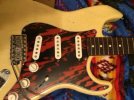
I just tallied up the bill for the Black Hole Stratocaster and it was over $1000. Granted I used some good parts, but what started out as a cheap guitar ended up
being upgraded to a not so cheap guitar.

I started out with a slightly worn Squier body, a Korean neck and some low cost pickups. As we all know upgrades commenced.

I ended up with a brand new MIM replacement body, a brand new Warmoth neck, a set of expensive Mojotone pickups, an upgraded bridge and the list goes on!

What I now have is a super nice guitar that I will NEVER be able to sell for near what I have in it...good thing I love it!

View attachment 32986

View attachment 32984
This is my first time seeing this thread. That is about the coolest looking Strat I've ever seen!

...almost makes me wish I was a Strat guy.
 
Well, since it’s been zombied up, I’ll continue saying that building a good Warmothcaster is not cheap. But the way prices are at Fender… I mean, my Zencaster might have cost me over $1,300 with all the fiddly cosmetic bits I did. But it destroys anything short of the Custom Shop, and I’ve A-B’ed it with CS guitars that didn’t play as well or sound as good. Whats an American Professional Strat go for now? The partscaster route is totally worth it.
IMG_0485.jpeg
 
I've built 7 or 8 (I actually lost count) Warmoth guitars over the last 10 years or so and I thought I knew exactly what I wanted with each build. In the end I only built 2 keepers and I ended up selling one of them anyway. Out of all my builds I only have one that I still play. I have several necks and bodies boxed up waiting for me to get inspired to do something with them, but if I'm being realistic, I probably never will.

I guess what I'm saying is that it's still hit or miss even if you build what you think will be your dream guitar, you just never know until it's done if you made the right decisions. And the cost will be more than you anticipate, you can bet on that.

I wonder how many really love the guitars you build yourself, or if you convince yourself that you do because you spent the time and money to build it. I chalk my failures up to experience, not considering the money I spent that I could have used on a nice guitar off the shelf. I could have bought a nice custom shop quality LP (or whatever) for the money I wasted trying to build my "dream guitar" over and over again.
 
Last edited:
I guess what I'm saying is that it's still hit or miss even if you build what you think will be your dream guitar, you just never know until it's done if you made the right decisions. And the cost will be more than you anticipate, you can bet on that.

I wonder how many really love the guitars you build yourself, or if you convince yourself that you do because you spent the time and money to build it. I chalk my failures up to experience, not considering the money I spent that I could have used on a nice guitar off the shelf. I could have bought a nice custom shop quality LP (or whatever) for the money I wasted trying to build my "dream guitar" over and over again.

Not necessarily true. We modified an MIM guitar (until there was nothing Fender left) to create the Zencaster, and each modification was very carefully considered based on years of playing. I got it right the first time every time… the only part modded more than once is when I went from EMG SAs to SA-X’s.

I’ve played the guitar for 55 years, and of those I’ve played this guitar for over 30 of them. It’s not confirmation bias.
 
I have difficulty putting a dollar value to a construct that I assembled from parts that I molded to my preference. The parts I can price out, but what makes them worth the effort is what I did to them after they arrived. An effort that makes them feel and sound an order of magnitude beyond what is cranked out of fender's custom shop.

They're both every bit of what fender calls their "master builds" (something that I find quite offensive as I'm of the opinion that everything they sell ought to be the very best effort...), except for the price. I've roughly $1200 - $1300 into each in parts, but the time put in shaping and such I can't assign a dollar figure to.

They feel like $5000 guitars, but I didn't spend $5000 putting either together. I didn't spend $5k putting both together...
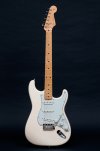
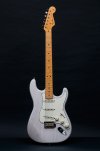
Oly-White`.jpgmary-kaye``.jpg
The vanilla is an Allparts body and a fender neck with Van Zandt pickups on a Lashing guard, the Kaye is a Warmoth body and neck with Fralin's or Duncan's, I don't remember what it's sporting at the moment. Both use Callaham bridges and Kluson tuners.

In the end, it was all about getting what I wanted and not settling for what a manufacturer wanted to sell. I happen to think that it is effort and resources well spent at any price point. The skill set acquired in the doing lasts a lifetime.
 
That's the way it works out.
Custom built stuff will rarely sell for more than you pay for it.
You will almost always lose money in the process. But if planned carefully, you get what you want.

I am appalled at the quality of most "amplifier kits..."
Most of them are cheap junk parts from China....flimsy aluminum chassis.....59 cent pots.....old oxidized tube sockets....
But yet you learn something from building it, and it increases your experience.
So, there is some benefit from it....and you do benefit yourself even when you lose money in the process.

(some amp kits are good ones, but not many of them)

I realized a long time ago
I don't really do this to make money.
I do it for the artistic satisfaction, for the accomplishment.
I like to do things that nobody else has achieved; new ideas, creativity, dreams imagination become reality.
 
I have built guitar amps in my past and repaired thousands I'm done with it
the mill spec parts are getting impossible to source and world wide shipping cost is crazy
My NOS tube suppliers are sold out the ones I trusted for the last 30 + years
I have never built a amp kit all from scratch I tried to stock the most common transformers same day service,
If I had to get custom wound transformers had to order 10 each and set up cost was $250.00 for power choke and output $750.00 set up fee.
When I traveled to service private amp collections TSA scum thought I was building bombs and strip search me and mess up my test equipment.
 
I have difficulty putting a dollar value to a construct that I assembled from parts that I molded to my preference. The parts I can price out, but what makes them worth the effort is what I did to them after they arrived. An effort that makes them feel and sound an order of magnitude beyond what is cranked out of fender's custom shop.

They're both every bit of what fender calls their "master builds" (something that I find quite offensive as I'm of the opinion that everything they sell ought to be the very best effort...), except for the price. I've roughly $1200 - $1300 into each in parts, but the time put in shaping and such I can't assign a dollar figure to.

They feel like $5000 guitars, but I didn't spend $5000 putting either together. I didn't spend $5k putting both together...

The vanilla is an Allparts body and a fender neck with Van Zandt pickups on a Lashing guard, the Kaye is a Warmoth body and neck with Fralin's or Duncan's, I don't remember what it's sporting at the moment. Both use Callaham bridges and Kluson tuners.

In the end, it was all about getting what I wanted and not settling for what a manufacturer wanted to sell. I happen to think that it is effort and resources well spent at any price point. The skill set acquired in the doing lasts a lifetime.
Assemble your own is best. My recent build

All the best parts in my opinion, the Fender Custom Shop could not assemble what I did for a similar amount of $ as @rolandson mentions.

The fun of the project was priceless.
 
I've put a few of my own together and do not really care about resale as no one will probably want what I want anyway. :blink:
Once they realize the guitars were made from lightening bolts shot out of your ass, you'll have to...well, shoot some more lightening bolts outta your butt to keep the crowds from rioting ... (this is Oregon, rioting is a favorite family night out.)

I was going to say "beat them off with a stick" but...if you can shoot lightening bolts outta your ass, why the hell would you bother with a stick?

If I could play worth a sh!t anymore you'd need to fuel up with an extra large burrito to keep me away...
 
Hey Squatch is that Scotch? :celebrate: ;)

Looks awesome, how do you like the grails?
Scotch? DunnoOld.gif

Thanks! The wood bits are stunningly gorgeous. I opted for quarter sawn maple for the neck. I was not prepared for the killer wood grain patterns. A near perfect example of quarter sawn at a fraction of the Fender Custom Shop price. The macassar ebony with ss frets was literally the icing on the cake.

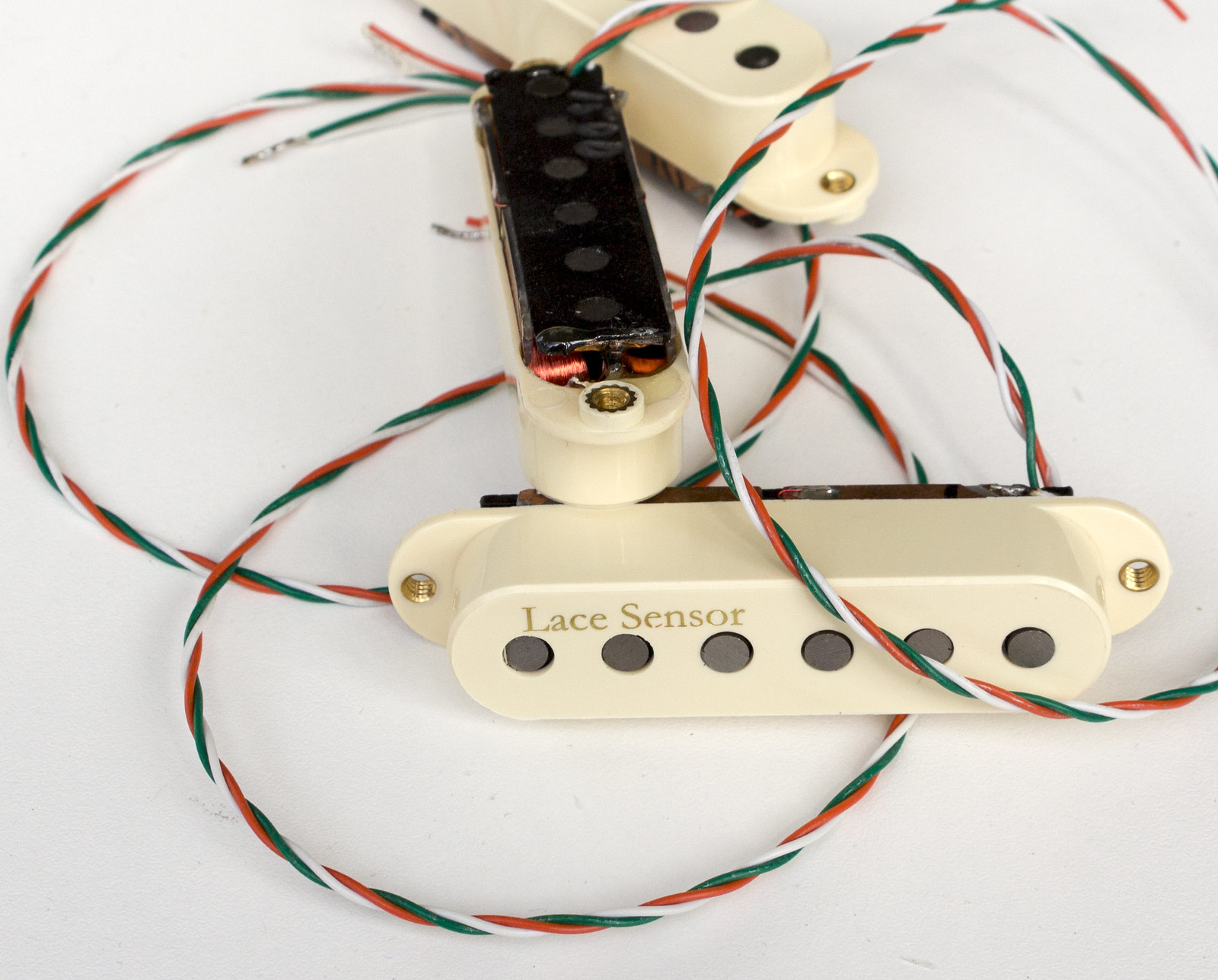
Love the grails. Astounding. Quiet. I had a set of 1980 SD SSL-1 I had from my first ill-fated assembly in the guitar at first. Got the classic Strat tone they provide, but the slight hum was annoying even fully shielded. Worse when I bent strings, the signal would drop in between magnets. The bridge was typically ice picky and anemic compared to the PAF clones in me Lester.

Gave the grails a try on the recommendation of a forum member on another site. All of the shortcomings of the 1950s Fender design were addressed. The bridge is a tad hotter than the other pickups which allows it to cut through better. Lost a tiny bit of quack quality in the imbalance, but plenty of duck noise is left.

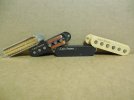
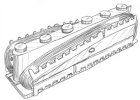
Even though they have two horizontal coils wired humbucker style, the central magnets allow for a convincing Strat tone with no icepick. There is no stupid stagger of the magnets that was designed for the strings of 1954. There are no dropouts in between the magnets as the two coils and "combs" extend the magnetic field like in other Lace Strat pickups. The last two images are ones I found on the internet. They could be earlier versions.

I bought them for just over $200 in 2019. I cannot find any discounter for the grails now. Looks like $400 rapage is the only choice direct from Lace.

32711304557_e476cb9dd2_h.jpg


Lace.jpg

HGDrawing.jpeg
 
Last edited:
Once they realize the guitars were made from lightening bolts shot out of your ass, you'll have to...well, shoot some more lightening bolts outta your butt to keep the crowds from rioting ... (this is Oregon, rioting is a favorite family night out.)

I was going to say "beat them off with a stick" but...if you can shoot lightening bolts outta your ass, why the hell would you bother with a stick?

If I could play worth a :poo: anymore you'd need to fuel up with an extra large burrito to keep me away...
HerbHuh2.gif
 
I am appalled at the quality of most "amplifier kits..."
Most of them are cheap junk parts from China....flimsy aluminum chassis.....59 cent pots.....old oxidized tube sockets....
But yet you learn something from building it, and it increases your experience.
So, there is some benefit from it....and you do benefit yourself even when you lose money in the process.

(some amp kits are good ones, but not many of them)
Mojotone puts together a nice amp kit. Mojotone Studio One Build

Far more rewarding than assembling a Warmoth project.
 
Once they realize the guitars were made from lightening bolts shot out of your ass, you'll have to...well, shoot some more lightening bolts outta your butt to keep the crowds from rioting ... (this is Oregon, rioting is a favorite family night out.)

I was going to say "beat them off with a stick" but...if you can shoot lightening bolts outta your ass, why the hell would you bother with a stick?

If I could play worth a :poo: anymore you'd need to fuel up with an extra large burrito to keep me away...
Truly the hardest part of being able to have such special powers is transformer placement :blink::unsure:.


Well that and just the sheer volume of underwear I go through. :ROFLMAO:
 
Scotch? View attachment 100599

Thanks! The wood bits are stunningly gorgeous. I opted for quarter sawn maple for the neck. I was not prepared for the killer wood grain patterns. A near perfect example of quarter sawn at a fraction of the Fender Custom Shop price. The macassar ebony with ss frets was literally the icing on the cake.

Love the grails. Astounding. Quiet. I had a set of 1980 SD SSL-1 I had from my first ill-fated assembly in the guitar at first. Got the classic Strat tone they provide, but the slight hum was annoying even fully shielded. Worse when I bent strings, the signal would drop in between magnets. The bridge was typically ice picky and anemic compared to the PAF clones in me Lester.

Gave the grails a try on the recommendation of a forum member on another site. All of the shortcomings of the 1950s Fender design were addressed. The bridge is a tad hotter than the other pickups which allows it to cut through better. Lost a tiny bit of quack quality in the imbalance, but plenty of duck noise is left.

Even though they have two horizontal coils wired humbucker style, the central magnets allow for a convincing Strat tone with no icepick. There is no stupid stagger of the magnets that was designed for the strings of 1954. There are no dropouts in between the magnets as the two coils and "combs" extend the magnetic field like in other Lace Strat pickups. The last two images are ones I found on the internet. They could be earlier versions.

I bought them for just over $200 in 2019. I cannot find any discounter for the grails now. Looks like $400 rapage is the only choice direct from Lace.

32711304557_e476cb9dd2_h.jpg


View attachment 100600

View attachment 100601

I thought maybe you were doing an SRV “Scotch “ thing. But yours is gorgeous!
1718196683417.jpeg
 
Back
Top