
RVA
Ambassador
When applied to a tone knob, caps reduce high end. Why does this work?

When applied to a tone knob, caps reduce high end. Why does this work?


Very interesting field you are getting into Robert & a great way to customise your tone. Regarding magnet types, I've read that for the "grail" humbuckers, the PAF's, Gibson used whatever was available, so along with the common A2 & A5, A3 & A4 were also used. Kinda strange that even Gibson don't offer these now. One thing I have learner about PAF magnets; when Tim Shaw's analysed original PAF magnets he found that they were slightly thicker than the 0.125" thickness commonly used now, being in the 0.131" ~ 0.139" thickness range. As magnet thickness has a direct effect on the magnetic field strength Tim used magnets of the same thicker dimension in the Shawbuckers. I also have a pair of overwound PAF type pickups from another winder that have unoriented, rough cast A5's of 0.134" (ish) thickness. Fender also used A3 magnets, the Broadcaster bridge pickup was an A3 type. Happy winding Robert. Cheers
When applied to a tone knob, caps reduce high end. Why does this work?


The high end passes through the tone cap. The pot is set up as a variable resistor between the cap & ground. With the pot turned up the resistance value is large, making it hard for frequencies that have passed through the cap to get to ground. As the pot is turned down the resistance gets smaller, making it easier for those frequencies that have passed through the cap to get to ground. Frequencies that pass through the cap to ground (high end) are taken out of the signal. Hope this makes sense. CheersWhen applied to a tone knob, caps reduce high end. Why does this work?
The high end passes through the tone cap. The pot is set up as a variable resistor between the cap & ground. With the pot turned up the resistance value is large, making it hard for frequencies that have passed through the cap to get to ground. As the pot is turned down the resistance gets smaller, making it easier for those frequencies that have passed through the cap to get to ground. Frequencies that pass through the cap to ground (high end) are taken out of the signal. Hope this makes sense. Cheers


Yes, this is correct. CheersThanks, Ivan...now, IIRC, a cap such as a .047uf, will cut more of the higher end of the frequency spectrum and a cap, such as a 0.01uf, will cut much less of the higher frequencies...
Very interesting field you are getting into Robert & a great way to customise your tone. Regarding magnet types, I've read that for the "grail" humbuckers, the PAF's, Gibson used whatever was available, so along with the common A2 & A5, A3 & A4 were also used. Kinda strange that even Gibson don't offer these now. One thing I have learner about PAF magnets; when Tim Shaw's analysed original PAF magnets he found that they were slightly thicker than the 0.125" thickness commonly used now, being in the 0.131" ~ 0.139" thickness range. As magnet thickness has a direct effect on the magnetic field strength Tim used magnets of the same thicker dimension in the Shawbuckers. I also have a pair of overwound PAF type pickups from another winder that have unoriented, rough cast A5's of 0.134" (ish) thickness. Fender also used A3 magnets, the Broadcaster bridge pickup was an A3 type. Happy winding Robert. Cheers

didnt slip that past you --- crafty boy -- or cheeky monkey?Dog Ears you say.
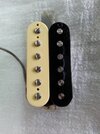
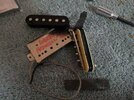
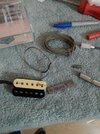
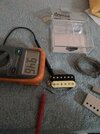
LOVE THE PERSONALIZATION

And SHarpie Marker
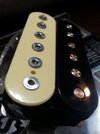

So, I thought it would be cool to use non-ferrous - and much larger - pole piececs, similar to a double slug. I used 3mm stainless Allen's and machined the tops of themto kind of (albeit loosely) mimic the string radius...
View attachment 18685
