SS Amps

Heck it won’t be long and people will say the same thing about SS amps in favor of IR’s if they aren’t already. One thing is certain is that change will happen whether we like it or not. BTW I’m playing a SS amp sitting on top of a tube amp right now ;) ( it’s just better for practice)
 
I’ve owned all three types—tube, solid state and digital.

I love my tube amps.

My 63RI Vibroverb is dang near perfect in every way…it’s my “forever” amp (at least as long as I’m strong enough to carry it)…great for guitar and harp/harmonica and baritone.

I love my new(er) Excelsior Pro—plenty loud and big enough to gig (especially with an even-handed drummer), sounds great, looks cool, fantabulous tremolo…sounds great for guitar and harp and baritone as well.

The recent acquisition of a Fender Pawn Shop Series Greta added a tiny tube amp that sounds good, looks cool and has the rich fullness of tubes (if ran through a larger external speaker cabinet).

After twenty years, I still miss everything about my old ‘72 Fender Bassman Ten (except the size and weight)…it worked for everything from bass to guitar to harp to keyboards and even a makeshift PA back in the drinking days.

However…

My first amp was a little solid-state Gibson G-20 that I bought for $25 and three beers…

I still own it and use it and hold its vibrato/tremolo/whatever as one of the benchmarks for the effect.

Good, usable amp for low-volume rehearsal and bedroom noodling…If it were loud and “big”-sounding enough, I’d gig with it—the tones are there, but it just gets swallowed up in a band setting.

My daughter’s Fender Rumble 150 is a really good bass amp and a pretty good guitar amp—super cheap, too: I paid about $1 per watt.

I think it’s the v2.0 of the Rumble series—not the early carpet-covered stuff of the late 80’s/early 90’s, but a later lineup of solid-state bass amps. Solid build, great EQ flexibility and even sounds good at lower volumes.

I recently picked up a Fender Rumble 40 from the current Rumble lineup (v3.0, I guess? Not sure)…I grabbed it for the cheap price (about $2.20 per watt), light weight (which I absolutely LOVE) and a dang-good sound. It is plenty loud enough for a rehearsal or a gig where the amp is mic’d. I really like the built-in overdrive. It looks cool, too.

I still miss my old Pignose 7-100. Those are some of the best-sounding solid-state amps ever developed, IMO. I’ll eventually pick up another one.

And…

In the early 00’s I used a Line 6 POD v1.0 into the PA—sometimes alone as my sole means of amplification, sometimes in conjunction with one or two other (usually, tube) amps. It was a nice way to beef up my signal, but between the complexity of the rig and carrying more stuff than I needed, I ceased using this particular setup.

I started using it more and more in-studio on recordings. I can’t tell you how many people who (after hearing a recording) said, “Man, your Vibroverb sounded great on that song!”

Sometimes I explain what I actually used…but usually, I just say, “Thanks!”

I don’t need any more amps, but…if I were to buy another higher-end amp, the new Tone Master ‘59 Bassman (a digital amp, no matter how they try to market it) would be very high on the list to try.

My point?

Yeah, my favorite is my tube-equipped 63-reissue Vibroverb, but it’s not always the most feasible for the situation.

I’ll use whatever I have on-hand.
 
Last edited:
Exclusively?
I'm not abandoning my tube amps anytime soon, but there're lots of great SS amps too.
I have no issues using either.

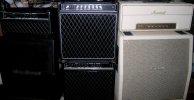
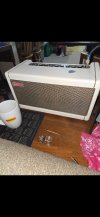
This lil' fella gets the job done... :yesway:

View attachment 106637

And running stereo with his lil' buddy on the other side of the room can rattle your bells. :rolf:

View attachment 106639
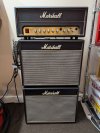
I’ve never owned a Marshall (I’ve played through a few, though)…but dang, they’re cool-looking amps!
 
I've used both tube and solid-state amps in a live setting.

I have no negative feelings toward them.

But, these days, I use a modeler exclusively.

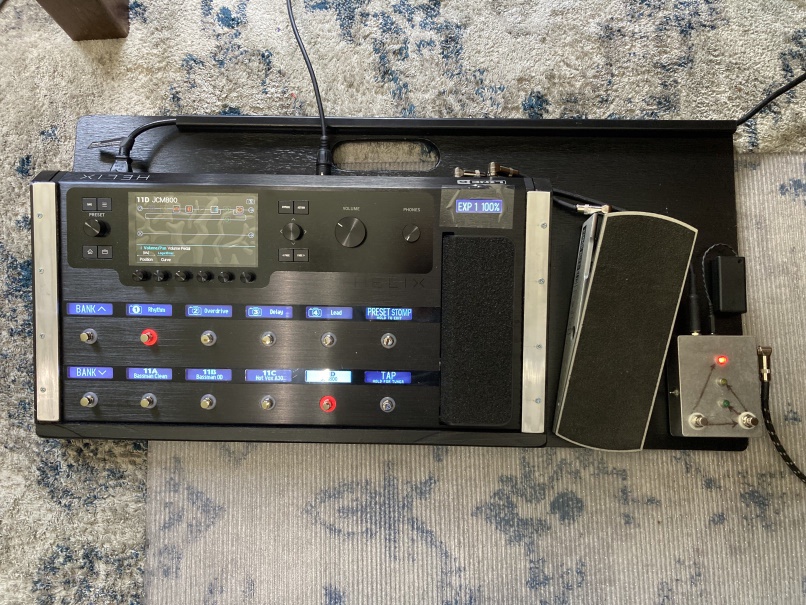
This is my rig:

wMrsuWq.jpg


Honestly, the sheer flexibility I get with it for live use, combined with the good sound it can achieve, pretty much makes physical amps of any variety a non-starter for me.

I'll be using it for a gig this afternoon, in about four hours, as a matter of fact!

Anyway, everything comes down to how you build your patches. One small example is mic placement modelling. As is the case in the real world, I can make a rather significant effect on the tone, just by changing out the mic model and how it is positioned.

I've gotten several unsolicited compliments on my sounds from the Helix.

I used to use a Line6 POD X3 Live. I used it live, as well, and it was okay, but the Helix is better in every way, including the sound.

The Helix, or modelers/processors similar to it, are just fantastic in my book. I have a pedal board built for it, as can be seen in my photo above. This means that when it comes to the "amp", "cabinet", and "effects", I grab one thing - ONE THING - and place it on the stage and run an XLR to the house. I get my sound back to me on a stage monitor, or in ears - okay...so maybe that's two things! But, you get the point. I can be set up and ready to go in minutes and occupy a minimum of stage space. My two guitars on stands take up more room than my rig.

Anyway, again, I have absolutely no hate for physical amps of any variety and I totally understand why people use and love them. Use what works for you! But, for me, it just works way better to do things this way.
 
One thing is certain is that change will happen whether we like it or not.

This is true.

While I have not personally run into this, I have heard that some venues are beginning to prohibit the use of physical amps. The obvious goal being to limit excessive noise/volume.

I have gigged in one place that did impose a dB limit. Because we ran everything to the mix, that was easy to accomodate.

One place I have gigged at a few times in the past didn't impose a ban on physical amps, but one of the managers did make kind of a snide comment one time about the band that gigged the night before one of our gigs because, in the words of the manager, "They brought in all of that old-fashioned, '70s stuff - like those amps and stuff. I like you guys; you don't bring in all of that."

So, yeah, times are changing.
 
Things change but the concepts are not that far off, the technology is better. I have a The Twin from 1990 or so that had a line out that we used to go directly to the board way back in the day and I really used the amp as a monitor. At first I used a Boss ME 5 multi effects unit but went to a first gen Pod which could go direct also but it sounded better going through the amp.
 
I’m looking at buying the first piece of gear I have been interested by in years… a UA Enigmatic pedal. Kind of an amp-in-a-box, it claims to reproduce the sound of several Dumble amplifiers. My experience with UA is that they don’t make such claims lightly.

My point being that if a 400 dollar solid-state/heavy software stompbox can make the sounds I want… who needs the multi thousand buck amplifier?
 
I had to go look at that pedal. Pretty cool. 349$ on Sweetwater compared to thousands for a real Dumble.no brainer here. Technology has come along ways.
 
I've used both tube and solid-state amps in a live setting.

I have no negative feelings toward them.

But, these days, I use a modeler exclusively.

This is my rig:

wMrsuWq.jpg


Honestly, the sheer flexibility I get with it for live use, combined with the good sound it can achieve, pretty much makes physical amps of any variety a non-starter for me.

I'll be using it for a gig this afternoon, in about four hours, as a matter of fact!

Anyway, everything comes down to how you build your patches. One small example is mic placement modelling. As is the case in the real world, I can make a rather significant effect on the tone, just by changing out the mic model and how it is positioned.

I've gotten several unsolicited compliments on my sounds from the Helix.

I used to use a Line6 POD X3 Live. I used it live, as well and it was okay, but the Helix is better in every way, including the sound.

The Helix, or modelers/processors similar to it, are just fantastic in my book. I have a pedal board built for it, as can be seen in my photo above. This means that when it comes to the "amp", "cabinet", and "effects", I grab one thing - ONE THING - and place it on the stage and run an XLR to the house. I get my sound back to me on a stage monitor, or in ears - okay...so maybe that's two things! But, you get the point. I can be set up and ready to go in minutes and occupy a minimum of stage space. My two guitars on stands take up more room than my rig.

Anyway, again, I have absolutely no hate for physical amps of any variety and I totally understand why some people use them. Use what works for you! But, for me, it just works way better to do things this way.
Smitty, I’m on the same page as you. We did a block party gig yesterday and I used my Tone Master Pro through the board and out to the PA and floor monitors. While I have plenty of tube amps I’ve drank the TMP kool-aid. It just has so many features and great sound in live performances. Interesting you mention the mic placement feature. In the last TMP firmware upgrade they upgraded the mic placement feature to add a second mic! I tweaked a few of my patches experimenting with a second mic and really like the improved sound.

IMG_0918.jpeg
 
Back
Top